St. Sergius Chapel (1933)

Russian Village is a historic district, located between Route 6 and the Pomperaug River in Southbury. It was established in 1925 by a group of Russians who had fled to America after the Russian Revolution in 1917. Count Ilya Tolstoy, the son of Leo Tolstoy, discovered the area during a visit to his translator in Southbury. Siberian novelist George Grebenstchikoff then led the establishment of a community there, intended as a seasonal cultural center for Russian writers, artists, musicians and scientists. The village was named Churaevka, after a Siberian village mentioned in Grebenstchikoff‘s works. The community, established by, but not limited to, the creative intelligentsia, remained a predominantly Russian community into the 1980s. The main building in the Village is a chapel dedicated to St. Sergius. A stone building, it was designed by philosopher and painter Nicholas Roerich, financed by helicopter inventor Igor Sikorsky, and built in 1932 – 33 with labor volunteered by village residents, including Ivan Wassileff, a stone mason. The Chapel was also intended to be a memorial to the Cathedral of Our Savior in Moscow, which was destroyed by the Soviets in 1931 and has more recently been rebuilt. Since the Chapel itself is too small to contain a congregation, there is a small amphitheater with curved stone benches just outside, facing the Chapel. In 1931, the Chapel was deeded to the Roerich Museum in New York and later to the Synod of Bishops of the Russian Orthodox Church Outside of Russia.

Colonel Avery Morgan House (1824)

The Colonel Avery Morgan House, at 219 South Main Street in Colchester, was built around 1824. Col. Morgan, born in 1781, was originally from Groton. He was a carpenter, merchant and farmer, who also served in the War of 1812 in the defense of New London. In 1802, he married Jerusha Gardner. Their first two children were born in Groton (they also lived for a time in Bozrah) and the other five children were born in Colchester, which they moved to in 1807. They later moved to Hartford, where Col. Morgan died in 1860 and his widow in 1861. The Colonel Avery Morgan House in Colchester is now a branch of Liberty Bank.

Huntington-Andrews House (1800)

A house at 118 South Street in Litchfield was built for Rev. Dan Huntington, who served as a minister in town from 1798 to 1809. As related in Memoir and Letters of Frederic Dan Huntington (1906), by Arria S. Huntington.

In his “Family Memorial,” written as an octogenarian, Rev. Dan Huntington says that at this time he was much attracted by the current setting towards what was then called “the West,” the Connecticut reserve lands in Ohio. But the place of assistant minister at Litchfield, Rev. Mr. Champion having become disabled, was offered to him. He accepted, and was ordained to the work of the ministry in September, 1798. This “delightful village” was, as he himself describes it, “on a fruitful hill, richly endowed with schools, both professional and scientific, and their accomplished teachers; with its learned lawyers, and senators, and representatives, both in the National and State departments; and with a population enlightened and respectable. Litchfield was now in its glory. I came among them without patrimony; but with their assistance, in a handsome settlement, I soon found myself in a way to be comfortably at home among them, with a neat domicile of my own.”

Rev. Huntington later moved to Middletown, but in 1816 he gave up the ministry and moved his large family to his wife Elizabeth Phelpshomestead in Hadley, Massachusetts. His former Litchfield domicile was later burned (perhaps not completely) and rebuilt in 1862, as mentioned in Alice T. Bulkeley’s Historic Litchfield (1907):

On the site of the Andrews place, a female seminary was established by Miss Henrietta Jones, a descendant of Governor Jones of the New Haven colony. This lady was celebrated for her wit and the energy of her character. The house was burned and the Andrews house built on the site. Judge Charles B. Andrews, the owner of the house until his death, was Governor of the State, and later Chief Justice. He is the only citizen in the history of Connecticut who held the two highest offices in the gift of the State.

Coe-Parsons House (1830)

Durham‘s most elegant Greek Revival style house was built by Benjamin Hutchins Coe on Main Street in 1830. The son of a wealthy Middlefield farmer, Benjamin H. Coe married Lydia Curtis of Durham in 1823. He had ambitions to become an artist and in 1833 moved to New York, where he became an art-dealer and author of books on drawing. He was described by H.W. French, in Art and Artists in Connecticut (1879), as follows:

The drawing-teacher of wide fame, Benjamin H. Coe, was born in Hartford, Conn., Oct. 8, 1799. His pictures are quiet, pleasant views; but his merit lay in his teaching. F. E. Church and E. S. Bartholomew, beside many others, came to him for their first information. He lived as a farmer, till, as he said of himself, he was too old to learn more than the rudiments. Always having possessed a great fondness for art, he mastered these rudiments with wonderful activity and success. He possessed a remarkable faculty for imparting truths in a way to fasten them in memory; and a long life of teaching both private students and large classes in nearly all of the important cities of New England, New York, and New Jersey, sustains this reputation. He had a very large private school in the University Building, in New-York City; moving from there in 1854 to his present home in New Haven. He opened his last school there, which he carried on successfully for ten years; then gave it up to one of his pupils, and entered into the temperance-work, writing and distributing tracts, and working in ale-houses, with the vigor of a young convert. Within a year, failing health has somewhat interrupted this work.

The house was sold to Samuel Parsons, a successful dry goods merchant in New York City. Suffering from tuberculosis, Parsons (1788-1848) had retired to his home town at the age of 45. His widow lived in the house until 1887. John R. Smith, a painter and decorator, occupied the house starting in 1902 with his wife, Hester Eliza Coe, a cousin of Benjamin H. Coe. The house three additions and a porch, all dating to the nineteenth century.

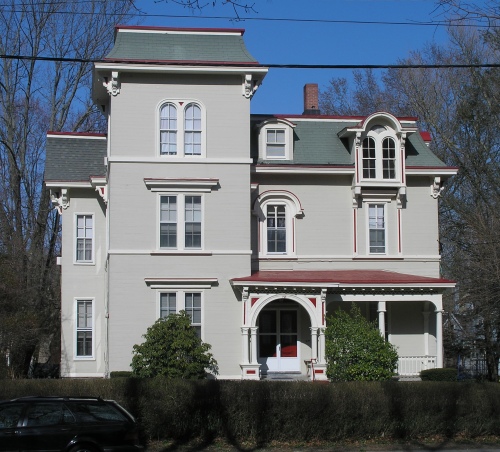
Glover-Budd House (1869)

At 50 Main Street in Newtown is an 1869 mansard-roofed Second Empire-style house built in 1869 for Henry Beers Glover. He was a successful businessman and, in 1855, he became one of the founders of the Newtown Savings Bank, serving as the bank’s treasurer until his death in 1870, just after the completion of his house. Glover was on the building committee for Trinity Episcopal Church in Newtown and his house may have been designed by Silas N. Beers, a surveyor and mapmaker who was the architect of Trinity Church. Glover’s daughter, Mary B. Glover, married William J. Beecher, an attorney, who later had his office in the Glover House, where they lived. Their daughter, Florence Beecher, married Stephen E. Budd around 1918. After her husband’s death, she continued to live in the Glover House, which became known as the Budd House, until she died in 1977. (more…)

Peters House (1795)

The Late Georgian, or Federal style, Peters House, at 150 East Street in Hebron, consists of two sections. The vernacular rear ell was built in the mid-eighteenth century and was home to enslaved African-American residents Caesar and Lowis Peters. They were owned by loyalist Rev. Samuel Peters, who fled Hebron in 1774 to live in England. Cesar was left to tend to the property, which was later seized by the State of Connecticut. After the Revolutionary War, Rev. Peters, still in England, sold off his American assets, Cesar and his wife and children being sold to David Prior of South Carolina. In 1787, Prior and his men came to take the family, who were then rescued by a group of Hebron men, who used the pretext that Cesar owed money to a local tailor as a way to rescue him and his family. In 1789, Cesar and his family were freed by the Connecticut General Assembly and, the following year, Cesar Peters sued David Prior for damages, although he later dropped the suit. The front part of the house was probably built by Jonathan Peters, Rev. Peter’s brother, around 1795. The house, which remained a single family home until 1967, was acquired by the Town of Hebron in 2004. The surrounding land became a recreational facility, but the house was in need of restoration. In recent years there were debates about the future of the house, which was recently added to the Connecticut Freedom Trail. Local residents and descendants of Lois and Cesar Peters urged that the building be restored as a historic site. The town has since received a $200,000 grant from the state for restorations and a film about Cesar and Lowis Peters, Testimonies of a Quiet New England Town, has recently been released.