Marks-Brownson House (1820)

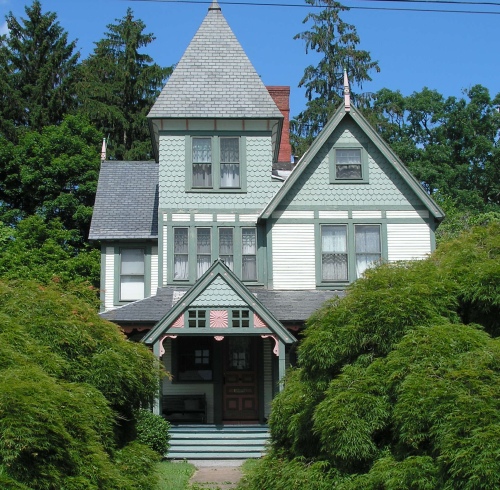
The Marks-Brownson House in Huntington (part of Shelton) was built between 1820 and 1825 for Hezekiah Marks, a merchant who served in the Connecticut General Assembly in 1828 and 1830. After his death in 1835, at the age of 54, the house was sold to the Bennett family, who sold it in 1866 to Henry Israel Brownson. The house eventually passed to his son, Harry Booth Brownson, who married Gertrude Buckingham in 1904. Making their living as farmers, the couple lived in the house for over sixty years. In 1960, the Brownson Country Club opened on land gifted for one dollar by the Brownsons, who wanted to save it from development. The Shelton Historical Society acquired the Brownson House in 1971, also for a dollar, and moved it from its original location, at the corner of Old Shelton Road and Shelton Avenue, to the corner of Ripton and Cloverdale Roads, where today it is open to the public as part of the Shelton History Center. The house is presented as it would have been during the early years of the marriage of Harry and Gertrude Brownson.

First Congregational Church of East Windsor (1802)

The Fourth Ecclesiastical Society of Windsor, or North Society, was established in 1752 and a meetinghouse was soon built near the Scantic River. In the late 1790s, there were intense debates over the issue of enlarging the building. A decision was finally reached to expand the meetinghouse, but it burned down on April 20, 1802. There was then a violent contoversy and accusations of arson, but a new meetinghouse on the same site was soon completed. In 1768, East Windsor had separated from the town of Windsor and in 1845 South Windsor separated fom East Windsor. The Congregational church in the East Windsor Hill section of the new town of South Windsor had been the First Church of East Windsor, but then became the First Church of South Windsor, while the former North Society Church in the Scantic section of East Windsor became the First Church of East Windsor. The church‘s exterior walls were extended in 1842. That same year, interior floor space was also enlarged, when the the empty space between the balconies above the main floor was floored over, creating a new upper floor for religious services. The lower floor was later known as Library Hall, because the town’s public library was located there from 1907 to 1920.

Frank E. Wolcott House (1924)

At 26 West Hill Drive, in the West Hill Historic District in West Hartford, is a Colonial/Tudor Revival house, built in 1924 and designed by Smith & Bassette for Frank E. Wolcott. His manufacturing company produced the Silex coffee pot. A vacuum brewer, the Silex coffee pot, utilizing heatproof Pyrex glass, was first produced in 1915. The rights to its design, which originated in Europe, had been acquired in 1909 by two sisters, Mrs. Ann Bridges and Mrs. Sutton, of Salem, Massachusetts. Wolcott’s company was later renamed the Silex Company. Its first patent for a coffee pot was assigned to Hazel M. Bridges in 1926. Frank E. Wolcott filed additional patents in the 1930s.

Fenner-Matthewson Mansion (1855)

The Fenner-Matthewson Mansion, in Plainfield‘s Central Village (pdf), has been described as one of the most outstanding Italian Villa-style houses in Connecticut. It was built around 1855 by Arnold Fenner at 40 Main Street, on what became known as Central Village’s “Manufacturers’ Row.” Born in Rhode Island, Fenner settled in Central Village about 1825 and in 1827 he purchased a major interest in the Central Manufacturing Company‘s cotton-spinning mill. Fenner and Allen Harris, a pioneering manufacturer in Central Village, constructed a second brick upper mill in 1828. Harris sold his interest in the company to Fenner in 1840. Fenner later replaced the company’s original lower mill with a brick one in 1845. After his death in 1871, Fenner’s daughter, Helen Walcott Fenner, lived in the house with her husband, Philip Matthewson, who was proprietor of a general store, which he sold in 1872 to live in retirement.

Chelsea Savings Bank (1911)

The Chelsea Savings Bank in Norwich was incorporated in 1858. According to A Modern History of New London County, Connecticut, Volume 2 (1922):

The home of the bank was in the Merchants Hotel building until April, 1864, when quarters were secured on Shetuckct street, which were occupied until 1909, when the bank building was so badly damaged by fire that the erection of a new modern building, large and imposing, was decided upon. The present building, most splendidly located and planned, was finished and occupied in November, 1911.

The building has a monumental character due to its location at the angle formed by the intersection of Cliff and Main Streets. A Universalist Church at the site was demolished to make way for the new building. The Chelsea Savings Bank was designed by the firm of Cudworth & Woodworth, who also designed the Norwich State Hospital.

Peter Parley House, Southbury (1777)

The house at 990 Main Street North in Southbury was built by Benjamin Hinman for his son Sherman in 1777. According to Biographical Sketches of the Graduates of Yale College with Annals of the College History, Vol. III (1903), by Franklin Bowditch Dexter, Sherman Hinman

married on February 9, 1777, his third cousin, Molly, youngest daughter of Captain Timothy and Emma (Preston) Hinman, of Southbury, and settled as a merchant and farmer in his native town. He built there an expensive brick house, and lived in dashing splendor for a few years, but was soon reduced to comparative poverty by his extravagance. His wife died on April 30, 1791, in her 34th year, and he married again shortly after. He died in Southbury on February 19, 1793, in his 41st year.

The house is known today as the Peter Parley House because Samuel Griswold Goodrich, who wrote many popular children’s books and textbooks under the name “Peter Parley,” lived in the house for a time, before his death in 1860. Goodrich was buried in Southbury. The house underwent extensive renovations in the 1890s and the History of New Haven County, Connecticut, Volume 2 (1892), edited by J. L. Rockey, states that it “was a pleasant country resort in 1890, kept by Egbert Warner.” In 1918, the house became a German Lutheran home for the aged (now the Lutheran Home of Southbury) and is connected to a modern complex of buildings.