United Church of Stonington (1834)

The United Church of Stonington was formed in 1950 as a union of the Second Congregational Church and First Baptist Church. The church building on Main Street in Stonington Borough was built in 1834 as the Second Congregational Church of Stonington. Richard Anson Wheeler, in his History of Stonington (1900), describes the formation of the church:

The First Congregational Society of Stonington, after several unsuccessful attempts to divide itself into two societies by metes and bounds, called a meeting to assemble on the 28th day of September, 1833, and after mature deliberation took a new departure and adopted a plan for organizing a new church and society in Stonington, viz.: “That whenever forty members of the First Society should withdraw and organize a new Congregational Society at the Borough and elect society officers, and shall give notice to the old society of their doings within thirty days from the day of the meeting, the new society shall then be regarded as organized and receive $1,825 of the old society’s fund.” The conditions were immediately complied with at the meeting. Forty-five members of the society withdrew, formed a new society, and took their money and invested it in a new meeting-house. As soon as the new society was formed, ninety-three members of the First Church seceded and organized the Second Church in connection with said society Nov. 11th, 1833.

The church’s clock, in a recently restored steeple, is owned and regulated by the Borough government.

Prentice Pendleton House (1820)

Prentice Pendleton, originally from Middlebury Vermont, built a house in 1819-1820 on Main Street in Essex. He had married Almira Pratt of Essex, but sold the house after her death in 1826. It was later owned by Captain Cornelius Doane. Part owner of the ship Cotton Planter, Capt. Doane was a pioneer in the Mobile packet and cotton trade. In the 1850s, he turned his attention from the declining shipping industry to the commercial development of Essex, where he became president of the Saybrook Bank in Essex. Starting in the later nineteenth century, Main Street in Essex began to develop as a retail area and the Doane House was owned by several local businessmen. In the twentieth century, a small store was attached to the house on the east.

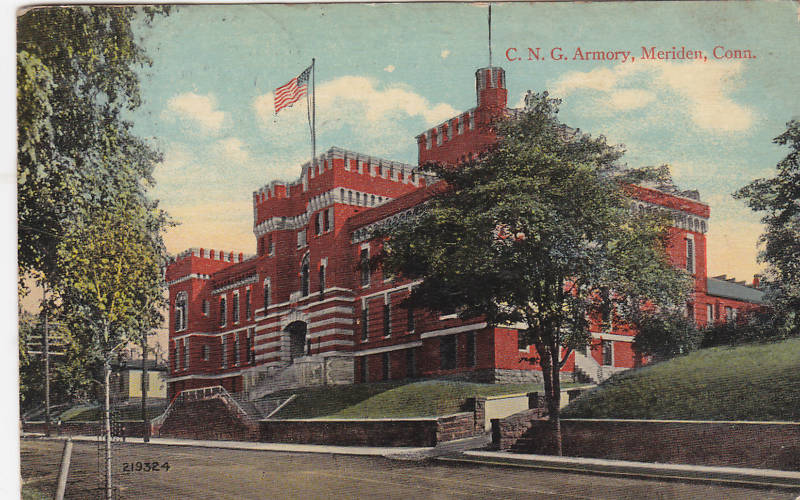
Meriden Armory (1908)

The imposing Meriden Armory on East Main Street was built in 1908. Once home to a National Guard unit, the Armory hosted dances and sporting events, including Meriden native Max E. Muravnick‘s first professional boxing match. The National Guard closed the Armory in 1998 and sold it to a private developer. The building has remained closed and is difficult to market due to its deteriorating condition and lack of parking.

Goodwin Building (1881)

Today, all that remains of the Goodwin Building, on Asylum Street in Hartford, are the outer walls, with their striking English Queen Anne facade utilizing ornamental terra cotta. Built in 1881 as an apartment building by the brothers, James J. Goodwin and Rev. Francis Goodwin, it was designed by Francis Kimball and was modeled on buildings Rev. Goodwin had seen being constructed at the time in England. Kimball, of the firm of Kimball & Wisedell, was the architect for the Day House in Hartford, which also has an English Queen Anne design. The Goodwin Building was expanded in 1891 to Ann Street and in 1900 to Pearl Street. It was a very prestigious address at the time, with even J.P. Morgan living there during his visits to the city of his birth. In 1985-1986, the building’s Arts and Crafts style interior was gutted to prepare for the structure’s incorporation into a new office tower, Goodwin Square, completed in 1989. That same year, the Goodwin Hotel opened in the former apartment building. The hotel closed in 2008 and last year Goodwin Square went into foreclosure.