Holy Ghost Orthodox Church, Bridgeport (1937)

In the 1890s, a group of Slavic immigrants, who had settled in Bridgeport, sought to leave the Greek Catholic Church (affiliated with Rome) and join the Orthodox Church in America. After meetings with Fr Alexis Toth (canonized in 1994 as St. Alexis of Wilkes-Barre) and Bishop Nicholas of San Francisco, Holy Ghost Orthodox Parish was established in 1894. The church was dedicated on Palm Sunday, 1895, with Fr Toth celebrating the first Divine Liturgy. Tsar Nicholas II of Russia donated six bells to the church. They had been cast in honor of his coronation in 1896. Upon arrival in New York, the bells were held up in customs for payment of a large import duty, but a special bill was passed by Congress and signed by President McKinley allowing the bells to enter the United States duty free. The parish grew and a new church was built at 1510 E. Main St and dedicated on Palm Sunday, 1937. It was rededicated in 1981, with the sealing of the relics of St. Herman of Alaska, brought by His Grace, Bishop Gregory of Sitka, Alaska, replacing the missing relics of St. Barbara.

Hotel Barnum (1928)

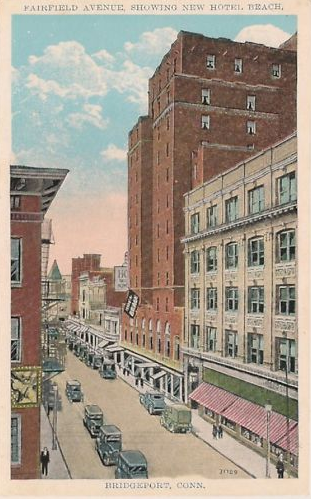
The striking 14-story Art Deco building at 140 Fairfield Avenue in Bridgeport was built in 1928 as the Hotel Beach. Named for Francis E. Beach, the local merchant who owned the land on which it was constructed, the name was changed within a year to the Hotel Barnum, named after P. T. Barnum. The hotel has an interesting terraced profile and is an Art Deco design, with eclectic elements, including English brickwork, Egyptian detailing and an Italian palazzo front. The building was designed by the firm of Thomas, Martin and Fitzpatrick and was lauded in the press upon its construction for bringing a “cosmopolitan” style to the city. In later years it was a residential hotel and then became an apartment building known as the Barnum House.

Morris W. Bacon House (1870)

Morris W. Bacon was a noted New London businessman, philanthrophist and sportsman, known for his racing horses and fine yachts. At one time he owned a property on upper State Street with a house and a barn for his thoroughbreds. In 1895, he sold the property to Frank Munsey, who built the Mohican Hotel on the land. Morris had another house on Channing Street, facing Granite Street. Probably built around 1870, the house was pictured in the 1901 book, Picturesque New London and its Environs.

Chester Bragaw House (1908)

The Chester, or Elias, Bragaw House is a brick mansion at the corner of Broad and Williams Streets in New London. Built in 1908 in the style of the Second Renaissance Revival (1890s-1920s), the house (183 Williams Street) was designed by James P. Duffy. A fire destroyed the interior of the building in 1980, which was restored and is now used for apartments (note, in the picture above, how the window openings of the house were made smaller to accommodate smaller standard-sized window panes).

Enoch P. Hincks House (1894)

The early Colonial Revival house built for Enoch P. Hincks in 1894 is at 515 Washington Avenue in Bridgeport. Warren Briggs was the architect of the house, which is constructed of brick with limestone and terra cotta highlights. Enoch P. Hincks was president of Hincks & Johnson, carriage manufacturers. As described in the second volume of Orcutt’s A History of the Old Town of Stratford and the City of Bridgeport (1886):

Hincks and Johnson, manufacturers of fine heavy carriages, such as coaches, landaus, broughams, coupes, hansom cabs, established their business on Broad street in May, 1879, as successors to Wood Brothers, who, with Stephen and Russell Tomlinson, gained a well deserved reputation during seventeen years of successful labors in the business. Mr. David Wood was among the first to commence a manufactory of heavy carriages in this country, beginning in 1828, under the firm name of Tomlinson, Wood and Company, Mr. Hincks is a native of this city, and Mr. Johnson was engaged In New York for a term of years before starting the business here. They occupy the original edifice built in 1831, with such additions as have been made from time to time, and now cover over two acres of ground floor, giving employment to 100 or 150 hands. They turn out complete about 200 of the larger carriages or coaches yearly, and of other styles a greater number, being, in fact, the largest establishment of the kind in New England and the second in this country. The departments for construction in wood and iron work each in itself would make a large business. They were the first to introduce recently the London hansom cabs, making some changes from the English design, and have already sold a large number of them in the most populous cities of the country. All their business is transacted at the office of their manufactory.

As reported in The Hub, Vol. I, No. 2 (May, 1908):

In connection with the revival of the rumor that the old firm of Hincks & Johnson, the well-known carriage manufacturers of Bridgeport, Conn., intend to go out of business, Enoch P. Hincks, senior member of the firm, practically confirmed the report recently, when he said that nothing definite had been decided upon, but that neither he nor Mr. Johnson cared to continue in business much longer. “We are both getting along in years,” said Mr. Hincks. “We have no plans for the future.”

This firm has had many years of a prosperous trade and its reputation among the trade is of the best. At different times during the past ten years there have been reports of the sale of the firm’s valuable property in Bridgeport.