
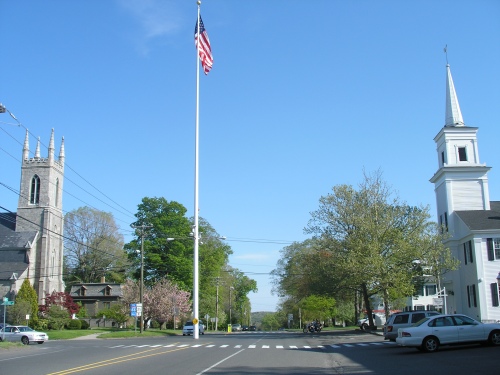
Newtown’s first meeting house was built in 1720 on Main Street, where the flagpole stands today. In 1792, this building was moved 132 feet to the middle of West Street. As explained in Newtown’s History and Historian, Ezra Levan Johnson (1917):
Nothing more appears on the society minutes about the meeting house, either for its adornment or repairs, until 1792, when the Church of England people having the consent of the town to build a church for public worship on the ground where the town house was standing, provided they would remove the Town house to some other site, without expense to the town. The meeting house standing near to. and in front of, the Town house made an objection to putting the Church of England house there without removing the meeting house also, and it was proposed to them that their house be removed to the opposite side of the north and south road
The meeting house was replaced with a new one in 1812, which was improved over the years. Quoting from the same book as above:
During the Rev. Jason Atwater’s ministry, between 1845 and 1852, the exterior of the building was very much improved, the belfry was closed in, a new steeple was built, the building newly covered and painted. Twelve hundred dollars were spent in renovating the exterior and in 1852 the basement was fitted up, the main floor raised to its present level, [and] new seats and a pulpit were provided for the audience room
By 1873, the meeting house looked much as it does today. In 1988, the Newtown Congregational Church moved to a new building and sold the old meeting house to the town. The Heritage Preservation Trust of Newtown, Inc. then restored and now maintains the Meeting House, which serves as a place for concerts, meetings, weddings and other events.


You must be logged in to post a comment.