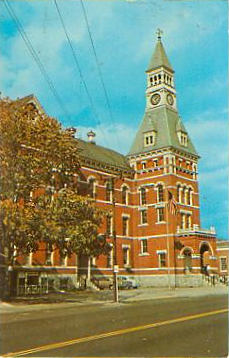
Masonic Temple, Hartford (1894)

The corner stone of the former Masonic Temple at 199-203 Ann Street in Hartford was laid on September 22, 1894. The completed building was first opened for lodge meetings in September, 1895 and the building was officially dedicated on July 14, 1896. Displaying a variety of Masonic symbols, it was designed by architect Brooks M. Lincoln of Hartford (1852-1898). No longer used as a Masonic hall, the building was converted into offices in 1982 and its original stained glass windows have been replaced with clear glass.

Copper Hill United Methodist Church (1839)

Copper Hill United Methodist Church is located at 27 Copper Hill Road in East Granby. As related by Charles Horace Clarke in The Memorial History of Hartford County:

The Methodist church at Copper Hill was built in 1839, and in 1850 was thoroughly repaired, and moved about five rods westward. Like all Methodist churches, it has had regular changes of pastor. In the ministry of Lemuel Richardson, in 1871, there was an extensive revival of religion, attended with remarkable manifestations. The writer, at a single evening meeting in the church, which lasted from seven o’clock until midnight, witnessed as many as fifteen persons who became apparently unconscious. Some were stretched upon the floor; others were lying or being supported upon the seats. This visitation of “the Spirit” was regarded as a great blessing, and it certainly did strengthen the church in numbers. Mr. Richardson was a large, powerful man, full of strength, zeal, and boldness, and possessed of a strong, loud voice, which he used in singing as well as in preaching and prayer.

Capitol Building (1926)

The Capitol Building, at 410 Asylum Street in Hartford, was built in 1926 as a retail and office block, a primary tenant being the newly chartered Capitol National Bank and Trust. The neo-Classical Revival structure was built by two partners, Joseph Ferrigno and Thomas Perrone and was designed by Thomas W. Lamb. Left vacant in the fall of 2007, the building was in danger of being demolished for a parking lot. City officials and preservationists successfully worked to have the Capitol Building listed on the National Register of Historic Places. Capitol Center, a group headed by Milton and Betty Ruth Hollander of Stamford, then donated the building to Common Ground, a New York-based nonprofit developer. Now known as the Hollander, the building has been converted into mixed-income apartments.

S.C. Kingman House (1870)

As related in D. Hamilton Hurd’s History of Fairfield County, Connecticut (1881):

Samuel Clayton Kingman, the second son of Samuel Kingman, was born in South Redding, Mass. (now Wakefield), in 1830, graduated in the high school, and was the valedictorian of his class. The following year he spent at sea for the benefit of his health, after which he served his time as a machinist in the celebrated Lawrence Machine-Shop, with such apprentices as Amos Whitney, Joseph Marble, F. Higgins, and J. A. Taylor, after which he spent one year in the service of Col. Anderson, at the Tredegar Works at Richmond, Va. Upon his return he entered the employ of the Wheeler & Wilson Manufacturing Company, at Watertown, Conn., organized about that time [1852; the company moved to Bridgeport in 1856], and still remains in their employ. He has invented a number of machines for the Company which have resulted in a great saving of labor.

Mr. Kingman was married in 1853 to Miss Emily Eustis Brooks, at Haverhill, Mass., a descendant of Governor Eustis. He has ever been a benefactor to the poor and sorrowing, and his gifts, with those of his companions, have been many. The bell of the Park Street Church, to which they belonged, memorizes the death of a soldier, friend, and brother, Albion D. Brooks, killed at Cold Harbor, June 3, 1864. The clock and communion-table presented by them attest their interest in the welfare of their church.

Mr. Kingman resides at Washington Park, [in East Bridgeport,] in a delightful residence, surrounded by his family, which consists of his wife and live daughters. He has occupied many positions of public trust, and enjoys the confidence and esteem of the citizens of the city in which he resides.

As a prominent citizen of Bridgeport, Kingman was appointed a secretary of the meeting of Republicans in Washington Hall that heard a speech by Abraham Lincoln on March 10, 1860. Kingman’s house in East Bridgeport was built in 1870. Located at 373 Noble Avenue, it was designed by architect Abram Skaats.