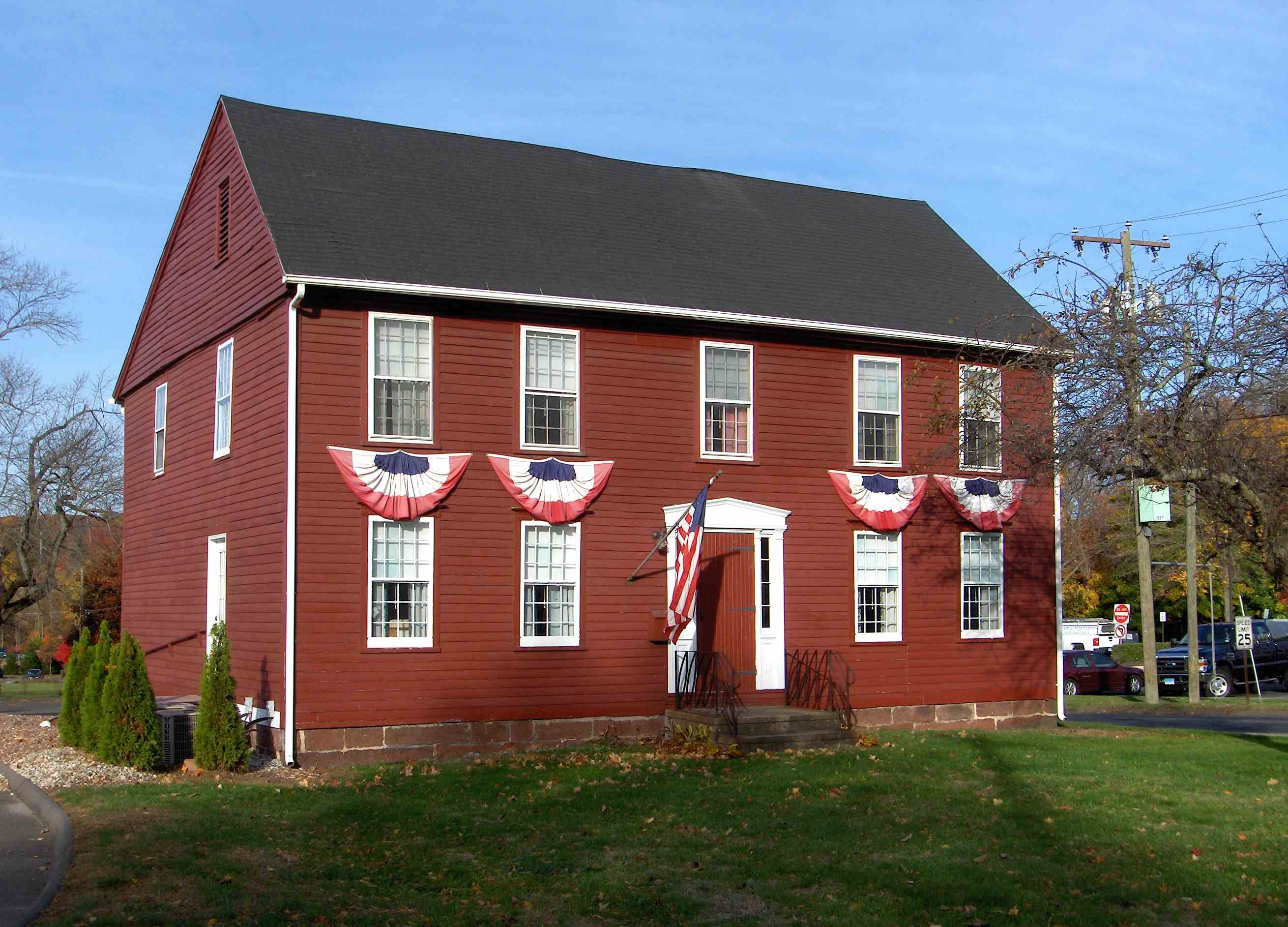
William Albertson House (1845)

In 1845-1846, a Greek Revival flushboard-sided house was built at the corner of Hempstead and Granite Streets in New London for William Albertson, who owned a successful cotton gin manufactory. The house was located on the spot where the New London plantation’s first house of worship, a large barn, had stood in the seventeenth century. In the later nineteenth century, a cast iron front porch and Italianate bay windows and cupola were added to the Albertson House. In 1973, the house was moved to the corner of Channing and Vauxhall Street to make way for the construction of Saint Sophia Church.

Cooke’s Tavern (1789)

In 1795, John Cooke purchased property (current address: 143 New Britain Avenue in Plainville) from Luther Shepard of Farmington and constructed a house/tavern (or was it already built in 1789?) for travelers along the Old College Highway. Originally it contained six rooms and a ballroom, but the building was much added to over its years as a tavern. The basement kitchen was later used as a blacksmith’s shop until 1880 and the old forge remains. In 1934, a great-great-grandson of John Cooke reopened the old tavern as a restaurant called Cooke’s Tavern. Today, the tavern is home to a restaurant called J. Timothy’s Taverne.

Gallery on the Green (1872)

Since 1960 a former schoolhouse on the Canton Village Green has been home to the Canton Artists’ Guild. Now called the Gallery on the Green, the building dates to 1872, when it was known as “The Academy.” It was later called the Canton Street School House and functioned as an elementary school until it was closed in 1949. The Canton Volunteer Fire Department used it for meetings from 1950 to 1958, when a fire station was built. The schoolhouse was then rented by the Artists’ Guild until 1971, when the Fire Department deeded the building to the Guild for $1.

Bishop-Woodward House (1790)

The Bishop-Woodward House, at 205 Center Street in Wolcott was built in 1790 for Bnai Bishop, who ran an adjacent store. Bishop also accommodated travelers in his house and there was a stable to the rear. It was later the home of Reverend Israel B. Woodward (1767-1810), the second minister of Wolcott‘s Congregational Church, who also ran a school in the house for young men training for the ministry. According to John Warner Barber in his Connecticut Historical Collections, Rev. Woodward,

though somewhat eccentric in some parts of his conduct, was a person of superior intelligence and esteemed by his parishioners. A thanksgiving sermon of his is recollected, in which he compared the state of Connecticut to the land of Canaan. In one respect, he mentioned, there was a striking similarity; the land of Canaan was rocky, this was very much the case with Connecticut, at least with that part of it in which Wolcott was situated.

By the end of the nineteenth century, the house was home to Adelbert Woods, Wolcott’s last postmaster.

Connecticut General Life Insurance Company (1926)

Thirty years before building their International Style complex in Bloomfied in 1957, the Connecticut General Life Insurance Company was headquartered in a Renaissance Revival-style building at 55 Elm Street in Hartford. Built in 1926 and designed by James Gamble Rogers, the building was inspired by the Medici-Riccardi Palace in Florence, Italy. Owned by other insurance companies after 1958, the building now houses state offices.

William Bouton House (1838)

Between 1838 and 1843, David Smith, a housewright from Greenfield Hill, built eight (mostly multi-family) houses along a street he had just opened up: Smith’s Lane (now Calderwood Court) in Black Rock, Bridgeport. This planned development also included a carriage factory and a school. The houses were transitional between the Federal and Greek Revival styles. The first of the houses to be built, in 1838, was the the William Bouton House at 4 (aka 25) Calderwood Court. The front porch is a twentieth-century addition.