
James Dunn was manager of the paper box department of the Warner Brothers Corset Company. He was the first resident, in 1914, of the Colonial Revival house at 457 Beechwood Avenue in Bridgeport.
James Dunn was manager of the paper box department of the Warner Brothers Corset Company. He was the first resident, in 1914, of the Colonial Revival house at 457 Beechwood Avenue in Bridgeport.

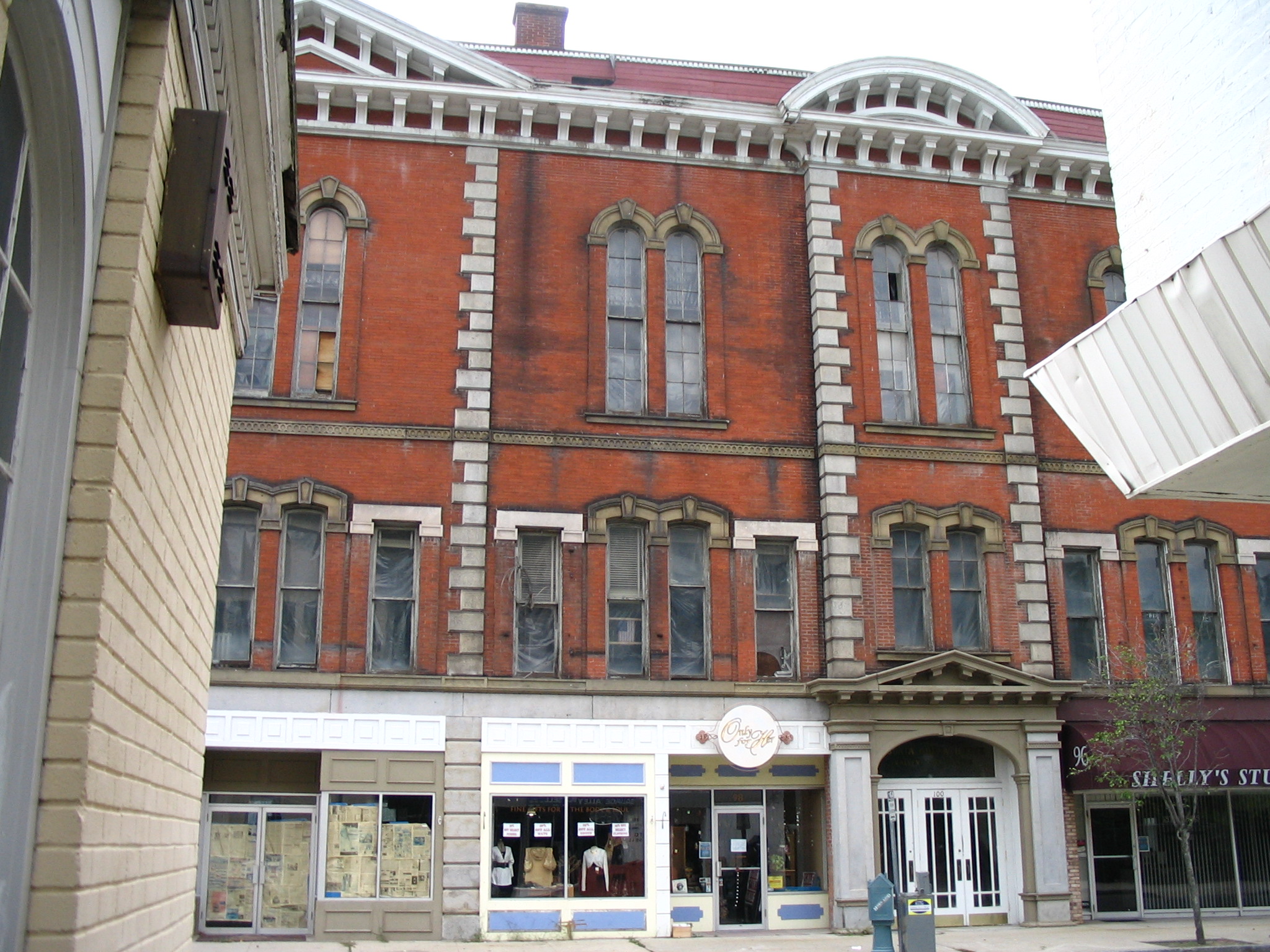
Built at 100 Main Street in Ansonia in 1869-1870, the Ansonia Opera House served as the lower Naugatuck Velley’s premier theater and public hall until the Sterling Opera House was built in Derby in 1889. The Ansonia Opera House’s hall is on the third floor of the the building, while stores are located on the first floor. Until 1910, the hall was run by a corporation called the Ansonia Hall Company, in which Jeremiah Bartholomew and his descendants held a controlling interest. Connecticut’s oldest opera house, for sixty years it was the center of Ansonia’s civic and social activity and entertainment, including graduations, dances, recitals, basketball games and boxing matches. Sometime after 1896, additional windows were added to the building‘s second floor. In 1971, the state fire marshal’s office closed the hall to public assemblies. It was later rented out as a gym and then as storage space and is currently in need of restoration.

The Colonial Revival-style house at 2333 North Avenue in Bridgeport was built in 1909 for Edgar W. Hurlock, an employee of the Prudential Insurance Company. According to The Spectator, Vol. LXXXIII, No. 10 (Thursday, September 9, 1909):
The Bridgeport staff of the Prudential held a celebration on August 21 for Superintendent Edgar W. Hurlock, who has been with the company for twenty-five years.

Avon Old Farms School, which opened in 1927, is a boarding school for boys founded by Theodate Pope Riddle, Connecticut’s first licensed female architect. She lived at Hill-Stead in Farmington, which she had helped design. Planning for the school’s campus began in 1918 and the land was cleared in 1921. The buildings were modeled after English Cotswold and Tudor styles and utilized traditional English methods. Among the earliest structures to be built were the Water Tower and the Forge, located at the entrance to the campus, whose foundations were laid in 1922. The cylindrical Water Tower is constructed of red sandstone at the base, which melds into similarly-colored brick. Connected to it is the Forge, which has two large chimneys. Constructed of sandstone blocks and brick, it was built as a working forge and provided the metal hardware (hinges, door latches, stair rails, and lanterns) used throughout the campus. The Water Tower contained water until 1976, when cisterns were placed underground. It is now the Ordway Gallery. The Forge was later converted to classroom and meeting space and its exterior has recently been restored.

The house at 995 Prospect Avenue in West Hartford, across from the Governor’s Residence, was built in 1916 for Lewis E. Gordon, resident manager of the American Mutual Liability Insurance Company. From 1926 to 1989, the house was owned by Miss Ethel Frances Donaghue (pdf) (1896-1989). Her father, Patrick Donaghue, an Irish immigrant, became wealthy running a wholesale and retail liquor business and purchasing commercial real estate in downtown Hartford. A wealthy heiress, Ethel Donaghue earned a law degree from the University of Pennsylvania and an SJD from New York University School of Law. Specializing in real estate and trust law in Hartford, she practiced until 1933, when her mother was ill with cancer. Her father had passed away when she was in High School from heart disease.
Experiencing health problems of her own in her later years, Ethel Donaghue left the bulk of her wealth ($53 million) to the Patrick and Catherine Weldon Donaghue Medical Research Foundation to “promote medical knowledge which will be of practical benefit to the preservation, maintenance and improvement of human life.” After Donaghue was incapacitated by a series of strokes in 1980, there was a legal battle over control of her financial affairs between the two conservators of her estate, who were both later removed (pdf). The resulting scandal led to the resignation, in 1984, of Probate Judge James H. Kinsella, to avoid an impending impeachment vote in the Connecticut House of Representatives. The house on Prospect Avenue, vacant for a number of years after her death, passed through other owners. In 2011, the house was sold to George Jepsen, who is currently serving as the state’s Attorney General.

The Church of the Holy Trinity in Middletown is an Episcopal church, built of local brownstone and designed in the Gothic Revival style by Henry Dudley. The first Anglican services in Middletown were conducted around 1730 and a parish, called Christ Church, was formally organized in 1750. The first church building was built in 1755 on South Green, followed by the second on Broad Street (now used as Russell Library) in 1834. Martha Mortimer Starr (1777-1848) bequeathed her land on Main Street to the parish on condition that it be renamed Church of the Holy Trinity. The name was changed in 1857 and the current church was built in 1870-1874 at 381 Main Street. Among the rectors of the church was Dr. Edward Campion Acheson, who served from 1892 to 1915 and was later bishop of Connecticut. His son, Dean Acheson, later served as Secretary of State in the administration of Harry S. Truman.

The Hotchkiss Block is a late-nineteenth-century commercial/residential building at 598-614 Main Street in Middletown. A large structure, it has Renaissance Revival elements and its impressive roof cornice, bay windows and first floor cornice are clad in pressed metal. The building is named for Frederick Hotchkiss, who built it c. 1894 and whose family owned it until 1919. It was then owned by Israel Mittleman, whose ground-floor clothing store had been in the building since 1910.

You must be logged in to post a comment.