
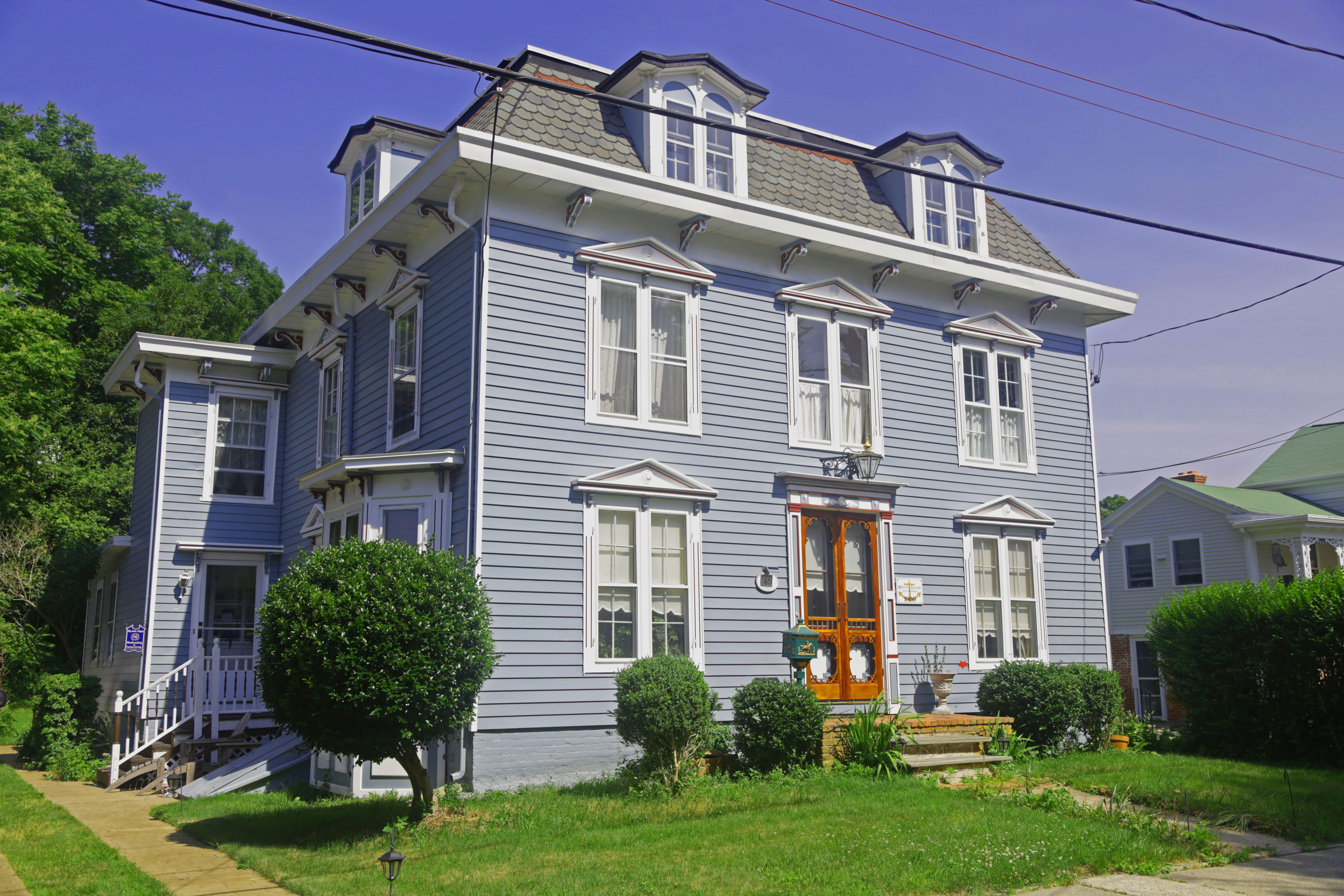
The house at 122 Broad Street in Guilford was built in 1874 for Elisha Chapman Bishop (1824-1903). A native of Guilford, Bishop had become wealthy in the 1860s oil boom in Titusville, Pennsylvania. According to Vol. II of A Modern History of New Haven and Eastern New Haven County (1918), Bishop
was born April 10, 1824, in Guilford, remaining upon the home farm until he reached the age of twenty years. He then began learning the machinist’s trade, which he afterward followed in Guilford on his own account. In 1861 he began operations in the oil fields at Titusville, Pennsylvania, where he remained for ten years, meeting with substantial success. He returned to Guilford in 1870 and then took up the occupation of general farming. In 1874 he built one of the finest homes in Guilford and equipped it in a most modern manner. In politics he was originally a republican but afterward became a prohibitionist. He was an ardent supporter of the abolition party from the time that he reached his majority in 1845. In 1882 he represented his town in the state legislature and he held various local offices. His religious faith was that of the Congregational church. On the 5th of July, 1846, he married Charlotte G. Fowler and they became the parents of twelve children, six of whom are living: Robert Allen; Edward Fowler; Mary Cornelia, the wife of N. G. White, of Hartford, Connecticut; Eva B., the wife of Edward M. Leete, of Guilford; Ida, the wife of William J. Canfield, of New Haven; and Marilla Canfield, the wife of F. C. Spencer, of Guilford.
Bishop’s house in Guilford, built in the French Second Empire style on the northeast corner of Guilford Green, was designed by the noted architect Henry Austin of New Haven. The house was later inherited by Bishop’s granddaughter, Marilla, who was married to Frederick C. Spencer, president of the Spencer Foundry. After her death in 1962, the First Congregational Church purchased the house for use as a rectory.


 Update (07/03/2014): The


You must be logged in to post a comment.