
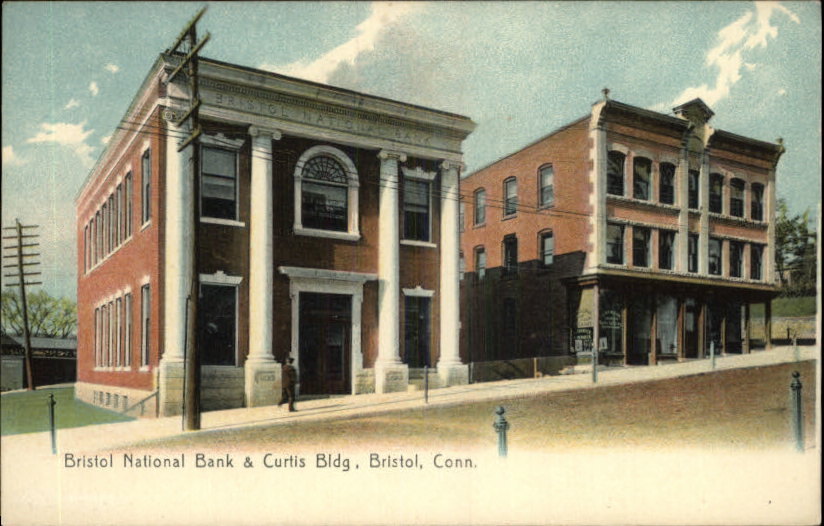
The Curtis Building is a blonde brick commercial building at 255 Main Street in Bristol. It has apartments on the upper floors and shops on the first floor that still have their original fronts with cast iron columns.
The Curtis Building is a blonde brick commercial building at 255 Main Street in Bristol. It has apartments on the upper floors and shops on the first floor that still have their original fronts with cast iron columns.

At 827 North Street in Suffield is a house built around 1723 by Lt. William King on a lot given to him by his father, James King. The lot was called King’s Great Field and the house is known as King’s Field House. William King (1695-1774) was a wealthy landowner, weaver and militia officer. He moved an earlier house to the property to form the rear of his new residence. The property was inherited by his son, William King, and then by his grandson, Seth King. The house was restored in the 1930s by Delphina Hammer Clark, author of Pictures of Suffield Houses (1940) and Notebooks on Houses in Suffield (1960). The house is now a Bed & Breakfast called Kingsfield.

At 614 Chapel Street in New Haven is Second Empire mansard-roofed house built in 1873 for Daniel Goffe Phipps (1821-1903). He had had many adventures serving as a captain in the U.S Navy and spent two years in the California gold mines during the Gold Rush. In St. Louis in 1851, he married “Mary E. Hunt, daughter of Captain James Hunt, a prominent West India merchant of New Haven,” as recorded in the History of the City of New Haven to the Present Time (1887), by Edward E. Atwater. That book goes on to relate that
In the fall of 1864 he ceased going to sea, and became identified with the New Haven Water Company; beginning soon afterward the manufacture of hydraulic pipe and the profession of hydraulic enginering [sic] and building of waterworks, his present business.
There are patents in his name for hydraulic water pipes. Daniel Goffe Phipps was later president of the West Haven Water Company. He died in 1903.

The house at 800 Clinton Avenue in Bridgeport was built in 1915 for George T. Hatheway, a real estate and insurance agent. As related in Vol. II of The History of Bridgeport and Vicinity (1917), George Thomas Hatheway “was born in Pequonnock, town of Windsor, Hartford county, August 5, 1865.”
George T. Hatheway was but a young lad at the time of his father’s death. He acquired his early education in the public schools, pursuing a course in the New Britain high school and also in the normal school there. The necessity of providing for his own support forced him at the age of sixteen years to become a wage earner and he secured a clerkship in a drug store at Unionville, Hartford county. In that store the village postoffice «»s conducted and in addition to selling drugs and sundries his duty included handling the mail. After two or three years there spent he removed to Winsted, Connecticut, but in the meantime, while still in the drug store at Unionville, he had taken up the study of telegraphy, there being a telegraph office also in the store. He thus picked up a knowledge of telegraphy and at Winsted was appointed to the position of Western Union operator. When about nineteen or twenty years of age he came to Bridgeport and accepted the position of operator in the Bankers & Merchants telegraph office. In a short time he went to New York city as operator in the main office of the Western Union Telegraph Company. He remained there for about two years after which he returned to Bridgeport with the Western Union Company and devoted eight or ten years to telegraphy in this city and also taught telegraph; in a local business college, his teaching paying his tuition for a course of study in the same institution, from which he in due time received a diploma. He then devoted five or six years to bookkeeping in a wholesale and retail hardware store and in August, 1901, he embarked in his present business of insurance and real estate. In this connection he soon forged to the front and for many years he has been one of the city’s leading fire insurance and real estate men, his business having now assumed extensive and gratifying proportions, he has never had a partner, always conducting his interests under his own name, which has become a synonym for progressiveness, enterprise and reliability in insurance and real estate circles. He is now president of the Bridgeport Fire Underwriters Association. He is thoroughly familiar with property upon the market, is correct in his valuation and has negotiated many important realty transfers satisfactory alike to seller and purchaser.
Hatheway married Clara Trulock Davis of Arkansas in 1893. They had two children.

Camp meetings, religious revival meetings where parishioners would set up their carts and tents around a central preaching platform, were once a vital feature of frontier American Protestant Evangelicalism in the nineteenth century. Participants, freed from their daily routines, could attend the almost continuous services that often lasted several days. While Presbyterians and Baptists sponsored camp meetings, these religious gatherings came to be particularly associated with the Methodist denomination. Methodists soon introduced the camp meeting, originally a western phenomenon that flourished before the Civil War, to the east.
The New Haven District of the Methodist Church founded a campground for summer revival meetings in the west end of Plainville (320 Camp Street) in 1865. Methodist camp meetings would continue to be held there every summer until 1957. Initially tents were pitched around a central platform. Soon the Association Building was constructed, where equipment could be stored. Individual churches then began constructing 2-story cottages facing the center of the Campground, along what is known as The Circle. Nineteen of these central cottages survive today. Individual families also began to build their own cottages on the narrow avenues radiating from The Circle, replacing the tents of the campground‘s early years. Most of the cottages date from the 1880s to 1910, although a few were constructed as late as 1925. The present Auditorium building was built around 1905 in place of the original preaching platform. At one time a screened pavilion, the Auditorium is now open to the outside. The Plainville Campground Association purchased the property from the Methodists in 1957. 87 of the cottages are now private residences, the other 39 being owned by various churches. A few of the cottages have been modified for year-round use, while the rest are occupied in the summer. I have additional photos of the Campground: (more…)

The Ecclesiastical Society of the section of Waterbury called Northbury (now Plymouth) was organized in 1739. The Society originally met in a building on the parish’s west side (now Thomaston). When plans were soon made to construct a meeting house on the east side, a number of west side settlers broke from the Congregational Society to form an Episcopal Society. (Plymouth was incorporated as a town in 1795 and Thomaston in 1875). As related in Francis Atwater’s History of the town of Plymouth, Connecticut (1895):
The Congregational society had its first home on the hill, and there it has always been, nor would an Episcopal society have been formed in Thomaston then if the church had been built here. The conflict was primarily of locality and only secondarily of ecclesiastical order.
The first meeting house (built c. 1747) was replaced by a second, built in 1792. The current Plymouth Congregational Church, which faces Plymouth Green, was built in 1838. It has wooden clockworks built by Eli Terry and donated by him to the church. (more…)

The house at 814 Laurel Avenue in the Statfield section of Bridgeport was built in 1914. It was the residence of Morris I. Rome, a wholesale tea and coffee dealer.
You must be logged in to post a comment.