Dr. Solomon E. Swift House (1840)

Dr. Solomon E. Swift House

At 156 South Main Street in Colchester is a Greek Revival house with Colonial Revival additions that include an elliptical attic light, long gabled wing on the right side and a one-story veranda. The house was built circa 1840 to 1850, being purchased in the latter year from David Carroll by Dr. Solomon Everest Swift (1819-1895), a dentist who practiced homeopathic medicine. After Dr. Swift‘s death, his widow Almira Lathrop Swift (1822-1904) (who had attended Bacon Academy) lived in the house until her own death. Their daughter, Caroline Swift Willard (1863-1950), probably made the Colonial Revival alterations/additions between 1896 and 1919, the year she eventually sold the house, having moved to Redlands, California. From the late 1990s until 2006, the house was used as a gift shop and is now lawyers’ offices.

Unitarian Universalist Church of Norwich (1910)

Unitarian Universalist Church of Norwich

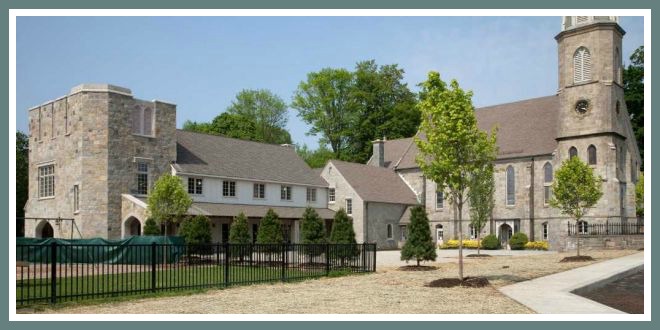
The Unitarian Universalist Church of Norwich began in 1820 as the “Society of United Christian Friends in the Towns of Norwich, Preston and Groton.” The Society erected a church in 1821, but did not have a settled pastor, the pulpit being occupied by temporary ministers. A church was finally organized in 1836, when the “First Universalist Society in Norwich” was established. A new brick church replaced the old one in 1841 on the same site on Main Street, facing Franklin Square. It was enlarged and rededicated in 1848. The church was demolished for the construction of the Chelsea Savings Bank. A new church, later called the Unitarian Universalist Church of Norwich, was erected in 1910 at 148 Broadway. Constructed of random granite ashlar, the church is also known as the Church of the Good Shepherd for the subject of its large stained glass window. The church’s bell, earlier located in the congregation’s Franklin Square church, was one of several bells salvaged from sacked churches after an uprising in Spain in 1833 that were shipped to New York for sale. With a dwindling congregation, the Unitarian-Universalists sold the church in 2009. It then became the Fount of Salvation Missionary Church.

Aaron Bronson House (1785)

Aaron Bronson House

The house at 846 Southford Road in Southbury was built circa 1785. The house may have been inherited by Aaron Bronson from his father, Noah Bronson. A cordwainer (shoemaker) and button maker, Aaron Bronson (1768-1834) left the house to his son, Augustus, who sold it in 1847. With the exception of a later Greek Revival doorway, the house’s exterior is typical of a late eighteenth-century Cape. The interior is notable for its early Federal-style features. The house has a later kitchen ell, attached at the left rear around 1820. A modern wing was added to the rear of the ell in 1987.

Bill Library, Ledyard (1893)

Bill Library

In 1818, the North Groton Union Library was established in the area that would later become the town of Ledyard. One of the original subscribers who helped found the library was Gurdon Bill, whose son Henry Bill (1824-1891) later became a wealthy publisher in Norwich. In 1867 Henry Bill approached town leaders on the subject of donating a new library. The new Bill library collection and the earlier library collection were housed at the Congregational Church. The number of books rapidly grew rapidly through donations made by both Henry Bill and his brothers, who had also become successful. Among the Bill brothers were Gurdon Bill, who became a publisher in Springfield, Massachusetts; Charles Bill, who became a traveler; Frederic Bill, who donated the Bill Memorial Library in Groton; and Ledyard Bill, the first child born in Ledyard after it became a town, who settled in Paxton, Massachusetts and wrote the History of the Bill Family (1867).

As related in the History of the Town of Ledyard, 1650-1900, by John Avery:

When the library was first created, book-cases were made and placed in the gallery of the Congregational Church. Here the books were kept for nearly twenty-six years, but in later years, the Bill brothers, seeing the necessity of a separate and permanent home for the growing library, secured a location on the “Common” near the church at the centre, and contributed the sum of three thousand dollars for the construction of a suitable edifice, and under the supervision of Mr. Frederic Bill, there was erected, for library purposes, an appropriate building, that will remain a monument to the generosity of the family for many years to come. This building was suitably dedicated on the day of our annual meeting in 1893. It contains a hall, room for the meeting of the trustees, and a spacious apartment where the library is located. The walls are adorned with pictures of the trustees, many of the citizens of the town, also many natives of the town of Ledyard, who have gone out from among these rocks and hills and become eminent in other states.

The Bill Library (current address: 718 Colonel Ledyard Highway) building was expanded in 1971 and 1982. (more…)

Oswin Taylor House (1840)

194 Main

The section of South Glastonbury just north of the Portland town line is a district called Taylortown because of the many members of the Taylor family who lived there. The 1869 atlas of Hartford County lists the house at 194 Main Street in Taylortown (built c. 1840) as the residence of O. Taylor. This was most likely Oswin Taylor (1809-1898), who once owned the Consolidated Feldspar Quarry on the west side of Main Street.

Hockanum Mill, Rockville (1855)

Hockanum Mill

A mill was first constructed at the site of the future Hockanum Mill on the Hockanum River in Rockville in Vernon in 1814 by Bingham & Nash. The mill produced satinet, a finely woven fabric that resembles satin but is made from wool. New owners acquired the mill in 1821 and soon expanded it by constructing a mirror image of the earlier building. These became known as the Twin Mills. The Hockanum Company was formed in 1836. They built new and larger mill was built on the site in 1849. After it burned down in 1854, it was rebuilt the following year to the same design. A wood-frame Greek Revival structure on a brick basement, it is the only wood-framed mill building surviving in Rockville. In 1881, the Hockanum Company built a three and a half story brick Romanesque Revival building, adjacent to the original wooden structure.

After George Maxwell became president of the company in 1869, he converted the mill’s production over to a higer-quality worsted cloth for menswear. By the turn-of-the-century the company was booming under the presidency of George Sykes. It produced the cloth for the inaugural suit worn by President William H. McKinley in 1897. The Hockanum Mill consolidated with three other Rockville mills in 1906 forming the Hockanum Mills Company, which was sold to M.T. Stevens in 1934. The Rockville mills were shut down in 1951. The Hockanum Mill recently received funds from the state to assist in the cleanup and reuse of the building for commercial and light industrial purposes. The site is also planned to be the home of the proposed New England Motorcycle Museum.