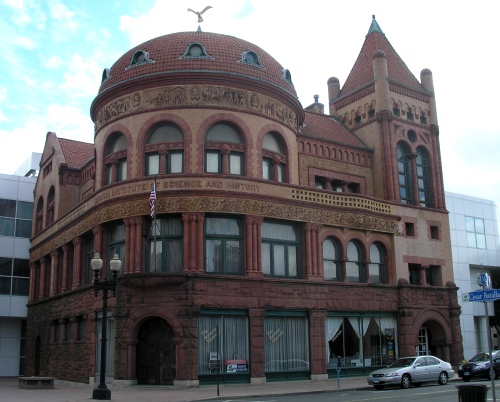
Barnum Museum (1893)

This is Historic Buildings of Connecticut’s 900th post, excepting the two April Fools posts, which some people have taken too seriously! What is that famous quote often attributed to P.T. Barnum? Well, with that in mind, let’s keep to the Barnum theme! The Barnum Museum is a place worth celebrating in an anniversary post, as it is a surviving legacy from one of Connecticut’s most important historical figures. P.T. Barnum had his famous American Museum in Manhattan, but this later burned. Barnum built four successive mansions in Bridgeport, where he served as mayor in 1875, but only a few traces of these survive today. The museum in Bridgeport which today bears his name was built in 1893 as the Barnum Institute of Science and History and originally housed a resource library and lecture hall. The building, which reflects the influence of Byzantine, Moorish and Richardsonian Romanesque architecture, was constructed of stone and terra cotta after Barnum‘s death using funds he had bequeathed for the purpose. The original societies which occupied the building ceased operation during the Great Depression and the city of Bridgeport assumed ownership in 1933. In 1943 the museum was closed for remodeling, reopening in 1946 as a city hall annex. In 1965, the city offices were removed and the building was again remodeled to reopen as the P. T. Barnum Museum in 1968, with exhibits about Barnum and the history of Bridgeport. The museum, which since 1986 has been operated by the Barnum Museum Foundation, was renovated in 1986-1989 and is today the only museum dedicated to the life of P. T. Barnum

Levi W. Eaton House (1893)

eaton-house.jpg

In 1893, Levi W. Eaton, president of the Bryant Electric Company, built a house on the southeast corner of Marina Park and Linden Avenue in Bridgeport. Eaton had been invited to build a home there by P.T. Barnum, whose fourth and final mansion was also located on the elliptical Marina Park circle. Eaton’s financial situation led him to sell the house right after completion to William A. Grippin, president of the Bridgeport Malleable Iron Company, Vulcan Ironworks and the North and Judd Manufacturing Company of New Britain. Three years after Grippin‘s first wife died, he married again in 1910, but died at the Grand Canyon in Arizona in 1911, while he was on his wedding trip. The Eaton-Grippin House was acquired by the University of Bridgeport in 1959 and for thirty years it served as a dormitory for law school students. The house, known as Darien Hall, has been unoccupied since the early 1990s and is in currently in disrepair.

Fayerweather Island Lighthouse (1823)

fayerweather-island-light.jpg

In the eighteenth century, what is today the Black Rock neighborhood of Bridgeport developed as an active port. In 1808, Black Rock Harbor’s first lighthouse, made of wood, was built on the southern end of Fayerweather Island. This was destroyed in an 1821 hurricane and replaced, in 1823, by a stone tower, designed to withstand future rough weather. Fayerweather Island Light, also known as Black Rock Harbor Light, had a number of long-tenured lighthouse keepers. Stephen Moore began as keeper in 1817, but he was later injured and unable to tend the light. His daughter, Catherine Moore, who had begun assisting him as a girl, then took on the full duties of keeper, although her father retained the official position until he died, at age 100, in 1871. Kate Moore then officially became keeper, retiring in 1878. The lighthouse was decommissioned in 1933 and became part of Bridgeport’s Seaside Park. The tower eventually fell prey to vandals and the adjacent keeper’s house, built in 1879 after Kate Moore retired, burned down in 1977. There was a preservation effort in 1983, but eventually the island was again neglected and the lighthouse vandalized. A new preservation group eventually formed and, in 1998, the structure was restored and now has with graffiti-resistant paint and vandal-proof steel panes for the windows. Black Rock Harbor Light was also relit, using solar panels. The island is today attached to land by a stone breakwater.

Stratford Shoal Lighthouse (1877)

stratford-shoal.jpg

Stratford Shoal Light marks a dangerous reef located in the middle of Long Island Sound. It was first marked for navigation by a pair of spar buoys in 1820. A lightship was placed there in 1838, but it frequently drifted off its station. Stratford Shoal Lighthouse, constructed on a small, unincorporated, man-made island, was completed in 1877 to replace the lightship. Automated in 1970, it is still an active aid to navigation. Also known as Middle Light, the lighthouse is halfway between Port Jefferson, New York and Bridgeport, Connecticut. Although the State of New York ceded the territory on which the lighthouse was built, it is classified as a Connecticut lighthouse on official maps. The lighthouse can be seen distantly from the Bridgeport-Port Jefferson Ferry. (more…)

Tongue Point Lighthouse (1895)

tongue-point-lighthouse.jpg

Tongue Point Light Lighthouse, built in 1895, is on the west side of the entrance to Bridgeport Harbor, on the east end of Tongue, or Wells, Point. Originally known as Bridgeport Breakwater Light, it stood at the end of a protective breakwater, built in 1891. There was no dwelling for the lighthouse keeper until Keeper C. Adolphus McNeil built a shack on the landing dock. After his death, in 1904, his wife Flora McNeil became the lightkeeper, while also running a manicure business in downtown Bridgeport. In 1919, when the breakwater was shortened, the cast-iron lighthouse was dismantled and moved 275 feet inland. The Tongue Point Light, also known as “The Bug,” was automated in 1954. The Coast Guard was going to remove the lighthouse in 1967, but local boaters protested.

Birmingham National Bank (1892)

birmingham-national-bank.jpg

The old Birmingham National Bank building is on Main Street in the City of Derby, which was once known as Birmingham. The bank was originally chartered in 1848 as the Manufacturers Bank of Birmingham, with Edward N. Shelton as its first president, and in 1865 became a national bank. Constructed in 1892-1893, the building features an elaborately detailed facade with terra cotta molding in the Sullivanesque, Neo-Grec and Richardsonian Romanesque Revival styles. The building is now the Twisted Vine Restaurant.

First National Bank of Litchfield (1816)

The First National Bank of Litchfield began in 1814 as a branch of the Phoenix Bank of Hartford. Benjamin Tallmadge was one of its founding directors. Its impressive Federal style building on North Street was built in 1816. The bank was reorganized as the First National Bank of Litchfield in 1864 and remains the oldest continuosly operating business in Litchfield and the oldest nationally chartered bank in Connecticut.