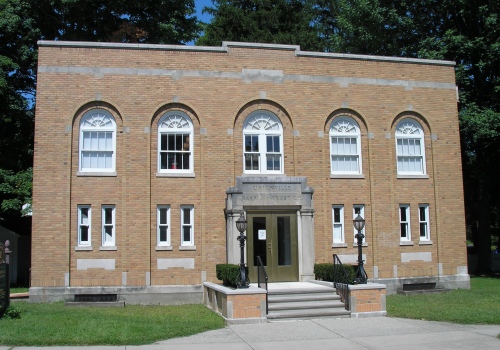
Naugatuck Savings Bank (1910)

The Naugatuck Savings Bank, a pressed buff brick and limestone building, was constructed in 1910 on Church Street in Naugatuck Center. The original south end of the building, with a grand entrance, was designed by the New York firm of Crowe, Lewis & Wickenhofer. The north end is an addition, built in 1934. The Bank was initially founded in 1870 as the Naugatuck Savings and Building Loan, formed to enable employees of the the Borough’s rubber-producing companies, Naugatuck Malleable Iron and other industries to build their own homes in town. Today, the building serves as the Bank‘s executive offices.

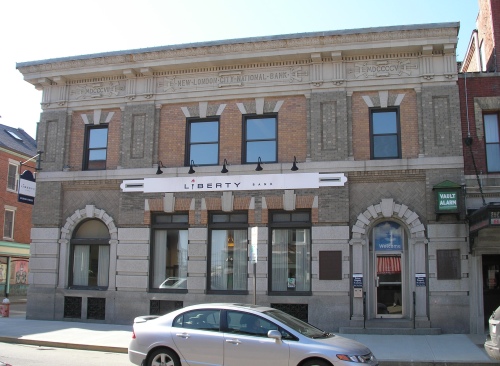
New London City National Bank (1905)

The New London Bank was founded in 1807 and in 1865 was reorganized as the New London City National Bank. It was New London’s second bank, following the establishment of the Union Bank in 1792, and its founding made New London the state’s first city to have two banks. According to A Modern History of New London County, Vol. 2 (1922):

The old stone building on Bank street, which was built for this institution in 1820 and was occupied by it for eighty-five years, was in most respects sufficient for the need of former days, but in 1905 it seemed evident that the time had come for increased facilities, and the present structure was erected, covering the old site and also the land extending to the corner of Golden street. This is a modern building, with a well protected vault and such other equipment as the business of the bank has thus far required.

In 1953 the bank became part of the Shawmut National Corporation. Today the building is a branch of Liberty Bank.

Unionville Bank and Trust Company (1929)

The Unionville Bank and Trust Company was founded in 1922 and a neoclassical building was constructed on School Street in Unionville in 1929. The Bank went into bankruptcy in 1932 and the building has since been used for other purposes, serving as a branch of the Farmington Savings Bank in the 1950s and being converted to offices in the 1960s. (see “Unionville Historic District Study Report,” pdf, p. 35/70).

(more…)

Lavinia L. Parmly House (1890)

The Parmly House, in the Marina Park district of Bridgeport, was originally built in 1890 by Lavinia L. Parmly, a wealthy New York widow. She used it as a summer home and, upon her death in 1894, bequeathed it to her grandson, Parmly S. Clapp, as a wedding present. He later became a New York City stockbroker. The house was later purchased by Allen W. Paige, whose widow, Elizabeth, donated it to the University of Bridgeport in 1950. Named Cortright Hall, in honor of E. Everett Cortright, first president of the Junior College of Connecticut (now the University of Bridgeport). Used at first as administrative offices, Cortright Hall now houses the Department of Public Relations.

New Britain National Bank (1927)

The New Britain National Bank building is on on West Main Street, next to the buildings which now serve as New Britain’s City Hall. It was built for the Commercial Trust Company in 1927, which failed during the Great Depression and was bought out by the New Britain National Bank in the 1930s. The building, which is also known as the Anvil Bank for the anvil motif which recurs frequently in its intricate brickwork, was designed in the Romanesque Revival style, with some Gothic elements as well. The bronze doors feature designs of beehives and Mercury and Buffalo coins. The building’s interior is also impressive: the lobby makes use of marble and bronze and has a 30-foot ceiling. The structure has been mostly vacant since 1996 and has suffered from deferred maintenance. After several years of planning to restore and adapt the bank building to new uses, work began a few years ago to covert it for stores and residential units, although progress was later halted by the economic downturn.

Norwich Savings Society (1895)

162-164-main.JPG

The Norwich Savings Society, the second oldest savings bank in Connecticut, was founded in 1824. The Norwich Savings Society building, at 162-4 Main Street, in downtown Norwich, was built between 1893 and 1895, with an addition being constructed in the 1970s. The building was designed to curve around one side of an intersection, joining seamlessly with the buildings on either side (although the building on the Broadway side has since been demolished). The Chateauesque-style Norwich Savings Society building now houses a People’s United Bank.