Seaside Institute (1887)

The Seaside Institute is a Richardsonian Romanesque building, erected in 1887 at the corner of Lafayette and Atlantic Avenues in Bridgeport. Designed by Warren R. Briggs, it was built by the brothers, Drs. I. D. Warner and Lucien C. Warner, across Atlantic Street from their corset factory. With seven eighths of their 1,200 employees being women, the Seaside Institute was built to provide the female workers with various amenities. As described in Volume II of Rev. Samuel Orcutt’s A History of the Old Town of Stratford and the City of Bridgeport (1886),

It comprises a Restaurant, Free Reading Room, Library, Bath Rooms, a large Public Hall, and Rooms for Evening Classes. It is a very elegant and substantial building of granite, brownstone and pressed brick, costing $60,000

The Seaside Institute‘s dedication ceremony was attended by Frances Folsom Cleveland, wife of President Grover Cleveland. Much lauded at the time for its role in remedying what was called “the problem of the working-girl,” the Institute continued to serve its original purpose until changing times led to its dissolution in 1929. The building was next owned by the Bridgeport Herald and, since 2007, has been home to Bridgeport International Academy, a private high school. (more…)

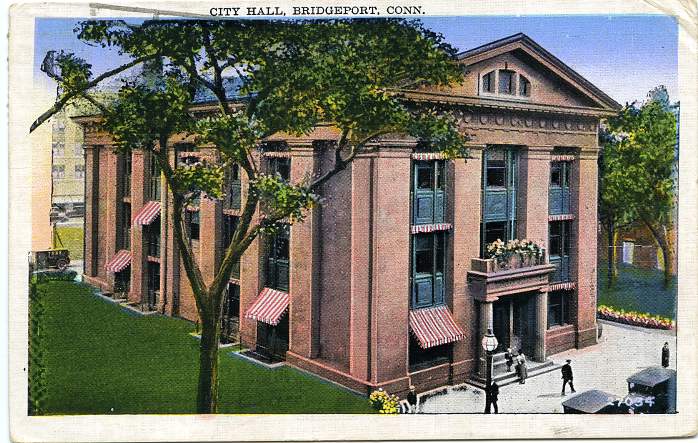
Bridgeport’s Old City Hall (1854)

This is Bridgeport Week!

The old City Hall of Bridgeport was constructed of Portland brownstone in 1853-54 between State and Bank Streets at a cost of $75,000. The Greek Revival building, designed by Alexander Jackson Davis to resemble a Greek temple, served as both City Hall and as the Fairfield County Courthouse. The original county seat and courthouse had been located in Fairfield, but when a larger building was required, it was decided to move the county seat to Bridgeport, which was experiencing considerable growth at the time. An alternative location for the courthouse was Norwalk, but Bridgeport offered to pay for the courthouse and a jail. The completed building had a large ground floor used as City Hall and two upper floors for court and county business. There was also an auditorium, called Washington Hall, used for public meetings. It was here, on March 10, 1860, that Abraham Lincoln gave a speech to a standing-room-only crowd.

The building served as courthouse until a new and larger one was constructed in 1887-1888 near the corner of Golden Hill and Main Streets. The old building, which continued to be used as City Hall until the 1960s and still contains city offices, was significantly remodeled in 1905. Bridgeport architect Joseph Northrop altered the building, toning down some of Davis’ romantic touches to make the structure conform more to the Neo-Classical style. The building’s dome had already been removed in the later nineteenth century and Northrop additionally altered the entablature and cornice. The first floor and entrance were also lowered to street level. In 1966, the former City Hall was renamed McLevy Hall after Bridgeport mayor, Jasper McLevy. The city is now consolidating its offices and plans to sell McLevy Hall to a developer.

Thames National Bank (1911)

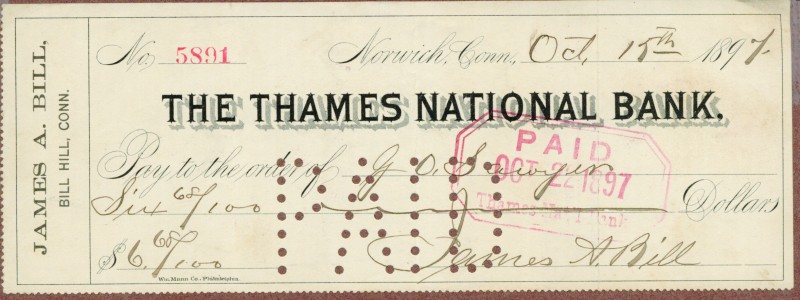
The 1911 Thames National Bank building is at 16-20 Chelsea Harbor Drive (formerly Shetucket Street) in downtown Norwich. As described in A Modern History of New London County, Connecticut, Volume 2 (1922):

The Thames Bank was the second institution of the kind chartered in Norwich, with a capital of $200,000, in 1825. By its charter the bank was obliged to purchase the stock of the Norwich Channel Company, and “maintain a depth of at least ten feet of water in the channel of the Thames river at common and ordinary tides.” The charter also permitted the bank to collect toll from all vessels coming to Norwich. These provisions of the charter were complied with so long as the bank operated under its State charter. The bank was also obliged to receive deposits from the State school fund, ecclesiastical societies, colleges and schools, at par, and pay on such deposits such dividends as were paid to their stockholders. The first bank rooms were on Main street

[…] Prosperity made it necessary to add to the facilities of the bank in order to properly meet the demands of increasing business, and in 1862 the bank erected enlarged quarters on Shetucket street. In 1864 the Thames Bank was succeeded by the Thames National Bank […] Its National Bank charter was renewed in 1884 and again in 1904, the home of the bank centering in the same quarters on Shetucket street until 1911, when the present building begun in 1910 was finished and occupied.

Society for Savings (1893)

The former Society for Savings building, at 31 Pratt Street in Hartford, was that bank’s third sucessive building on the same site. Organized in 1819, Society for Savings was the state’s first mutual savings bank. Its first building was constructed in 1834, the second in 1860, and the present structure in 1893. It has since been altered: the ground floor during an interior renovation in 1927 and the upper floors in 1957, when architect Sherwood F. Jeter departed drastically from the Renaissance Revival style of the first floor. Society for Savings merged with Bank of Boston Connecticut in 1993 and the old building remained closed for over a decade. More recently, it has become the Society Room of Hartford, which takes advantage of the grand 1926 interior, an ornate space designed by Denison & Hirons with ornamental plaster work by Anthony DiLorenzo and murals by H.T. Schladermundt.

Bristol Trust Company (1907)

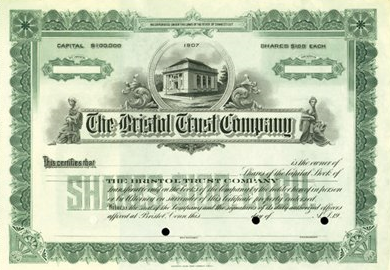
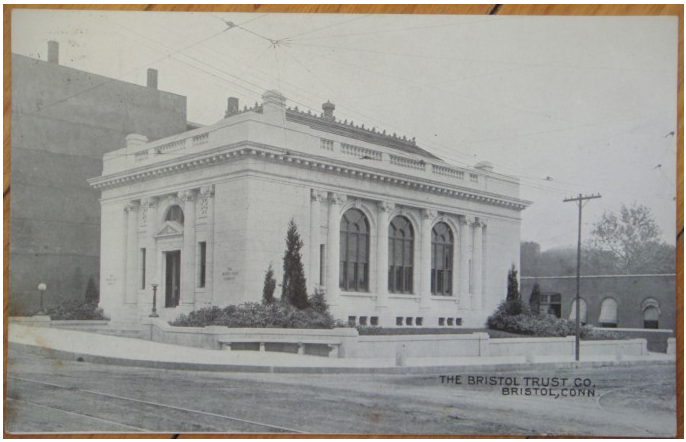
Walter Percival Crabtree designed the Bristol Trust Company building, now a branch of Webster Bank, which is located at 150 Main Street, on the northeast corner of Main and Riverside Avenue in Bristol. The company was incorporated in 1907, the same year the marble Neoclassical building with monumental brass doors was built. Outside, the building was surrounded by landscaped grounds, while the interior was designed by Mortensen and Holdensen, a Boston firm that created many interiors of public buildings and theaters at the time. The bank was later expanded to the north with the addition of space for a drive-in teller window.

Chelsea Savings Bank (1911)

The Chelsea Savings Bank in Norwich was incorporated in 1858. According to A Modern History of New London County, Connecticut, Volume 2 (1922):

The home of the bank was in the Merchants Hotel building until April, 1864, when quarters were secured on Shetuckct street, which were occupied until 1909, when the bank building was so badly damaged by fire that the erection of a new modern building, large and imposing, was decided upon. The present building, most splendidly located and planned, was finished and occupied in November, 1911.

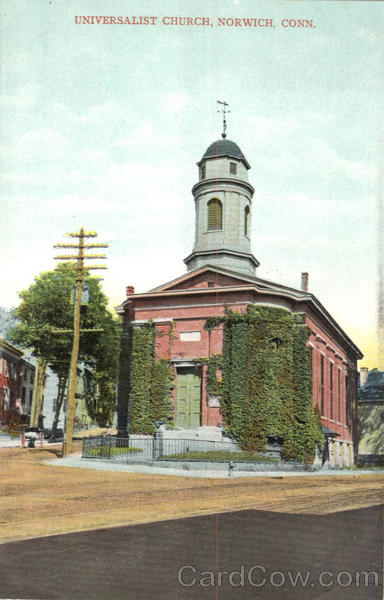
The building has a monumental character due to its location at the angle formed by the intersection of Cliff and Main Streets. A Universalist Church at the site was demolished to make way for the new building. The Chelsea Savings Bank was designed by the firm of Cudworth & Woodworth, who also designed the Norwich State Hospital.