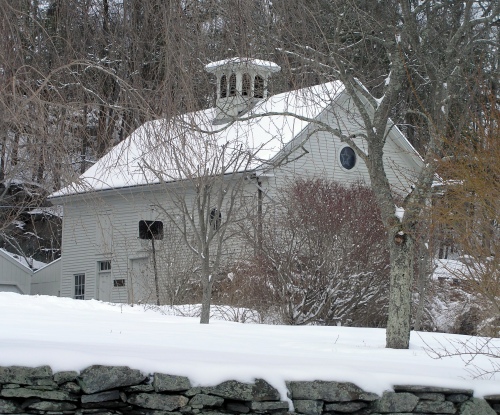
Burwell Tavern – Thomas House (1785)

Burwell Tavern - Thomas House

Little is known about the origins of the house at 4 Southbury Road in Roxbury, which originally served as a tavern and stage-coah stop. It is said to have been built in 1785 by a man named Burwell. He may be identified with one of several men named Brothwell (a variant spelling of the same surname) who lived in Roxbury at the time [refer to Roxbury Place-Name Stories (2010) by Jeannine Green, p. 17 for more details]. In 1839 the building was purchased by the Thomas family who owned it for over a century. The most well known member of the family was Harvey Thomas (died 1894). He raised and sold horses. A nineteenth-century barn that survives on the property almost certainly served as his horse barn.

Black Horse Tavern (1712)

Black Horse Tavern

Located at 175 North Cove Road on Saybrook Point in Old Saybrook is a building erected around 1712 by John Burrows. Known as the Black Horse Tavern, it served travelers as an inn for many years and was a customs house during the brief period Saybrook was a port of entry on the Connecticut River. In the eighteenth and nineteenth centuries the area was a commercial district with a busy wharf. Ambrose Kirtland acquired the tavern in 1771 and deeded it to his son, Daniel Kirtland, in 1794. It may have been Daniel Kirtland who updated the building in the Federal style. From 1871 to 1924 the Valley Shore Railroad went right by the former tavern, which revived the tavern’s buiseness in the nineteenth century. The building was acquired by Henry Potter in 1866. He built a dock for trading vessels and a store on the site (since demolished) which he operated with his son until 1890, leaving it to his clerks, Robert Burns and Frank Young. In 1910 they moved the store, called Burns and Young, to Main Street in Old Saybrook. This marked the end of the North Cove neighborhood as a maritime commercial district. The house is now a private residence. The original Black Horse Tavern sign is now at the Connecticut Historical Society.

William Parker House (1646)

Parker House, Old Saybrook

The sign on the Parker House at 680 Middlesex Turnpike in Old Saybrook gives it the date of 1646. The National Register of Historic Places nomination for the house gives a date of 1679. In either case, it is one of the oldest houses in Connecticut. It was built by William Parker (1645-1725). Born in Hartford, Parker settled in Saybrook. As described in Family Records: Parker-Pond-Peck (1892), by Edwin Pond Parker:

Dea. William Parker was a leading citizen, and very prominent in church and state. He is said to have represented Saybrook as Deputy to the General Court in more sessions than any other person, excepting only Robert Chapman. He was Sergeant in Train-band as early as 1672, and in 1678-9 the town voted him five acres of land for services “out of the town” in the Indian wars. He was elected Deacon before 1687, and probably continued in that office until his death. He was a lay member of the Saybrook Synod of 1705 that framed the “Saybrook Platform” for the churches of Connecticut.

The house descended in the same family into the 1960s. It is now a commercial property.

St. John’s Episcopal Church, Guilford (1814)

St. John's Episcopal Church, Guilford

Meeting House Hill in North Guilford is noted for the impressive view of its two early-nineteenth-century churches: the North Guilford Congregational Church and St. John’s Episcopal Church. The latter, located at 129 Ledge Hill Road, was built in 1812-1814 in the Federal style. The church was originally founded by members who had left the North Congregational Church in 1747, building their first small meeting house south of the hill in 1754. By 1812 they had developed a solid relationship with their neighboring church, which donated land for them to to build a new church on Meeting House Hill. The top section of the original steeple was removed and replaced with a belfry in 1843. The interior was remodeled and the chancel, sacristy, and vestry were added in 1870. Around the same time, Gothic arches were added to the windows as well. The belfry was repaired after being struck by lightning in 1890. Originally standing on large stones, the church did not acquire a permanent foundation until the 1950s. A rear addition added in 1972.

J. & E. Stevens Company (1843)

J. & E. Stevens Company

A group of buildings surviving from the J & E Stevens Company manufacturing complex can be found on the north side of Nooks Hill Road in Cromwell. The J. & E. Stevens Company was formed in 1843 by brothers John and Elisha Stevens. The company, which operated into the mid-twentieth century, is noted for its manufacture of cast iron toys, especially mechanical iron banks and cap pistols. On the left in the image above, at the corner of Shadow Lane, is the earliest surviving Stevens factory building, a white-painted brick structure, which later served as the main office building (it once had a cupola, since removed). The adjacent brick structures to the right were erected sometime later in the nineteenth century: the Assembly Building (white-painted brick, center) and the Pattern Shop (unpainted brick, right). Across Nooks Hill Road is the factory‘s former 1865 foundry building (not pictured), which has been much added to over the years. Other structures that were part of the complex have since been torn down. The buildings above are now home to Horton Brasses, 49 Nooks Hill Road.