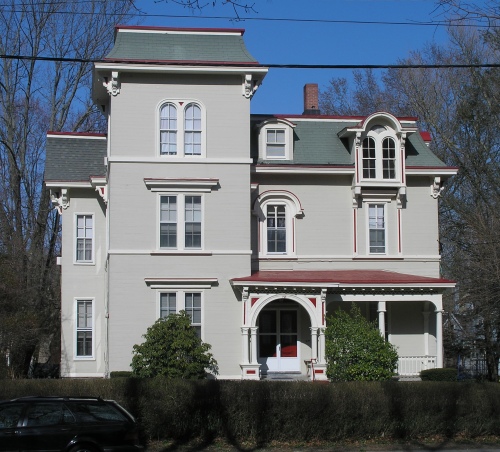
Stone-Otis House (1830)

The Town of Orange was incorporated in 1822 and soon new buildings began to be constructed in the vicinity of the new town’s Green. The Stone-Otis House was one such structure, built around 1830 for Dennis Stone. A prominent citizen, Stone owned the town’s second general store, located in his home. Around 1840, he added a large front display window to the house for the store. Stone and his family later moved to Kansas. The house, which is transitional between the Federal and Greek Revival styles, was sold Phoebe and Charles Otis, a tool and dye maker, in 1887. The family sold the house to the town in 1966. The restored house is now a museum and the headquarters of the Orange Historical Society.

Plumb Memorial Library (1894)

David Wells Plumb was a successful manufacturer in Birmingham (Derby) and Ansonia, who later settled in Shelton. In 1892, he led a committee of citizens which established a free public library, which opened the following year on the second floor of the Pierpont Block. D.W. Plumb then planned to erect a dedicated library building, but died before he could undertake the project or include funds for it in his will. His brother Horace, a Bridgeport businessman, decided to honor his brother’s wishes and financed the building of the library. Named the Plumb Memorial Library in honor of his brother, it was completed in 1894 on land donated by Plumb’s widow, Louise, next to their family home. The architect for the Richardsonian Romanesque structure was Charles T. Beardsley, Jr. of Bridgeport. A modern addition to the library was constructed in 1974.

Samuel C. Morgan House (1843)

Samuel C. Morgan (1789-1876) was born in Lisbon, graduated from Yale in 1812, trained as a lawyer and in 1815 began his practice in Jewett City. In 1842, he was elected president of the Quinebaug Bank and moved to Norwich. The Quinebaug Bank had been founded in 1832 and became the First National Bank in 1865. His house in Norwich, at 3 Crossway Street, was built around 1843. The house has interesting corner pilasters with H-shaped moldings.

St. Sergius Chapel (1933)

Russian Village is a historic district, located between Route 6 and the Pomperaug River in Southbury. It was established in 1925 by a group of Russians who had fled to America after the Russian Revolution in 1917. Count Ilya Tolstoy, the son of Leo Tolstoy, discovered the area during a visit to his translator in Southbury. Siberian novelist George Grebenstchikoff then led the establishment of a community there, intended as a seasonal cultural center for Russian writers, artists, musicians and scientists. The village was named Churaevka, after a Siberian village mentioned in Grebenstchikoff‘s works. The community, established by, but not limited to, the creative intelligentsia, remained a predominantly Russian community into the 1980s. The main building in the Village is a chapel dedicated to St. Sergius. A stone building, it was designed by philosopher and painter Nicholas Roerich, financed by helicopter inventor Igor Sikorsky, and built in 1932 – 33 with labor volunteered by village residents, including Ivan Wassileff, a stone mason. The Chapel was also intended to be a memorial to the Cathedral of Our Savior in Moscow, which was destroyed by the Soviets in 1931 and has more recently been rebuilt. Since the Chapel itself is too small to contain a congregation, there is a small amphitheater with curved stone benches just outside, facing the Chapel. In 1931, the Chapel was deeded to the Roerich Museum in New York and later to the Synod of Bishops of the Russian Orthodox Church Outside of Russia.

Colonel Avery Morgan House (1824)

The Colonel Avery Morgan House, at 219 South Main Street in Colchester, was built around 1824. Col. Morgan, born in 1781, was originally from Groton. He was a carpenter, merchant and farmer, who also served in the War of 1812 in the defense of New London. In 1802, he married Jerusha Gardner. Their first two children were born in Groton (they also lived for a time in Bozrah) and the other five children were born in Colchester, which they moved to in 1807. They later moved to Hartford, where Col. Morgan died in 1860 and his widow in 1861. The Colonel Avery Morgan House in Colchester is now a branch of Liberty Bank.