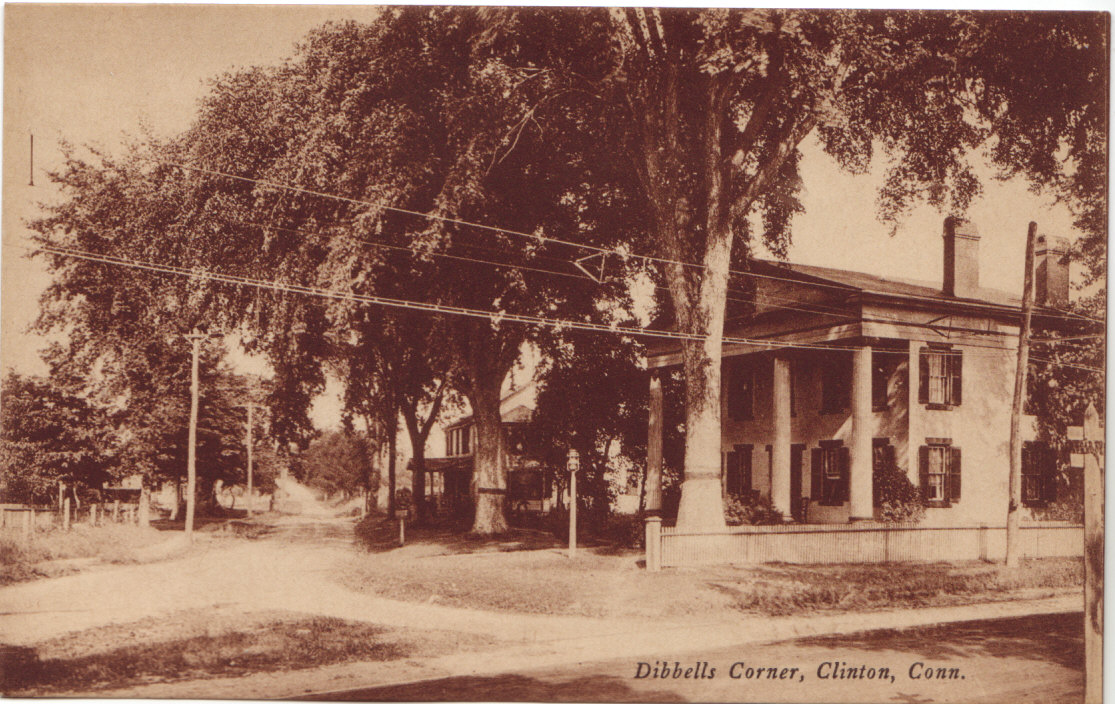
Dibbell House (1848)

At 170 East Main Street in Clinton is a brick Greek Revival house, built around 1848. The earliest surviving deed to the house dates to October 1850, when it was transferred from Samuel R. Dibbell to Charles Dibbell. The plot where the Dibbell House sits, at the corner of Boston Post Road and Old Clinton Road (Route 145), is known as Dibbell’s Corner and the house is still in the Dibbell family. The house has a full, two-story Greek portico with freestanding Ionic columns, which were originally made by hand in a barn then on the property. The house’s corner location makes it vulnerable to damage from vehicle crashes. Twenty years ago, a motorcycle crash which killed the driver destroyed the two left columns. Preservationist Jeffrey Bradley crafted exact replacements. Last year, another crash just missed the right column and damaged brickwork on the house. The column survived, but rot was discovered. Bradley’s services were again called upon to repair the damaged column.

Eclectic Society (1907)

The Eclectic Society was established as a fraternity at Wesleyan University in Middletown in 1837, later adopting the Greek letters Phi Nu Theta. The Society‘s first permanent house, which did not have residential accommodations, was built 1882. In 1906, the Society hired architect Henry Bacon to design a Doric Greek revival structure at 200 High Street. Bacon had previously worked for the architectural firm of McKim, Mead and White and would go on to design the Lincoln Memorial in Washington, DC and to make preliminary sketches for Wesleyan’s Olin library. Completed in 1907, the Eclectic building is seen as a precursor to the Lincoln Memorial, both having a Doric design but lacking the typical accompanying pediment. In 1970, there was a split between undergraduate and alumni members: ties were severed and the alumni organization, the Socratic Literary Society, incorporated a century before, was dissolved. The undergraduates abandoned the use of Greek letters, elected women to membership and sold the house to the University.

Viets’ Tavern (1760)

Viets’ Tavern is an eighteenth century building, which was much added to over the years. It is located just across the street from Old Newgate Prison in East Granby and served as an inn and tavern. According to Francis Hubbard Viets, in A Genealogy of the Viets Family (1902), Captain John Viets (1712-1777),

worked for a time with his brother Henry in the Simsbury copper mines at Newgate. It is said that while working in the mines at Newgate he met Lois Phelps, an unusually charming girl, who had come with others to visit the caverns, which, then as now, were objects of curiosity. Lois afterwards became his wife. […] He settled on an estate near Newgate and became a farmer, store and hotel keeper, and an extensive trader. His homestead is now in possession of his descendant, Virgil E. Viets. The present house, however, or the greater part of it, was built at a later day. Tradition gives John Viets the credit of introducing potato culture into this part of Connecticut; he is said to have brought the seed from Rhode Island in his saddlebags. […]
He was first a lieutenant and afterwards captain of militia. […] In 1773 Captain John Viets was appointed master or keeper of Newgate prison for the ensuing year. In 1775 he was again appointed keeper of Newgate during the pleasure of the Assembly; he was paid this year for his services as keeper £149, 17s, 8½d.

As further related by Richard H. Phelps in Newgate of Connecticut: its Origins and Early History (1876):

Lieutenant Viet’s tavern, a few rods from the prison, was an especial accommodation, not only for travellers, but for the better sort of convicts. He who could muster the needful change, would prevail on some one of the guard to escort him over the way to the inn of the merry old gentleman, where his necessities and those of his escort were amply supplied at the bar.

John’s son, Luke Viets, was tavern-keeper through 1834. The tavern sign from his time displayed the date 1790. More recent estimates give a date for the Tavern of c. 1760. The unrestored tavern is now part of the state’s Old New-Gate Prison and Copper Mine site and museum.

Edmund J. Thompson, Jr. House (1800)

Built around 1800, the Edmund J. Thompson, Jr. House is at 99 South Main Street in East Granby. The house has a finely-detailed Palladian window over the entrance and a later colonnaded Greek Revival portico on the south side, added around 1840. During the Revolutionary War, Edmund (or Edward) J. Thompson, Jr. served in the Connecticut Continental Line from 1779 to 1780. He later left East Granby and settled in Lowville, New York.

White Oak School House (1840)

When the first settlers came to Southbury from Stratford in 1673, they spent their first night under a white oak tree on Crook Horn Road, in what is now Settlers Park. That section of Southbury became known as White Oak and at 886 Main Street North is the old White Oak School House, built around 1840. More recently used as an antiques shop, the Greek Revival school house is part of a property, currently on the market, which includes the adjacent 1715 Croucher-Richmond House.

St. Paul’s Universalist Church (1893)

A Universalist Society in Meriden was formed in 1854 and was formally organized in 1863. The Society’s first church building was constructed in 1860. This wooden structure fronted Norwood Street, but was moved to the northeast corner of Norwood and Liberty Streets when construction of a new church was begun in 1891. Completed in 1893 as St. Paul’s Universalist Church, it later became the Unitarian Universalist Church of Meriden. In 2002, with a dwindling membership and the prohibitive costs of maintaining the Richardsonian Romanesque church, the congregation sold the building to two partners who wanted to transform it into a rock and comedy club. When that project fell through, the church was put on the market again and one of its stained-glass windows, made by Louis Comfort Tiffany, was put on auction. In 2007, the church was sold to a Pentecostal congregation, the Holy Word Foundation Ministries. In 2005, alterations were completed on the Unitarian Universalist Church of Meriden‘s new home in a former house at 328 Paddock Avenue.