Bryan-Downs House (1785)

The first residents of the Bryan-Downs House, originally located on the Post Road between Milford and New Haven, were Jehiel Bryan, Jr. wed Mary Treat, who were married in April, 1784. It was then the home of their daughter, Mary Esther, and her husband, Ebenezer Downs. Their son, Ebenezer Jr., inherited in 1837 and made a number of major changes to the house, replacing the original stone chimney with a smaller one and remodeling the interior. After Ebenezer’s death in 1873, the family rented out the house, which was later dismantled and stored for several years. In 1977, it was erected on the Milford Historical Society property, where today it forms part of the Wharf Lane complex of historic houses.

William Augustus Erving House (1880)

Located on the West Hartford side (across from the Hartford side) of Prospect Avenue, at #825, is the William Augustus Erving House. It is an elaborate Queen Anne residence, built in 1880 for William Augustus Erving, who was, at that time, secretary of the Hartford County Mutual Fire Insurance Company. His father, Daniel Dodge Erving, had previously served as president of the company and William Augustus Erving became president himself in 1917. According to A Century in Hartford, a history of the company, published in 1931,

Large and well proportioned, he maintained his fine physical vigor mainly by walking; he seldom missed his “morning constitutional” from his home on Prospect avenue to the office, a distance of three miles.

Erving’s brother, Henry Wood Erving, chairman of the board of the Connecticut River Banking Company, lived in a similar house next door.

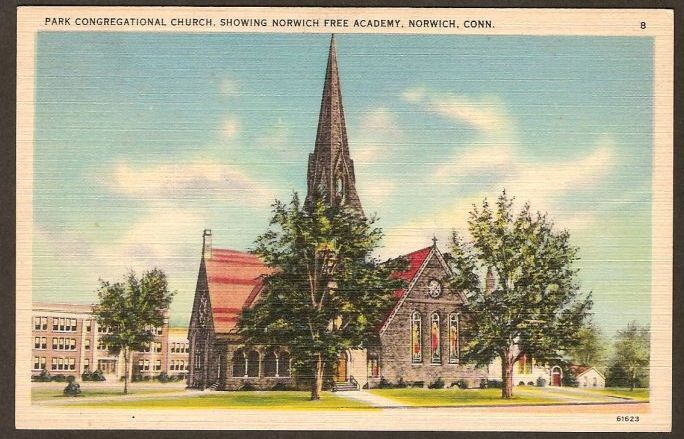
Park Congregational Church, Norwich (1874)

As related in A Modern History of New London County, Connecticut, Volume 1 (1922), during the pastorate of Rev. Malcolm McGregor Dana at the Second Congregational Church of Norwich:

The feeling that its helpfulness to the community would be increased by removal to the suburban district near the Academy led to marked differences of opinion with the majority of his parishioners, and in 1874 Dr. Dana resigned and, with one hundred and five of his old members, formed the Park Congregational Church.

The church, built in 1874, was designed by Stephen C. Earle of Worcester in the Romanesque Revival style.