First Church of Christ, Congregational, Glastonbury (1939)

First Church of Christ, Congregational, Glastonbury

The First Church of Christ, Congregational in Glastonbury has had five church buildings since it was established in the 1690s. As related in Vol. 2 of the Memorial History of Hartford County (1886), the first meeting house was erected on the Green in 1693:

It was enlarged in 1706, and stood until destroyed by fire on the night of Dec. 9, 1734. The second meeting-house, by compromise between the north and south, and by the decision of the General Court, was erected on the main street, about one fourth of a mile south of the Green, standing half in the street, just north of the old Moseley tavern. […] It was used as a church for more than a century, having been built in 1735. On the division of the society in 1836, by the establishment of the society at South Glastonbury, it was abandoned as a meeting-house, and during the year 1837 was demolished. […] By the division of the First Society in 1836, and the dilapidation of its ancient edifice, a new meeting-house became a necessity for the mother organization, and it was so voted in society’s meeting January 17, 1837. This was located farther to the north, on land which in 1640 was owned by the Rev. Henry Smith, the first settled minister of Wethersfield (from 1641 to 1648), and later (in 1684) by Samuel Hale, the ancestor of the Hale family. It was built in 1837, under the supervision of David Hubbard, Josiah B. Holmes, George Plummer, Benjamin Hale, and Ralph Carter, as a building committee. It was a very tasteful edifice, with tower, bell, and clock, especially attractive after its enlargement and thorough repair in 1858, which made it a most fitting and beautiful sanctuary. It was burned on the morning of Sunday, Dec. 23, 1866. The church which takes its place was erected in the year following, and with its graceful spire (rebuilt in 1880) forms a prominent object in the views of the valley.

This last church was destroyed in the hurricane of 1938, when the steeple crashed down into the sanctuary. The current church was built the following year on the same site.

Joseph Wright House (1808)

2033 Main Street, Glastonbury

Joseph Wright was a prosperous farmer in Glastonbury. He kept detailed diaries for over 30 years that are an important source for Glastonbury history. His house, at 2033 Main Street, was built in 1808. According to tradition, two bricklayers worked on each half of the house and when they got to the middle of the front facade, they discovered that their work did not line up. This is why the brickwork above the front door does not line up today. The house’s ell is part of an earlier Wright family home that was located on Wrights Island in the Connecticut River.

Roswell Goodrich House (1789)

2038 Main St., Glastonbury

At 2038 Main Street in Glastonbury is the gambrel-roofed Roswell Goodrich House. Roswell was a descendant of William Goodrich, an early settler of Wethersfield. William purchased land in what is now Glastonbury in 1646, on which his descendents later built homes. The house at 2030 Main Street was built about 1760 by Captain John Goodrich (pdf) and the one at 2038 was built about 1789 by Roswell, son of Captain John’s younger brother David Goodrich. Roswell married Rachael Stevens, a descendent of Rev. Timothy Stevens , Glastonbury’s first minister (his house is at 1808 Main Street). Their son Israel, who later bought the house at 2030 Main Street, was a farmer who played the violin and also taught a dancing school.

St. James’ Episcopal Church, Glastonbury (1859)

St. James' Episcopal Church, Glastonbury

St. James’ Episcopal Church was established in North Glastonbury in 1857 and the church at 2584 Main Street was built in 1859. The interior was gutted by fire in 1904, but the church was able to reopen for services within one year. The building was enlarged in 1965 and in 1978 a parcel of town redevelopment land was purchased to become a parking lot and major repairs were made to the church and parish house (the latter built in 1956). (more…)

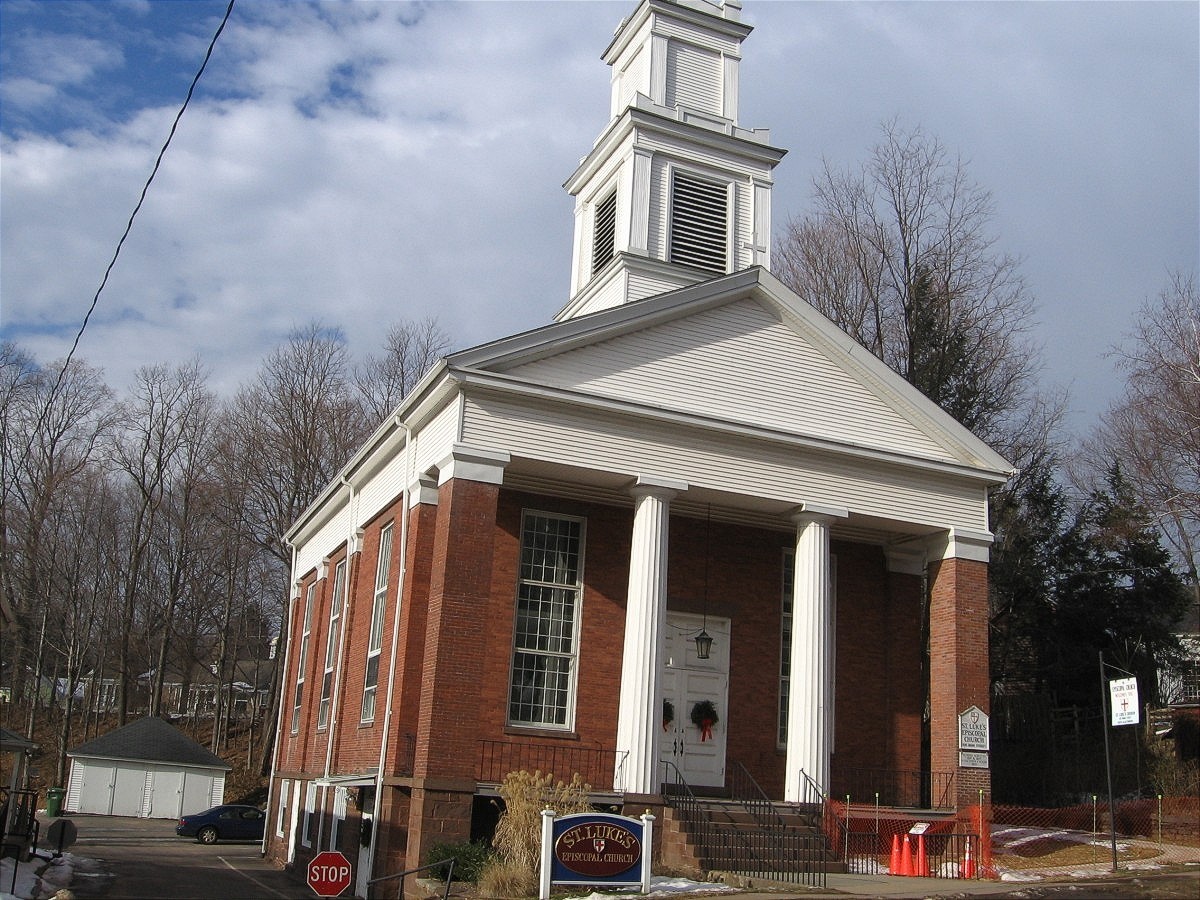
St. Luke’s Episcopal Church, South Glastonbury (1838)

In 1806, Episcopalians in Nayaug (South Glastonbury) established an Episcopal Society and built a church in 1812-13. The church was officially consecrated as St. Luke’s Episcopal Church in 1821 and served as a church until a new church was consecrated in 1838. The old church was sold and became a school. It was moved further down Main Street in 1860 and was torn down in 1933. The 1838 church is still in use, with few modern modifications to the original structure.