Salem School (1894)

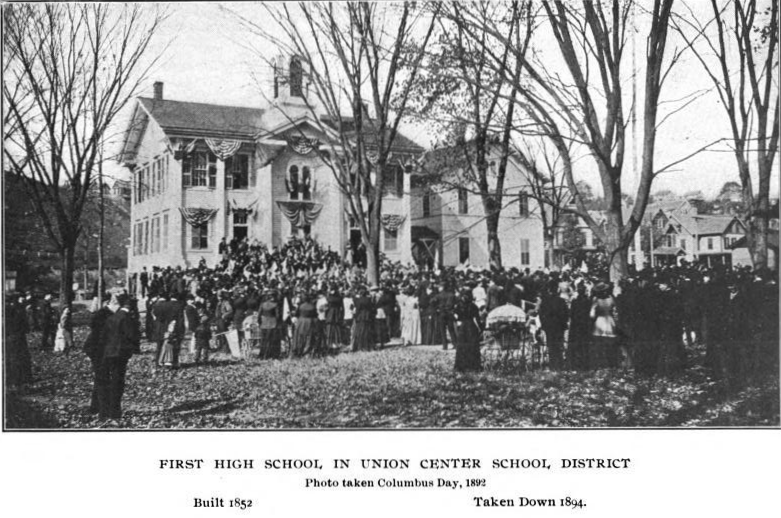
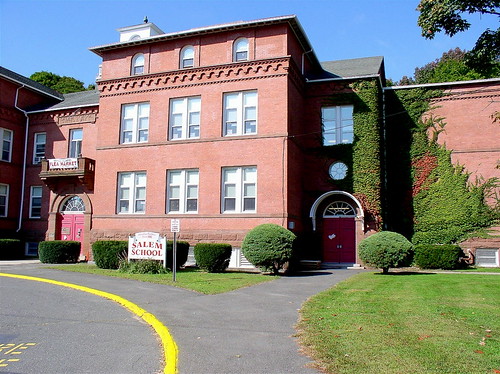
Naugatuck’s Salem School has been in the news recently. Just this past week, the Naugatuck Board of Education, facing a budget shortfall, voted to close the historic school, resulting in the circulation of a petition to save it. Salem School has been open since 1894. Previously, the Union Center School, built in 1852 and located on Naugatuck Green, had served the community. By the 1890s, the Borough of Naugatuck required a new and larger school building. The result was Salem School, the gift of John Howard Whittemore, a wealthy industrialist who wanted to enrich his hometown. He hired the nation’s leading architectural firm, McKim, Mead and White, to design the school, as well as many other prominent buildings in the center of Naugatuck. The old school on the Green was taken down and Salem School was built across Meadow Street in 1893 and opened the following year. The school served all grades until a separate High School building, also designed by McKim, Mead and White, was built in 1905. The Middle School grades were moved out in the 1950s. Salem School, named for “Salem Bridge,” an early name for Naugatuck, has continued since then as an elementary school, but is now slated to close. The future use of the building has not yet been determined.

Norfolk Academy (1840)

A school was established by the town of Norfolk as early as 1768. Initially, students were taught in the church parsonage, until the the School Society built a small structure, used as a school and church conference room, in 1819. According to an 1899 speech by librarian Henry H. Eddy (quoted in the 1900 History of Norfolk): When John F. Norton was the teacher at the school, it

was so successful that by 1838 there were upwards of seventy pupils under his charge. The next year, the need of still greater accommodations being felt, an Academy Corporation was formed for the purpose of building an academy, and in 1840 such a building was erected on the east side of the Green, for the sum of $2,000. As the career of Mr. Norton had been so successful he was appointed first principal, and continued as such until duties outside of the town took him away.

As Frederic S. Dennis relates, in his 1917 book, The Norfolk Village Green:

The Town Hall, originally the academy, was built in 1840 and from that time on was used as the place for the transactions of town business, including voting. In 1846 a committee was appointed to confer with the proprietors of the academy with a view to the use of this building for town meetings. The lower floor is used for town meetings; the upper floor is the property of Mr. and Mrs. Carl Stoeckel; it was not unusual in early days to have one building owned by two or more parties. In addition to the school room above and the town hall below, there was constructed in the basement a lock-up, which has been built on the first floor by partitioning off a room.

Today, the building serves a different purpose, as the Norfolk Historical Society Museum.

Durham Academy (1844)

Durham Academy was established in 1843 as a private school during a period of time when public schooling was very inadequate. The Greek Revival-influenced Academy building was constructed in 1843-1844 and attracted students from a wide area. After the establishment of Middletown High School as a public alternative, the Durham Academy declined and eventually closed in 1884. The building was purchased by the town of Durham in 1891 and became the Coginchaug School, a consolidated school which also offered two years of high school-level instruction. This was dropped in 1898 for financial reasons, but the building later did serve as a high school, from 1916 to 1923. It next became a Lodge of the Knights of Pythias until 1973. It also served as a post office from 1935 to 1958.

Anne V. Torrant School (1874/1912)

The Anne V. Torrant School in Plainville consists of two connected buildings. The earlier Italianate structure was built in 1874, when the town’s various one and two room schools were consolidated into a single building. The second structure was built of brick in 1911-1912. In style, both buildings are similar to other schools built in Connecticut during the same period. The school was called the Broad Street School and later was renamed in honor of Anne V. Torrant, who worked there for fifty years, starting as a teacher in the 1920s and later serving as principal. The school was named for her shortly before her retirement in 1972. Today, the building is no longer a school but has been converted into housing for the elderly and is called the Torrant House.

Daniel Lathrop School (1783)

daniel-lathrop-school.JPG

Dr. Daniel Lathrop, who operated the first apothecary in Norwich, died in 1782 and left an endowment of £500 for the establishment of a free school in Norwich, with the condition that it remain in session eleven months of the year. Built of brick in 1783, the school is located on East Town Street, off Norwichtown Green. The Daniel Lathrop School stands next to the shop of Joseph Carpenter, built in 1772.

Lee Academy (1821)

lee-academy.JPG

Lee Academy was built as a schoolhouse in 1821, at the corner of the Boston Post Road and Neck Road in Madison. It was named for Captain Frederick Lee, who had led the effort to establish a private college preparatory school in town, and the new building was constructed across the street from his own house. Capt. Lee had also been the one to propose Madison as a name for the new town in 1826. Although built with a proviso that it would never be moved, the school building has been relocated several times: in 1836 to the western end of the town Green; in 1839 (when it began to serve as a district school, continuing to accommodate the preparatory school as well until 1884) to a plot across from the Green’s northeast corner; in 1896 (making way for the construction of Memorial Hall) to a location behind the Hand Academy. In 1923, the Madison Historical Society began to manage the building, which was moved, for the last time, to its present location, facing west toward the Green. Having housed a number of organizations and businesses over the years, Lee Academy is now used as a museum and as offices for the Historical Society.

Jordan Schoolhouse (1740)

jordan-schoolhouse.jpg

One of the historic structures on Jordan Green in Waterford is the 1740 Jordan Schoolhouse, the oldest surviving public building in Waterford. The earliest mention of a schoolhouse in Jordan actually dates to 1737. The present schoolhouse building was converted into a private home in the mid-nineteenth century for the widow Eliza Gallup and her three children. The building’s granite front steps came originally from the nineteenth-century West Neck Schoolhouse. The Jordan Schoolhouse was moved to Jordan Green in 1972 and is now a museum run by the Waterford Historical Society.