Hall-Wilson Cottage (1910)

The summer cottage at 11 Pettipaug Avenue in the Borough of Fenwick in Old Saybrook was built in 1910 for the Hall and Wilson families. It was erected on what had previously been the site of the 1885 cottage of Henry Morgan. That cottage was long rented by John Henry Hall and his family. Hall was one of the family that owned the Portland brownstone quarries and was a president of Colt Firearms. The Halls purchased the Morgan Cottage in 1901 and sold it to Ernest Wilson, who moved it to its current address at 4 Agawam Avenue. The Halls then built the current cottage, which was later owned by their grandson, John C. Wilson, Jr. You can read more about the cottage in Marion Hepburn Grant’s The Fenwick Story (Connecticut Historical Society, 1974), pages 114-115.

Joseph Hamilton House (1899)

The house at 86 Central Avenue in East Hartford was built between 1894 and 1903 by Joseph Hamilton, a clerk. He acquired the property from P. Boyle, who had acquired it from Patrick Garvan, who developed Garvan Street. It was one of several lots acquired by Garvan in 1871. This well-preserved example of the Queen Anne style displays the use of contrasting siding on two different stories.

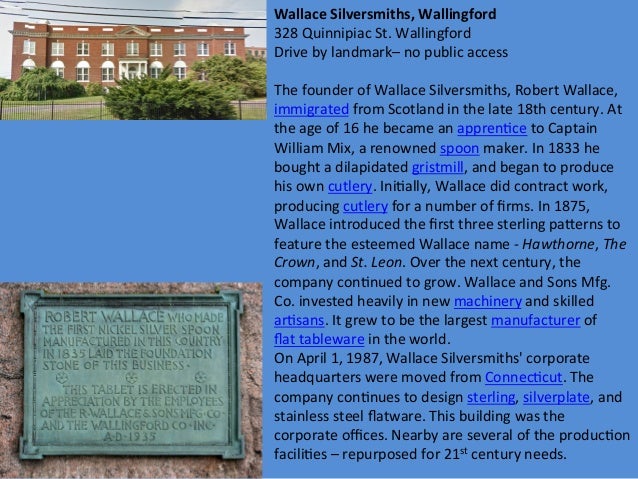
Wallace Silversmiths Administration Building (1920)

Happy Tanksgiving! Perhaps you will eat your Thanksgiving dinner with fine Wallace silverware? In the 1870s, Robert Wallace, an immigrant from Scotland, established what would become the R. Wallace and Sons Manufacturing Company, a major American manufacturer of sterling silver. Over time, the company expanded its factory complex at 340 Quinnipiac Street in Wallingford. The Administration Building was built c. 1920-1924. By the 1950s, the company was known as Wallace Silversmiths. Over the years it would be sold three times and would relocate twice within Wallingford before leaving the state in 1987.

Old Mystic National Bank (1856)

The Old Mystic National Bank began as the Mystic Bank in 1833. It was established in a newly-built granite building in the village of Old Mystic in Stonington, which was a commercial center at the time. By 1856, business had grown to an extent that a larger building was required. It was erected of brick in the center of the village of Old Mystic. The iron bars across the windows were added after a attempted burglary in 1884. The institution became a national bank in 1865 and continued in business until undergoing a voluntary liquidation in 1887. By that time the village of Mystic to the south had become the local business hub instead of Old Mystic. After the bank closed, the 1856 building was sold to the town of Stonington in 1889. It was used as a District Hall for voting until the 1960s. During World War II, the Reliance Fire Company of Old Mystic used the attached back shed as a Civil Defense headquarters. It was later used to store fire equipment. In 1965, the building was sold to the Indian and Colonial Research Center. The ICRC is a non-profit organization that preserves the preserves the papers and collections of Eva L. Butler (1887-1969), a noted anthropologist, archeologist, historian, and naturalist.

Mystic Bank (1833)

Now located at Mystic Seaport, the Mystic Bank was originally built in 1833 in Old Mystic, at the head of the Mystic River. The first president of the bank was Elias Brown and the first cashier was George W. Noyes, who later held the same position at the Mystic River Bank. The Mystic Bank moved its operations to a new brick building in 1856. The first floor of the old bank building then became the post office and the upper floor was used as a carpenter’s shop. The building would be used for different purposes over the years until 1948-1951, when it was moved to Mystic Seaport. The current front portico is a reproduction of the original. (more…)

Guilford Academy (1794)

For sixty years the First and Fourth Congregational Societies in Guilford each maintained their own schoolhouse, located next to each other on the Green. These were then combined into one building of two stories, erected in 1794. The building was moved from the Green to its current location, at 19 Church Street, in 1827. It then housed a secondary school, called the Guilford Academy (aka high school), on the upper floor. As related in A History of the Plantation of Menunkatuck and of the Original town of Guilford, Connecticut (1897), by Bernard Christian Steiner:

In 1837 the [town’s center school] district was divided into four parts and school houses built in the northeast and southwest districts, the northwest district occupying a part of the academy, the upper part of which building was occupied in 1838 by Mr. Dudley as a high school.

The academy closed in 1856, after the Guilford Institute (which would later become the high school) opened. The former Academy building then became a private residence. The front porch was most likely added around that time.

Christ Church Tashua (1846)

Christ Church, the Episcopal parish in the Tashua area of Trumbull, was organized about 1760, by which time the residents had built a small wooden church. The parish began as a mission of Christ Church in Statford, the oldest Episcopal parish in Connecticut. In 1788, the parish voted to build a new church by subscription. As described in Vol. 2 of Samuel Orcutt’s A History of the Old Town of Stratford and the City Bridgeport (1886), the church was proportioned

not to exceed 50 feet in length, and 34 in breadth, and 24 in height. Also to be 24 windows in said church, of six-by-eight glass, thirty panes in each window, exclusive of the arch. This edifice was located, apparently, on the north side of the highway, where it remained until the present one was erected. The same year it was voted to call the parish Trinity Church, and by that name it was known in the records for many years. In June, 1790, the church was so far advanced that by vote of the parish the pew spots were sold at public veendue, the buyers being obligated to pay the prices bid and build the pews in one year from the time of purchase. The pews were to be in uniform style, as they were in the North Fairfield meeting house. The purchase money was applied towards the expense of building the church. The pew spots, except two, were sold for $310.66. The square pews were sixteen in number, being the wall pews round the building. The chancel was on the north side, and there was a door in the opposite side and one also at the east and west ends. In the body of church there were long, open seats free to all. A tower and spire were built at the west entrance in 1823.

The erection of the current church was begun in 1846 and the building was consecrated on May 28, 1847. While there have been additions, the church remains an excellent and very well preserved example of the Carpenter Gothic style.