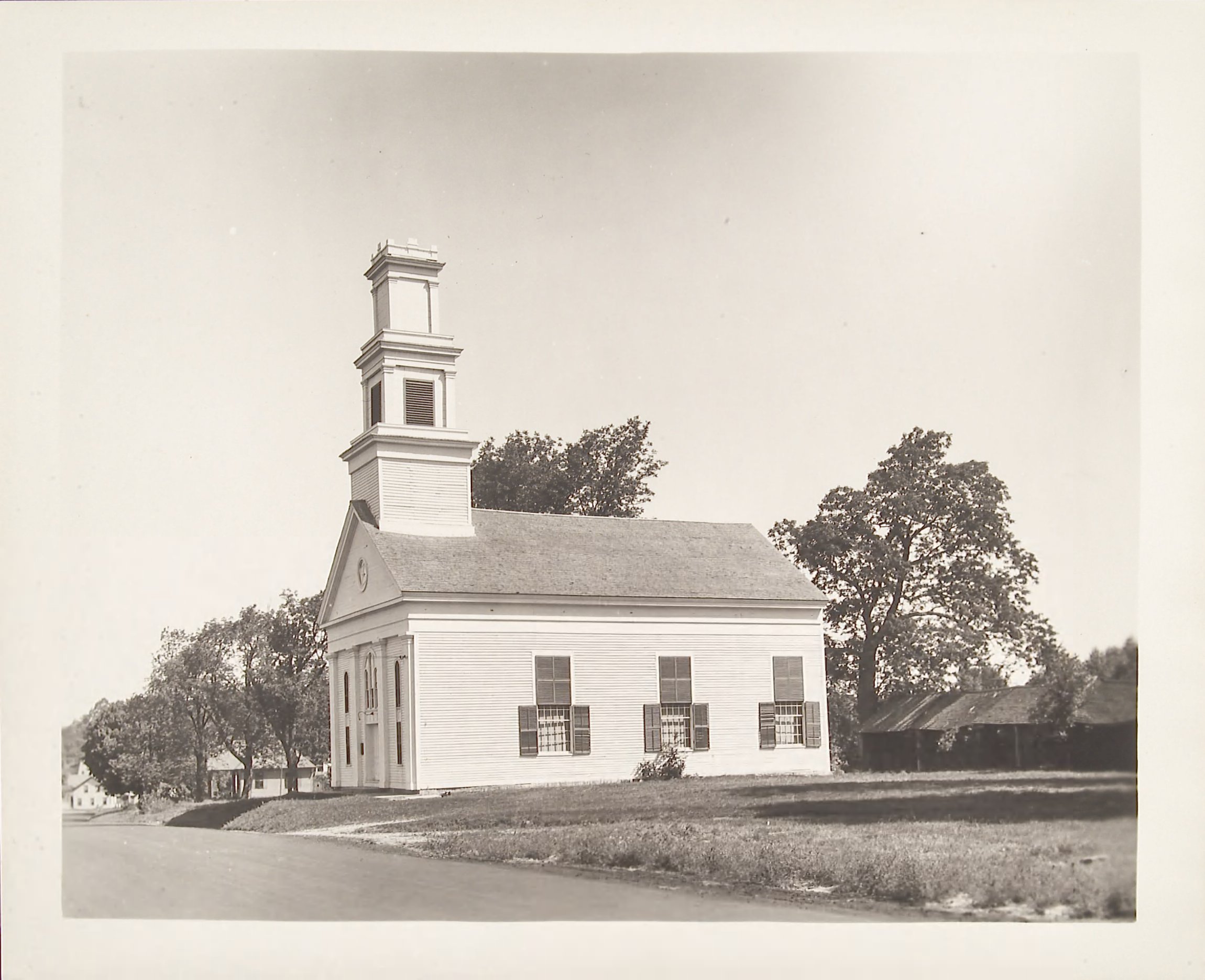
Abington Congregational Church (1751)

The oldest ecclesiastical building in the State of Connecticut that has been continuously used for its original religious purpose is the Abington Congregational Church in the Town of Pomfret. Overcrowding at the Pomfret meetinghouse, as well as the great distance residents from the Abington section of town had to travel to attend services there, led to the creation of a separate ecclesiastical society in Abington 1749. The new congregation erected its own meetinghouse in 1751, a building that is one of the few surviving examples in New England of eighteenth-century peg and beam construction. The building was completely remodeled in the Greek Revival style between 1834 and 1840 by the architect-builder Edwin Fitch of Mansfield. Among various interior and exterior alterations, Fitch created a new facade featuring four Doric pilasters and replaced the church‘s 1802 bell tower with the current three-stage steeple.

(more…)

William Bevin House (1757)

One of the oldest houses in East Hampton is the colonial saltbox at 53 Barton Hill Road. It was erected circa 1748-1757 by William Bevin, who died in 1793 at the age of 83. The property was maintained by William’s son Isaac Bevin, Sr. (1746-1791) and grandson Isaac Bevin, Jr. (1773-1870), who married Anna Avery of Glastonbury in 1800. In 1832, their sons, William, Chauncy and Abner, later joined by a fourth brother Philo, started Bevin Brothers Manufacturing Company, a bell foundry that is still in business today.

John Batty House (1842)

John Batty House in Mystic

At 18 Pearl Street in Mystic is a Greek Revival style house built in 1842. It was originally the home of John Batty, a spar maker in Mystic’s ship-building industry. As described in the nomination form for the Mystic River Historic District, the house’s “pediment has two right-angle triangular windows with diagonal muntins that form horizontal diamond glazing. The front wall under the pediment is flush vertical boards.”

(more…)

James Potter, Jr. House (1858)

Capt. James Potter, Jr. House

The Greek Revival-style residence at 82 Front Street in Noank was the home of James Potter, Jr., a ship captain. In June of 1863, during the Civil War, the Confederate bark C.S.S. Tacony spent two weeks raiding off the coast of New England. One of the fifteen Union ships the Tacony captured and burned was the fishing smack L. A. Macomber, Captain James Potter, Jr. of Noank. The crew were allowed to seek safety in their small boat, which was able to reach Woods Hole. The Tacony‘s career ended after the capture of the schooner Archer. The Confederate crew transferred to the new vessel and burned the Tacony on June 25, 1863.

(more…)

House at 16 Charter Oak Place, Hartford (1894)

According to the nomination for the Charter Oak Place National Historic District, the house at 16 Charter Oak Place in Hartford was erected in 1894 for Philemon Robbins, a furniture manufacturer, but Robbins had passed away in 1890. In the 1830s he was a partner with Isaac Wright and Joseph Winship in Isaac Wright & Company, one of Hartford’s leading furniture companies. After Wright’s death in 1838 his partners formed Robbins & Winship, which became Robbins Brothers in 1878.

The house’s first story is brick, with its upper two stories being shingled. There is a Palladian window in the upper story’s triangular gable.

The ninth chimney fire was added to the fire department list yesterday, when the headquarters chemical company answered a telephone call just after noon to the house of Mananger Norman McD. Crawford of the street railway, at No: 16 Charter Oak Place. The chimney burned Itself out and no damage was done.

Hartford Courant, February 14, 1901