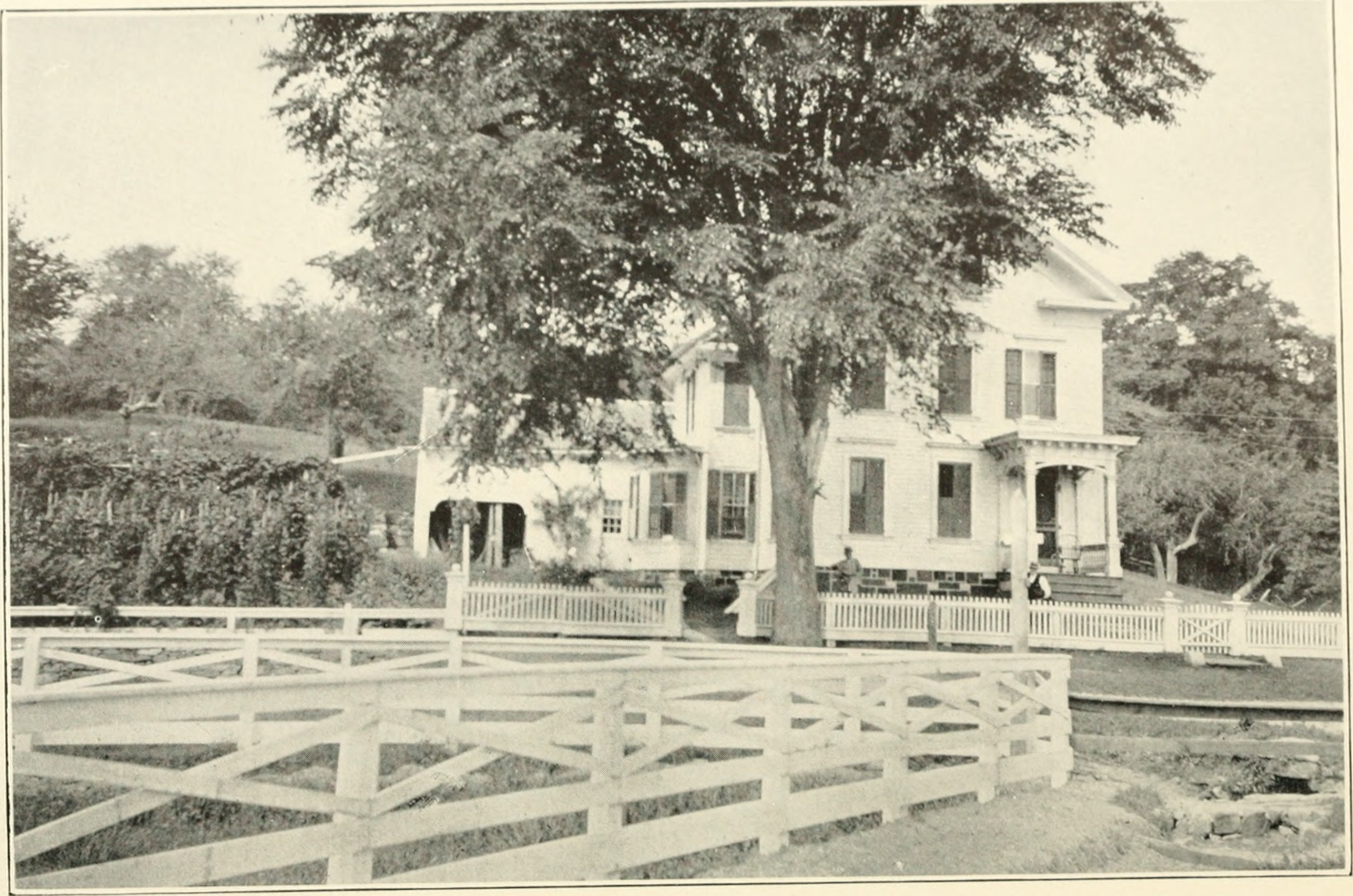
Tremko-Stebbins House (1773)

Temko-Stebbins House

The house on the right in the picture above is the Tremko-Stebbins House, located on Route 44 in the Warrenville section of Ashford. The building on the left is a former Post Office. The house was built c. 1773 by Thomas Stebbins Sr., who bought 1/4 of an acre from Benjamin Clark. The last owner of the house was George T. Tremko, who bought it in 1946 from Abbie M. Balch (she served on the Ashford Board of School Visitors, to which she was elected in 1898). It was known as the post-master’s house because the Tremko’s were involved with the post office next door. The Town of Ashford bought the house via eminent domain in 1987 and there were plans to take it down and build a new library on the premises. The Ashford Historical Society helped to save the house and to acquire a grant to rehabilitate its exterior (this work was completed in 2014-2015). The town is waiting for another grant to rehabilitate the interior of the house, after which it can be used as a Museum and Tourist Information Center.

Thanks to Joan E. Bowley, Pres. of the AHS, for information on the house.

Elijah Sherman House (1791)

50 Main St S., Woodbury

Not to be confused with another nearby Elijah Sherman House, the house at 50 Main Street South in Woodbury was erected by Deacon Elijah Sherman on land owned by Lee and Timothy Terrell. As related in the c. 1900 book Woodbury and the Colonial Homes:

The Sherman place is now occupied by Chas. Roswell, and the stone door step still bears the date May 19, 1791 A. D., chiseled on it. In the basement of this house, a tannery was located, later being moved across the street.

The house has been home to the Newell family since 1918.

Rev. Samuel Clark House (1759)

Rev. Samuel Clark House

Reverend Samuel Clark (1729-1778), a Princeton graduate, was ordained in the Kensington Congregational Church in Berlin 1756 and then served as its minister until his death twenty-two years later. He built the grand house at 67 Burnham Street, one of the earliest brick residences in Connecticut, in 1759, but did not marry until 1766, when he wed Jerusha White. The latter part of his pastorate was contentious and the congregation split into separate societies in 1772. In 1773, Rev. Clark entered into a financially unsuccessful partnership, ending in a quarrel, with merchant Jonathan Hart. At the time of his death the Revolutionary War was underway and Rev. Clark was facing dismissal from his pastorate for suspected Tory sympathies. His house was next occupied by Rev. Benoni Upson, who succeeded him as minister. The Upson family lived in the house into the twentieth century. The house has a white-painted twentieth-century addition to the left of its front facade.

Elisha H. Holmes, Jr. House (1872)

4-main-st-south-windham

The Italianate house at 4 Main Street (pdf) in South Windham was built in 1871-1872 by Elisha H. Holmes (1799-1886) for his son, Elisha H. Holmes, Jr. (1844-1915), known as “Harlow.” He is described in Vol. I of the Commemorative Biographical Record of Tolland and Windham Counties (1903):

Elisha Harlow Holmes, secretary and treasurer of the Willimantic Machine Company, and a member of the firm known as the Radial Thread Buff Company, is one of the active business men of Willimantic. Windham county.

Elisha H. Holmes, his father, came to Windham in 1818, and followed his trade of cabinetmaker, also engaging in farming. Later he had a grist and plaster mill at South Windham. [. . .] His wife, Lydia, was a daughter of Amos Dennison Allen, a cabinet—maker of Windham, with whom Mr. Holmes learned his trade.

Elisha Harlow Holmes was born in South Windham, Conn., July 13, 1844. [. . .] In 1889 was formed the Willimantic Machine Company, of which he is secretary and treasurer and a member of the board of directors, and to this business he devotes the greater part of his time. The business is one of the very successful institutions of the “Thread Company,” being so great as to necessitate the employment of a number of skilled workmen, about fifty people in all, in the production of silk and thread machinery.

Mr. Holmes is also a member of the Radial Thread Buff Company, of South Windham. The buildings occupied are nearly all of brick, and are located adjacent to the tracks of the New London Northern railroad at South Windham. They are lighted by gas made on the premises, and the works are operated by a twenty-horse-power engine. The products are old-style and patent buffs for polishing silver, bronze and all metals requiring high polish, and the machinery used in their production is of original design. adapted especially for the work. This machinery is unique in its construction, and embodies ideas on which Mr. Binns was granted patents in 1884. The patent buff wheel, while superior to the old style and unlike any other, is made with less labor, at less expense, and its manner of construction is such that almost no waste of material results. The wheels made by this concern are now used by platers, cutlers and manufacturers generally on fine work, throughout the United States and Canada; each year shows an increase in the demand for them, and from a dozen to fifteen people are employed in their manufacture.

On May 7, 1866, Mr. Holmes was married, by Rev. Clayton Eddy, of St. Paul’s Church, Windham, to Miss Sarah Wheeler Johnson, a native of Windham, who was born May 24, 1844, [. . .] In 1871 Mr. Holmes erected a handsome home on Main street, in South Windham, where he has since resided. The beautiful trees on that street were set out by Mr. Holmes’ father.

Youngs-Rowley-Curtice House (1770)

650-gilead-street

The house at 650 Gilead Street in the Gilead section of Hebron was erected c. 1770-1771 (possible dates range from 1740 to 1780) by a member of the Youngs-Curtice family or possibly Abijah Rowley, who in 1768 was sold part of the Youngs property by his sister-in-law, Elizabeth Curtice Youngs, widow of Ephraim Youngs, Jr. In 1782 Abijah’s widow, Hannah Curtice, sold the property to her brother, John Curtice. In 1812 he sold it to Rev. Nathan Gillett, who raised the roof to add rooms to the third floor. Rev. Gillett was minister of the Gilead Congregational Church from 1799 to 1824. His successor, Rev. Charles Nichols (minister from 1825 to 1856), then lived in the house and added rooms to the rear. The house was later owned by Ralph T. “Tracy” Hutchinson, who served as Gilead postmaster from 1859 to 1905.

One of the house’s parlors, featuring elaborately carved wood paneling, overhead beams and a corner cupboard, were sold to Yale University in 1930 and removed by architect and architectural historian J. Frederick Kelly. Curators planned to install the room in the Old Yale Art Gallery Building, but the Great Depression prevented the work being undertaken. The woodwork remained in storage until conservation efforts began in 2009. The room has been on view since 2012 at the newly renovated Yale University Art Gallery.