
Known as the Wyant Homestead, the house at 82 Woodside Avenue in Oxford was built in 1815 by Captain Ebenezar Johnson, a veteran of the War of 1812. He built the barn first in 1814 and lived in it until he completed the house the following year.
Known as the Wyant Homestead, the house at 82 Woodside Avenue in Oxford was built in 1815 by Captain Ebenezar Johnson, a veteran of the War of 1812. He built the barn first in 1814 and lived in it until he completed the house the following year.

The house at 28 Church Street in Roxbury was built c. 1842 by James Leavenworth (b. 1815). It was later owned by Charles Beardsley (1807-1888), builder of the Roxbury Congregational Church, and continued in his family until it was acquired by the church for use as a parsonage. It was the church’s second parsonage, used after the house at 16 Church Street, built in 1883, which is now a private residence. (more…)

Horace Bower developed the residential block on Prospect Street in Windsor after the Civil War. One of the brick houses, erected c. 1875, is the residence known as the Bower Homestead, at 40 Prospect Street. It is next door to a nearly identical brick house built around the same time, the infamous Archer-Gilligan Murder House at 37 Prospect Street.

The house at 381 Saybrook Road in Higganum in Haddam was built in 1828 by Silas Clark, who lost it a year later in a lawsuit. Asahel P. Bailey purchased the house in 1849. Bailey was a wood turner who later became a blacksmith and worked for the D. & H. Scoville Hoe Company. After Bailey’s death in 1901, one of his two daughters, Sabra, and her husband, Frederic Kelsey occupied the house until the early 1930s. The house remained in the extended Bailey family until 1938.

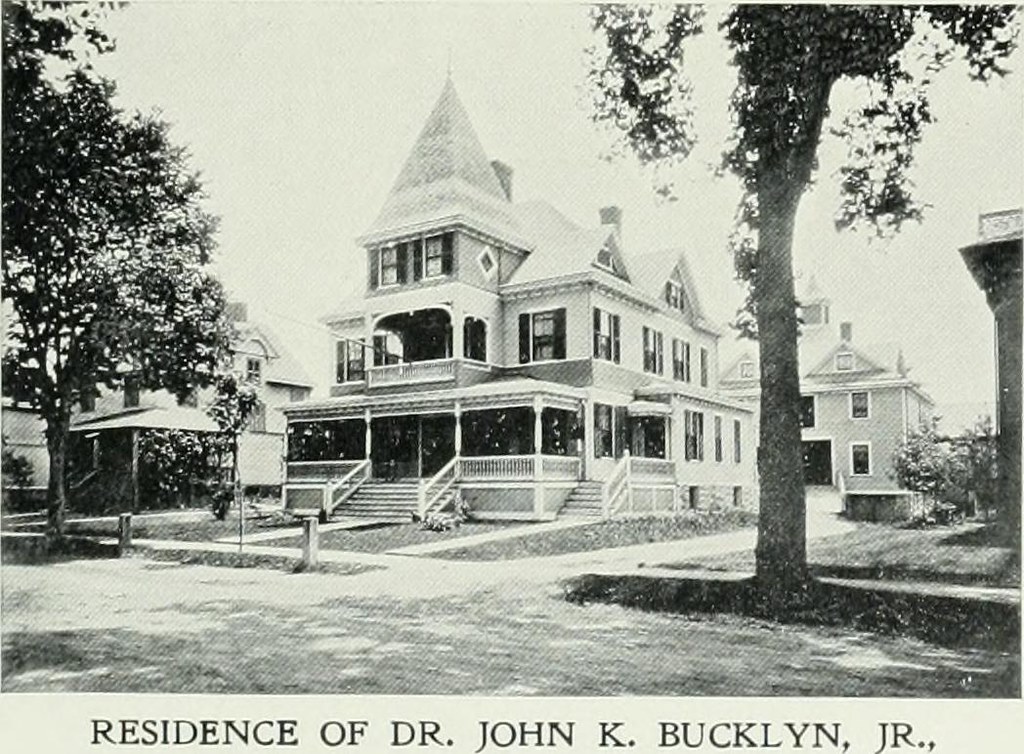
Dr. John K. Bucklyn, Jr. was the son of John Knight Bucklyn (1834-1906), a Civil War veteran who in 1899 earned the Medal of Honor for his action during the Battle of Chancellorsville on May 3, 1863. The senior Bucklyn was an educator who founded the Mystic Valley Institute in 1868. His two sons both attended the Institute and then the New York Medical College to became doctors. Dr. J. K. Bucklyn, Jr. built the house at 56-58 East Main Street in Mystic c. 1890. As described in Picturesque New London and Its Environs (1901):
The residence and offices of Dr. John Knight Bucklyn, Jr., one of its ablest physicians, are located on East Main Street, Mystic, and are connected by telephone. Dr. Bucklyn is a graduate of the New York Medical College, class of 1887, and of the Mystic Valley English and Classical Institute, J. K. Bucklyn, L.L.D., Principal. He has a large practice in Mystic, Stonington, Old Mystic, Noank, Poquonnock, and New London. He is a member of the Odd Fellows, and Medical Examiner for the Prudential Life Insurance Company, of Newark, New Jersey, and for the Knights of Pythias. His office hours are from 2 to 3, and 7 to 8 P. M. Dr. Bucklyn was born in Mystic July 31st, 1865, son of Professor John K. Bucklyn and Mary M. Young Bucklyn. On June 25th, 1891, he was united in marriage to Mary Emma Hall, of Mystic.

The house at 276 West Main Street in Cheshire is an eclectic Victorian house built c. 1879 by Irwin Tolles Guilford (1856-1881), a bookkeeper at the Cheshire Manufacturing Company. His father, Ralph Hall Gilford (1820-1886), was one of the founders of the company, where he worked as a die sinker for many years. Irwin T. Guilford died at the age of twenty-six. His son, Irwin M. Guilford, later became secretary of the Ball & Socket Manufacturing Company, created after a 1901 merger of the Cheshire Manufacturing Company and the Ball & Socket Fastener Company of New Hampshire.

Merry Christmas from Historic Buildings of Connecticut!
The house pictured above, with a silhouette nativity scene in front, is located at 100 Barbourtown Road in Canton. It was built in 1821 as a story and a half house by Uriah Hosford, who raised it to two full stories in 1850. Hosford was a deacon of the First Congregational Church in Canton Center. The house was later owned by Deacon Archibald Mills, a Civil War veteran and farmer, who had an apple orchard and grew broadleaf tobacco and hay. In 1891, Mills removed the house’s large stone chimney and fireplaces. In 1902, he added onto the house a photographic studio for his son, Lewis. The studio later became a kitchen after another son, Irwin, married Bertha Hosford. Irwin Mills grew Canton’s last tobacco crop c. 1946-1947.
Lewis Sprague Mills (1874-1965) was an educator with a lifelong interest in photography. Lame in the left leg after an injury at the age of three, Lewis wore a steel brace for the rest of his life, but still labored for his father as a full-time field hand. He later used photography to support himself through school at Columbia University, where he earned a bachelor‘s degree in education in 1908 and master‘s degree in school administration in 1912. Lewis S. Mills worked as a teacher and then as a school supervisor in Burlington and Harwinton, while also continuing to be an avid photographer of local scenes. He is particularly known for his collection of over 500 photographs of Connecticut school houses. After retiring he edited The Lure of the Litchfield Hills magazine and wrote The Story of Connecticut (1932). Lewis S. Mills High School, which serves Burlington and Harwinton, is named for him.
You must be logged in to post a comment.