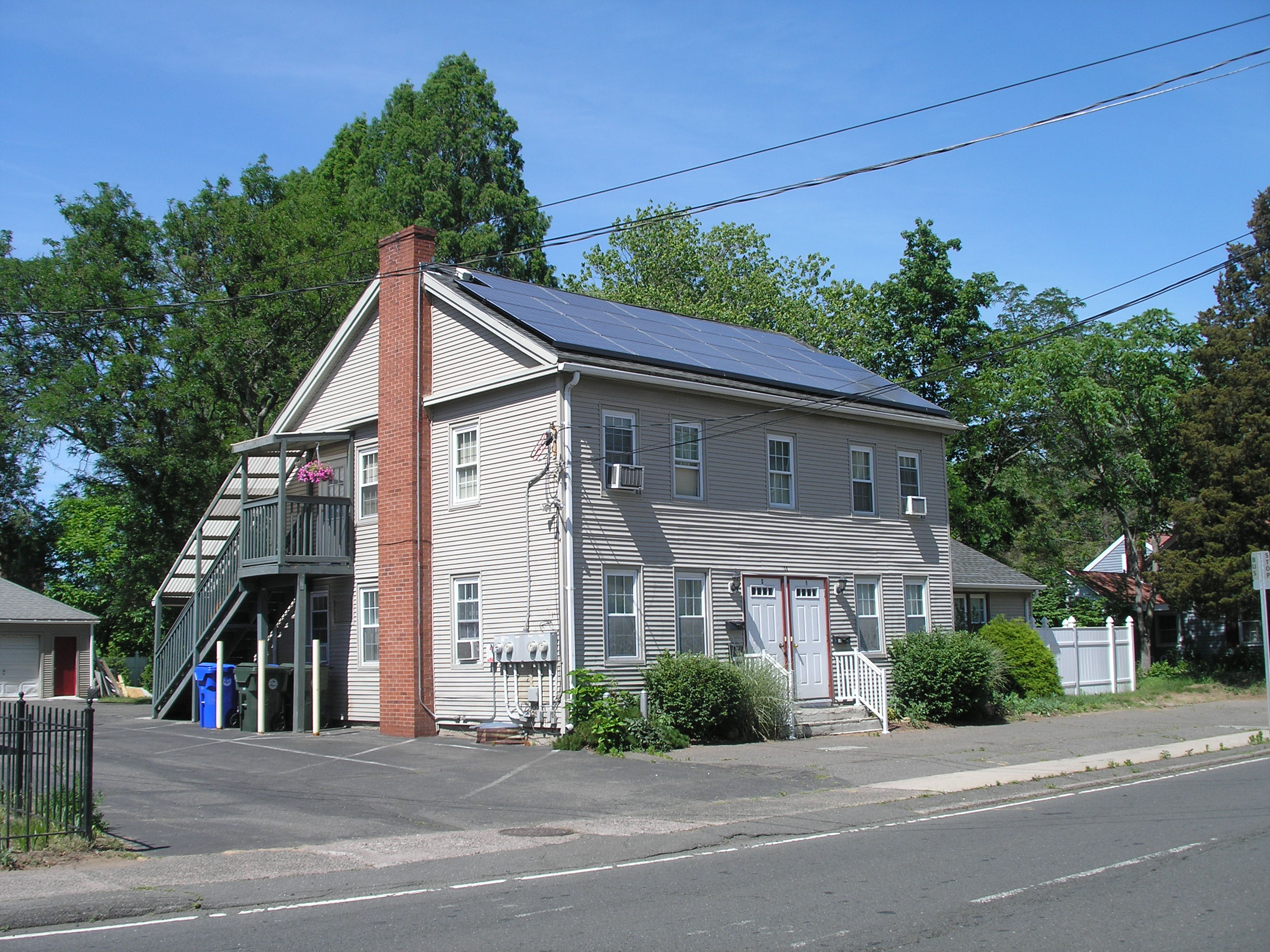
Sylvester Bailey House (1850)

In 1849, Sylvester Bailey purchased the land at 103 Main Street in Middlefield and a year later had built a house. Bailey, a gunsmith, established a nearby pistol factory with his partners, Henry Aston, Ira N. Johnson, John North, Nelson Aston, and Peter Ashton. Bailey died in 1864 and the house passed to his three sons, who sold it out of the family in 1866. Three Polish immigrant families then successively owned the house.

Caroline P. Root House (1860)

The nomination form for the Plymouth Center Historic District lists the house at 717 Main Street as a former ell of the Curtiss Hotel, known as the Quiet House. It gives a date of c. 1860, but I’m not sure if this is the date the ell was constructed or he date it was removed to become a separate house. It was the home of Caroline P. Root. Her son, Edward Root, lived with her. He was a carriage painter.

A. G. Martin House (1902)

The A. G. Martin House, built c. 1902 and now a multi-family home, is located at 27 Moss Street in Pawcatuck. According to the Legislative History and Souvenir of Connecticut, vol. VII (1909-1910):

Albert G. Martin, of Stonington (Pawcatuck), was born in Warwick, R. I., March 6, 1859. He is the son of John and Elizabeth Barnes Martin. His early days were spent at Carolina. R. I., receiving such education as the village school afforded. On September 30, 1882, he married M. Nettie, daughter of George F. and Mary E. Davis, to whom one son was born June 23, 1895. Albert G., Jr., and who deceased December 15. 1899. Mr. Martin removed to Philadelphia, Pa., in 1886, and engaged in mercantile life; assisted in organizing the Frankford Grocers’ Association, serving as president and director for years; being also identified with public matters and charitable enterprises; a most successful merchant and ardent Republican in politics Returning east in May, 1903. Mr. Martin located in Pawcatuck, town of Stonington, and has shown a deep interest in all public matters both civic and moral for town improvement. For several years Mr. Martin has served as financial secretary of the First Baptist Church, of Westerly. R. I., and is an active member and official of the Westerly and Pawcatuck Business Men’s Association and the Board of Trade. He is a member of the school committee of the Eighteenth School District and moderator of the Pawcatuck Fire District. Mr. Martin is closely associated with fraternal organizations, being a member of Pawcatuck Lodge No. 90. F. & A. M.. Palmer Chapter No. 26, Westerly Lodge of Elks No. 678, and Misquamicut Tribe of Red Men No. 19. Mr. Martin served on the Committee on Finance.

Atwater Homestead (1774)

The house at 242 Christian Street in Wallingford was built in 1774 by Caleb Atwater (1741–1832), a wealthy merchant who supplied the patriot forces during the American Revolution. It was located on the Atwater property, which was in the family for many generations. There is a secret passage behind the chimney inside the house, which was possibly a station on the Underground Railroad. The Atwood family property, which became known as Rosemary Farm, was later the childhood home and summer residence of Caleb Atwater’s granddaughter, Mary Lyman Atwater. She married Judge William G. Choate. In 1890, Mary Choate founded a school for girls at Rosemary Farm called Rosemary Hall. The school initially utilized another Atwater family home, no longer extant, that was built in 1758. Soon other houses in the vicinity were rented for the growing school. William Choate also founded the Choate School for boys in 1896. The two schools were neighbors, but remained separate entities. Mary wold host dances for students of both schools at the 1774 homestead. Rosemary Hall moved to Greenwich in 1900, but would move back to Wallingford in 1971 and merge with Choate in 1974. Choate had acquired the Atwater Homestead from Hunt Atwater, a nephew of Mary Atwater Choate in 1933 and it has served as a dormitory since 1936. The school undertook a major restoration of the building, known as Homestead, in 2006.

North West Center School, Guilford (1848)

Guilford‘s North West Center School, a one-room school house, was built in 1848. It originally had a columned portico with three steps leading up to the entrance. It served as a school until a consolidation of schools in town in 1871. An agricultural class was taught here in 1922, but the building, located at 85 Fair Street, is now a private home. It once sat further back on its lot, but was then moved closer to the street. The bay windows are also a later addition.