
The house at 141 North Cove Road in Old Saybrook was built in 1790 by John Bushnell. It was significantly remodeled in 1920.
The house at 141 North Cove Road in Old Saybrook was built in 1790 by John Bushnell. It was significantly remodeled in 1920.

Built circa 1850, the house at 726 Burnside Avenue in East Hartford was used by the Burnside Methodist Church (now New Covenant Methodist Church) across the street as a parsonage from the 1910s until 1944, when it was sold to private owners. The house is a variation on the typical Greek Revival form, with the front entrance being located on the ell, rather than on the main block.

On the western edge of the village of Rockfall in Middlefield is a Greek Revival house at 51 Derby Road at the corner of Main Street. The house was erected c. 1840 by Lewis Miller, who had acquired the land in 1836 from Jane W. Baldwin. Lewis was the son of Giles Miller and the grandson of Deacon Giles Miller, an early settler of the area. The house remained in the Miller family until 1893.

The house at 1 Broad Street in Guilford was built in 1804 by architect-builder Abraham Coan for Abel Chittenden (1779-1816) on land that had been in the Chittenden family since 1639. After Abel’s death, his widow was in financial straits. She sold the house to Danforth Nettleton, who built the property’s unusual fence. In 1851, Abel’s son, Simon Baldwin Chittenden, returned to Guilford from New York, where he had made a fortune in the dry goods business. He bought back the old family homelot and developed the property into a landscaped summer estate. Behind the house he built a stone water tower, called Cranbrook Tower. Chittenden also added a Queen Anne-style front porch to the house, which was later removed, and a rear wing for a ballroom. He named the house at 1 Broad Street “Carnbrook,” after the place in England from which his ancestor, William Chittenden, had emigrated. He also purchased the house next door, at 29 Broad Street, which he named “Mapleside.” The house at 1 Broad Street remained in the Chiitenden family until 1968.

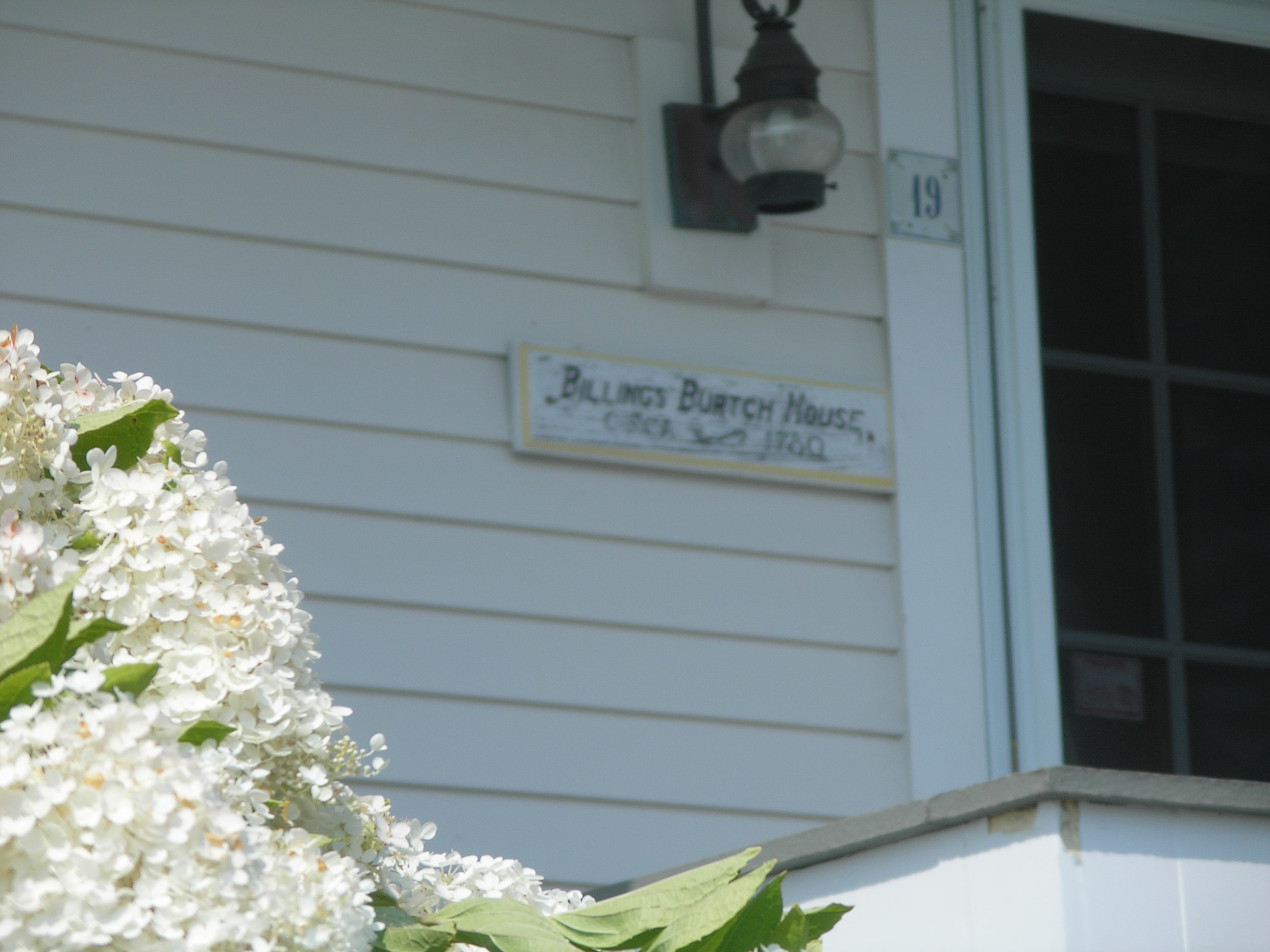
The Billings Burtch House, located at 19 Nothwest Street in Stonington, was built circa 1780. The house may be named for Sgt. Billing Burtch (1746-1836). Grace Denison Wheeler describes the house in her 1903 book, The Homes of Our Ancestors in Stonington, Conn.:
The Billings Burtch house formerly stood where Mr. Peleg Hancox built his fine new house on Water Street, but about 1850 it was moved from there to the corner of Water and High Streets by Mr. Ezra Chesebrough, who purchased it and placed it where it now stands. It was some three feet or more above the road bed, with its yellow front door facing south, the approach to which was by some rambling stone flags, or slabs, about four or five inches thick, and placed as they were broken out with neither form nor comeliness. At one time the house was tenanted by George Howe, who was sexton and tithing-man at the old Baptist Church, and at another time Mrs. Elias Gallup, sister of Mrs. Ezra Chesebrough, lived there and had a millinery store. According to an old letter found, Mr. Billings Burtch died in this house aged ninety-two years.
The house must have been moved again to its current address.

Ransom Hudson (1810-1871) was a farmer and shoemaker in Oxford who also served as postmaster and Justice of the Peace. He built the house at 434 Oxford Road in Oxford for his mother, Mary Clark.

The house at 67 Church Street in East Hartford was built as a five-bay Federal-style house by Stephen Cadwell shortly after he bought the land in 1822. He sold it just a few years later. The sixth bay to the north was added c. the 1870s. The bay window on the south end was also added later.
You must be logged in to post a comment.