Seabright Cottage (1877)

The house at 174-176 Seabright Avenue in the Black Rock section of Bridgeport has a sign that names it “Seabright Cottage.” The Bridgeport assesor’s field card gives it a date of 1877. The building is listed in the Black Rock Historic District as one of two “William Nichols Tenament Houses” built in 1894 (the other being at 181 Brewster Street). They were located next to Nichol’s businesses: the Nichols Hotel and the General Store.

Ambrose Hine House (1760)

Ambrose Hine acquired land at what is now 118 Cook Road in Prospect, c.1755-1757. The property record card for the Ambrose Hind House lists a date of 1760. The house does not appear in land records until 1794. Ambrose Hine (born 1726) served in the Revolutionary War as captain of the 5th battalion in James Wadsworth’s Brigade, which was with Washington at the Battle of Long Island on August 27, 1776. Highland Greens Golf Course in Prospect is located on land that Capt. Hine once farmed and he built many of the stone walls that survive on the property.

Munsill-Bronson House (1857)

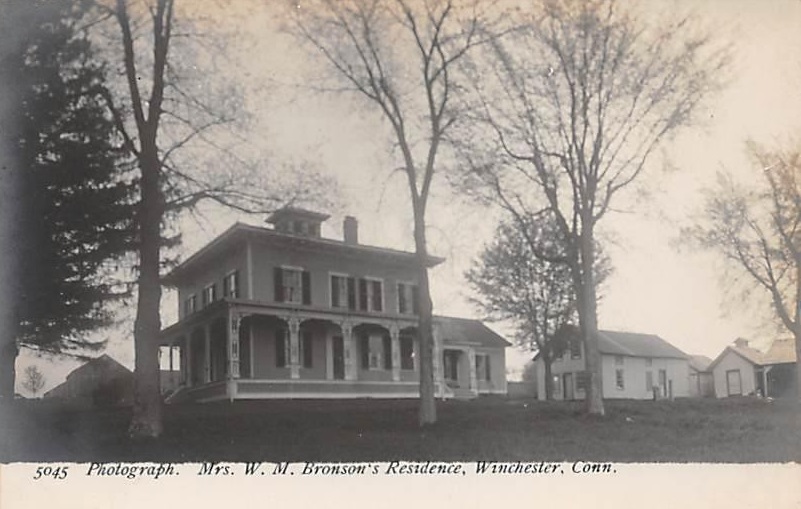
A sign next to the Italianate house at 147 Chapel Road in Winchester Center indicates that it was built in 1857 by Miles Samuel Munsill, who later sold it to his cousin, Wilbur Bronson, Winchester Postmaster. Munsill’s aunt Maria married Theron Bronson. Their son was Wilbur Munsill Bronson (1848-1903), who ran the Bronson Supply Company on the village green and a lumber company in Winsted. He was postmaster from 1885 until his death in 1903.

Dr. Jeduthan Eaton House (1790)

The house at 85 Tolland Green in Tolland was built circa 1790. From 1839 to 1878 it was the home of Dr. Jeduthan Eaton, whose medicine shop was located in an attached ell that has since been removed. Between 1850 and 1853, Dr. Eaton was mining for gold in California. His letters home to his family have been published by the Tolland Historical Society. In the early twentieth century, the property was a boarding house known as Squirrel Lodge. In 1964 the house became the rectory of St. Matthew Roman Catholic Church.

Milo Burr House (1827)

The house at 41 Burr Mountain Road in Torrington has a sign indicating it was built by Milo Burr in 1827. Milo Burr (1797-1872), is described in the The Torrington Register Souvenir Edition: An Illustrated and Descriptive Exposition of Torrington, Connecticut (1897):

Milo Burr, a native of Torrington and an energetic, hardworking and enterprising man, did a great deal at the time of the building of the Naugatuck Railroad. He also purchased timber lands where Burrville now stands, engaged in the lumber business, cutting pine timber in the vicinity and reducing it to lumber, used two or three sawmills in this business and owned several hundred acres of land. He erected many buildings and built a dam, making a reservoir on the mountain west of Burrville at an elevation of 250 to 300 feet above the residence, and also had large farming interests.

John M. Burr resides in the house his father erected in 1827, and maintains the old family homestead. He has erected and operates a grist mill, and has continued to make improvements in harmony with his father’s spirit and work.

The house, grounds, stables and everything about the place indicate thrift and good keeping, and the recent donation by Mr. Burr of a site for the power and car house of the electric railway, practically making the place a center, shows the public spirit of the man and must lead to an appreciation of property in the vicinity as well as add new life to the place.

Starr Cottage (1885)

The house at 144 South Street in Litchfield was built in 1885 by Almon B. Fuller, a furniture dealer and real estate speculator, who immediately sold the house to F. Ratchford Starr, who also owned the William F. Baldwin House immediately to the south. The two houses were known as the Starr Cottages. An insurance salesman and seasonal resident from Philadelphia, Starr had begun a highly successful dairy farm in Litchfield called Echo Farm in the 1870s. Starr also wrote several books, including Farm Echoes (1886) and The Lamb of God (1888). He sold the business in 1887 and died in 1889, his daughter inheriting the two houses. She willed the houses to Florence Frost, who resided in the Baldwin House until her death in 1923. In 1914, Frost sold the house at 144 South Street to Kate J. Thomas of New York City, who lived in it until her death in 1928. The house was acquired by Melvin Diems in 1949.