Elisha Case House (1806)

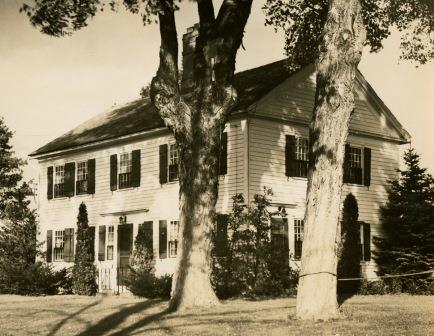
Deacon Elisha Case (1755-1839) built the house at 45 Lawton Road in Canton in 1805-1806. Elisha Case is one of the founding fathers of the town of Canton because he signed the petition to make Canton a separate town from Simsbury in 1806. His house was later owned by George Mills, Newell Minor (c. 1855) and by 1869 by Wells Lawton (1830-1898), who married Eliza Higley. It was then the home of Wells’ son, Fred Lawton, who was born c. 1870. Lawton’s widow, Helen Gilbert Lawton, lived in the house for many years after his death. In 1919, Fred Lawton urged his friend, James Lowell, Sr., to purchase the Higley farm. Lowell would build the Canton Public Golf Course there in 1931.

Elijah Barber House (1800)

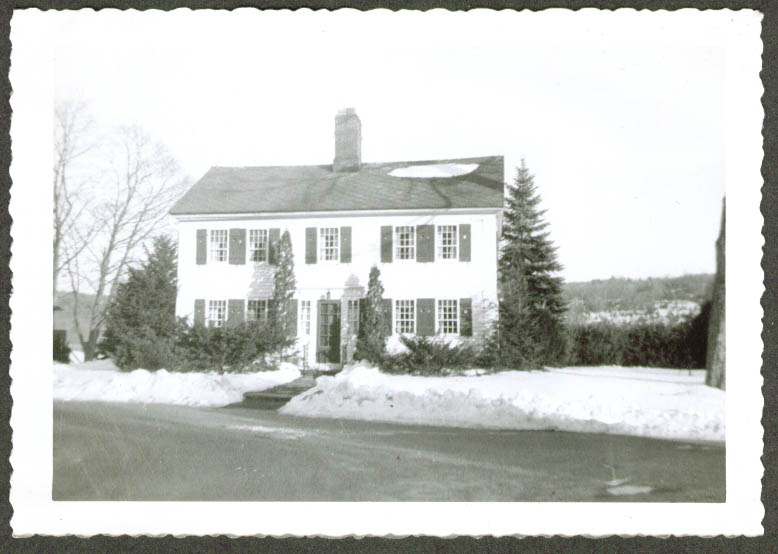
The house at 59 Barbourtown Road in Canton was built in 1800 by Elijah Barber (1748-1820). Elijah’s son, Daniel, raised the house higher and Daniel Hiram, a later owner, added an ell. In the 1830s, when there was a boom in raising silk worms, a silk worm house, or “cocoonery,” was erected on the property. In 1844 a disease struck the mulberry trees in Connecticut that fed the worms and the industry failed. The silk worm house was replaced by a barn, which later became a residence. Roy C. Webster, who had been a “Yankee Peddler” in his youth, bought the Barber House in 1926 and restored it.

Elisha H. Holmes, Sr. House (1840)

The house at 16 Main Street in South Windham was built c. 1840 by Elisha H. Holmes, Sr. (1799-1886). As related in Vol. I of the Commemorative Biographical Record of Tolland and Windham Counties (1903), Holmes

came to Windham in 1818, and followed his trade of cabinetmaker, also engaging in farming. Later he had a grist and plaster mill at South Windham. At one time he engaged largely in dredging operations, both in salt water and the Great Lakes. His death, which occurred Sept. 21, 1886, was regarded as a loss throughout the community. In politics he was a Democrat, and he represented the town of Windham in the State Legislature, also holding local offices. His wife, Lydia, was a daughter of Amos Dennison Allen, a cabinet—maker of Windham, with whom Mr. Holmes learned his trade.

In 1833, Elisha H. Holmes inherited land from his in-laws, the Allen family, which he sold to George Spafford, a partner in Spafford, Phelps and Co., which made paper manufacturing machines. The company failed after the Panic of 1837 and was acquired by Charles Smith and Harvey Winchester. In 1837 and 1838, Holmes sold additional land to the new partners, who were expanding the company. In 1872, Holmes built a house for his son, Elisha H. Holmes, Jr., at 4 Main Street in South Windsor.