Built in 1788-1789 on Main Street in Wethersfield, adjacent to the Joseph Webb House, for the leather worker Isaac Stevens. Joseph Webb, Jr was greatly in debt after the Revolutionary war and sold the land to Stevens, whose house follows a similar Georgian design to that of the Webb House, but on a smaller scale and without a gambrel roof. Title to the house was conveyed to the Colonial Dames in 1945 by its last resident, Jennie Andrews, to prevent its being torn down (note the proximity of the commercial building to the right of the house). After Mrs. Andrews’s death in 1958, the Dames restored the house, opening it to the public in 1963. The Isaac Stevens House, together with the Joseph Webb House and Silas Deane House, today comprise the Webb-Deane-Stevens Museum.
Built on Main Street in 1788-1789 for East Windsor Hill’s leading merchant, John Watson. This Adam style house, with a Palladian window and classical proportions, was designed by the architect and builder Thomas Hayden of Windsor. It is the oldest three-story mansion surviving in the Connecticut River valley and resembles the great Federal period mansions built for the wealthy merchants in New England’s coastal cities. It has recently been opened as a bed-and-breakfast.
Built on Main Street in Hartford for Dr. Daniel Butler in 1782. Butler had a medical practice and managed mills that his wife, Sarah Sheldon Ledyard, had inherited from her first husband. Their son, John, and his wife, Eliza Lydia Royce Sheldon, added the Greek Revival Portico. In 1865, John and Eliza’s daughter, Eliza Sheldon Butler, hired landscape architect Jacob Weidenmann to design the garden behind the house. The next year, she married John James McCook, one of the famous Civil War Fighting McCooks. For 60 years, Rev. McCook was volunteer rector of Saint John’s Episcopal Church in East Hartford and he later taught at Trinity College. He also did important sociological work in his studies of homeless people.
Rather than abandon a changing Main Street, as so many of the other long-established families were doing in the later nineteenth century, the McCooks remained, instead accommodating their growing family by expanding their attic into a third floor of bedrooms. In 1897, their son John, a doctor, added an office to the house for his medical practice. His sister, Frances A. McCook, was the last of the family to live in the house. When she died in 1971, she left it to the Antiquarian and Landmarks Society, and the house is open to the public as the Butler-McCook House & Garden and Main Street History Center.
Informative articles on the house and its residents have appeared in Antiques and the Hog River Journal.
Built in 1804 on Main Street in Wethersfield for Captain John Hurlbut, who had served on the Neptune, the first ship from Connecticut to sail around the world. In the 1850s, a later owner added Italianate features to this brick Federal style house. These additions include the projecting cornice with brackets, the entry portico, side veranda, and belvedere tower. Jane Robbins Dunham left the property to the Wethersfield Historical Society and it is now a historic house museum.
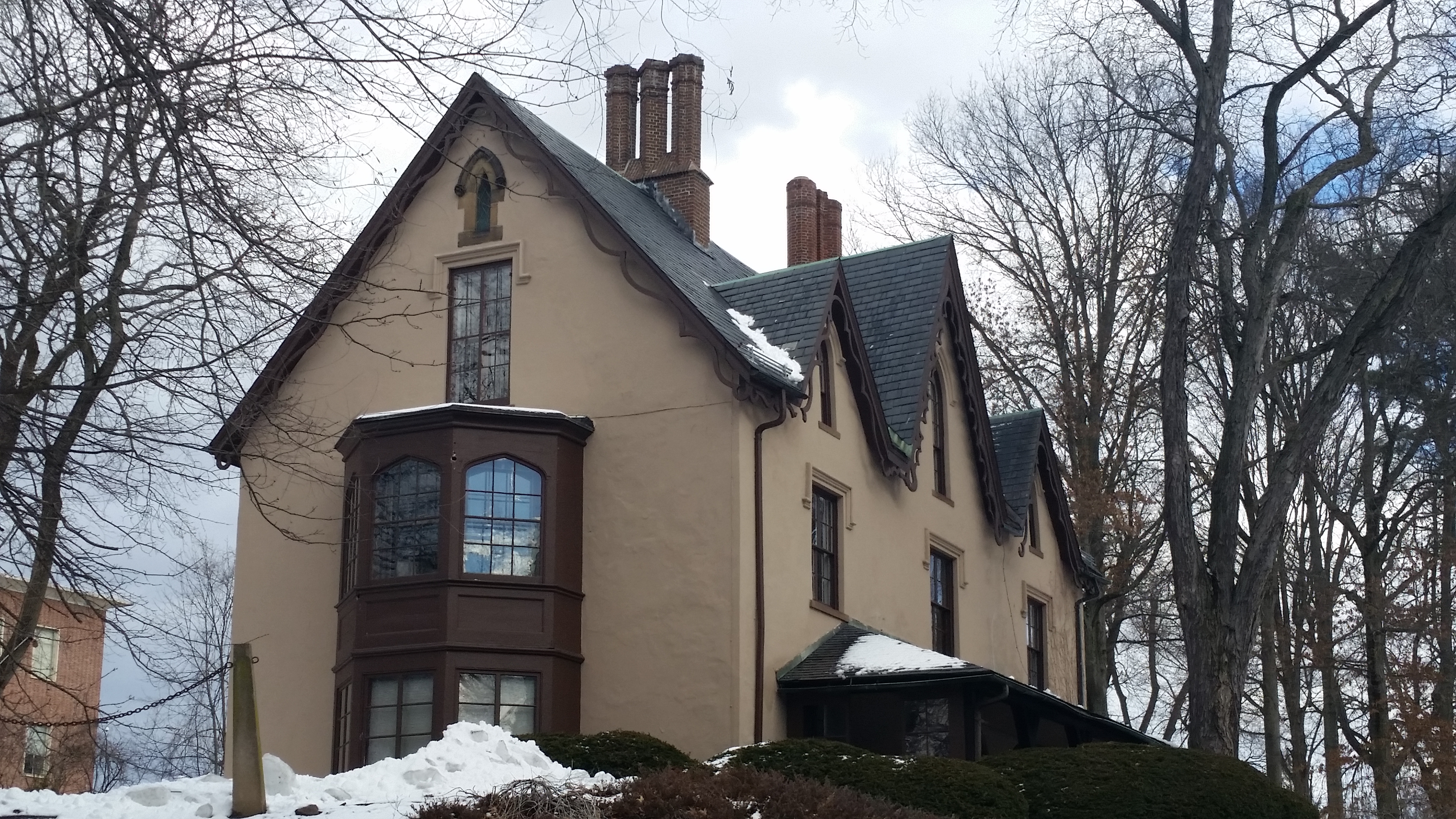
A Gothic Revival villa, built in 1861 on Hartford’s Woodland Street for Charles Perkins, who was Mark Twain’s lawyer. Perkins was the son of Mary Beecher Perkins, an older sister of Harriet Beecher Stowe and Isabella Beecher Hooker. The house’s architect, Octavius Jordan, also created homes for these three Beecher sisters in the nearby Nook Farm neighborhood. Of these, the Thomas Clap Perkins House (1855), which was later the childhood home of Katharine Hepburn, and Harriet Beecher Stowe’s “Oakholm” (1864) were both later torn down, but the John and Isabella Beecher Hooker House (1861) survives as an apartment building. The Perkins-Clark House was bought in 1924 by Probate Judge Walter Clark. Today it serves as the offices of an architectural firm.
Built next door to the Webb House, on Wethersfield’s Main Street, in the late 1760s for Silas Deane, a Yale educated lawyer from Goton who settled in town in 1762. Deane married Mehitable Nott Webb, the widow of the merchant Joseph Webb, in 1763 and their son, Jesse Deane, was born in 1764. Because Mehitable died in 1767, it is probable she never lived in the Deane House. After her death, Deane married a second wealthy widow, Elizabeth Saltonstall Evards, in 1769. Deane became involved in the American Revolution, serving as a delegate to the Continental Congress. In 1776, he was sent to France on a mission to secure French aid. Later joined by Benjamin Franklin and Arthur Lee, Deane worked well with the former in negotiating an alliance with the French, but clashed with the latter. Lee’s charges that his colleague had mismanaged funds eventually led to Deane’s recall.
After a dispute with Congress, Deane returned to Europe in 1781, where he lived in poverty for many years. He later died in mysterious circumstances in 1789 before he could complete his return journey to America. By then his reputation had been severely damaged by Lee’s accusations and by the publication of private letters in which Deane had questioned the Revolution and considered rapprochment with Britain. He had never been found guilty of Lee’s charges and in 1842 was exhonorated by Congress.
His house was acquired by the Colonial Dames in 1959. After undergoing a historic restoration, it opened to the public in 1974, as part of the Webb-Deane-Stevens Museum. The museum has created a website, Silas Deane Online, which features images, a timeline, exerpts from primary sources relating to Deane, and a virtual tour of the house. He was also discussed last year in the Hartford Courant.


You must be logged in to post a comment.