The Coite-Hubbard House (1856)

coite-hubbard-house.jpg

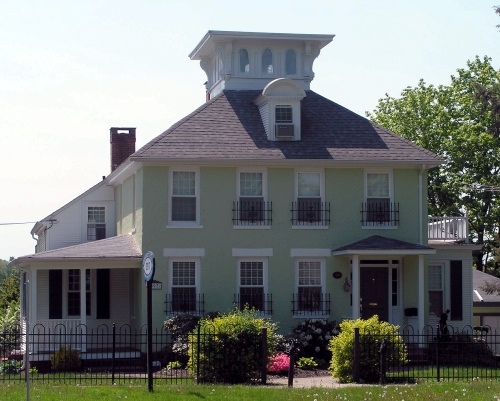
The building which now serves as Wesleyan’s President’s House was originally built in 1856 for Gabriel Coite, who became a state senator in 1860 and moved to Hartford in 1862, when he became the State Treasurer. In 1863, his Italianate house on High Street in Middletown was sold to Mrs. Jane Miles Hubbard, the widow of Samuel Hubbard, who had been a US Postmaster General. Wesleyan University acquired the Coite-Hubbard House from her heirs in 1904 to become the new President’s House, replacing the first building used for that purpose.

The Horace B. Cheney House (1895)

horace-cheney.jpg

One of the Manchester mansions of the Cheney family of Silk Manufacturers, the Horace B. Cheney House was built in the mid-1890s. It has a Forest Street address and is also adjacent to the “Great Lawn,” where many of the mansion are located. Horace B. Cheney was the son of Frank Woodbridge Cheney and Mary Bushnell Cheney, the daughter of Horace Bushnell. His brothers were Ward, Howell, Austin and Frank D. Cheney.

Edward Savage House (1837)

Edward Savage House

The Greek Revival-style home of Edward Savage, on Main Street in Cromwell, was built in 1837. Savage had inherited half of his father’s farm and then bought the other half from his brother. He was also involved with manufacturing, founding the Savage Revolving Firearms Co. in 1858. The house was later significantly altered, with the addition of the cupola, porches and a new wing on the north side. Some of these changes were probably in response to the popularity of the Italianate style on Cromwell’s Main Street in the 1850s and 1860s.

The Bradford-Huntington House (1705)

jabez-huntington.jpg

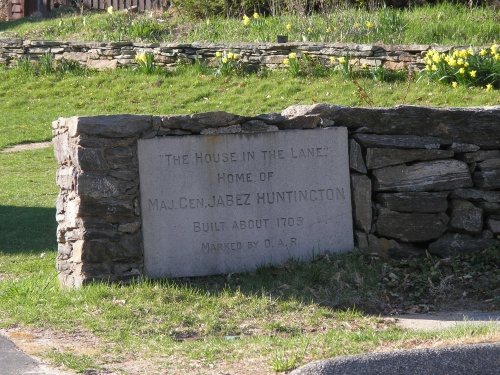
A portion of what would later be known as the Bradford-Huntington House was built in Norwich on the home lot of John Bradford sometime prior to 1691 (perhaps as early as 1660, although a D.A.R. marker on the property gives the date as 1705). The house was bought by Capt. Joshua Huntington, a merchant, in 1719 (or by his father, Simon Huntington, in 1691). In later years he would enlarge and update the house in the Georgian style, adding a gambrel roof and a new chimney. The house was later owned (1745), and expanded with the addition of a rear ell, by his son, Jabez Huntington, who became Major General of the Connecticut militia in 1776, the same year George Washington spent a night in the home during the Revolutionary War. Later, Huntington experienced mental strain from his efforts and resigned in 1779. He died in 1786 and is buried near his house in the Old Norwichtown Cemetery.

The Hurd House (1660)

hurd-house.jpg

The Hurd House in Woodbury is a combination of what were originally two smaller houses. The older, north section, dates to around 1680 and was the home of John Hurd, who became the town’s miller in 1681. The south section, which may have originally been the home of Hurd’s son, was added to the older structure in 1718, to increase the overall size of the house. The two original houses were of the end-chimney type, while the structure resulting from the combination has a central chimney. By 1779, a lean-to was added, making the house a saltbox, although this was later removed. In 1967, the house was acquired by the Old Woodbury Historical Society.

A new feature is being launched today at Historic Buildings of Connecticut. I plan to do a series of articles discussing some of the different architectural styles found in Connecticut. I will be using buildings which have appeared on this site as examples, sometimes with different photos than those which have appeared here before. The first of these articles is on Colonial Houses, which can be found at the url address:
https://historicbuildingsct.com/?page_id=502. This and later articles to come will be indexed on the Architecture page (also listed in the bar above the site banner), so please check there for future additions!