Henry Dwight Bradburn House (1900)

bradburn.jpg

A Queen Anne style home, which also features elements of the Gothic Revival, Shingle and Colonial Revival styles, the Henry Dwight Bradburn House, on Prospect Avenue in Hartford, is an eclectic mix. The house dates to 1900, the year Bradburn retired as manager of the Nonotuck Paper Company of Holyoke, Mass. The house bears a strong resemblance to the W. F. Clark House in Springfield, Massachusetts.

Burdett Loomis House (1885)

burdett-loomis.jpg

This week we look at houses on Prospect Avenue, the border between Hartford and West Hartford. An eclectic mix of large houses were constructed here in the later nineteenth century. One of the earliest is that of Burdett Loomis, an inventor and manufacturer of gas plant machinery. A civic leader in Hartford, in 1873 he also opened a trotting horse park on New Park Avenue. This would later evolve into Charter Oak Park, which early in the twentieth century would feature Luna Park, a popular amusement park. In the late nineteenth century, Prospect Avenue was considered to be in the countryside, and around 1885, Loomis bought a c. 1845 Greek Revival farmhouse and transformed it into his country estate by adding a new Queen Anne-style section on the front.

Daniel Chadwick House (1830)

daniel-chadwick-house.jpg

The Daniel Chadwick House, on Lyme Street in Old Lyme, was built in 1830 in the Greek Revival style and includes a widow’s or captain’s walk. It was the home of a notable sea captain involved in trade with London. He died tragically by taking his own life in 1855. Chadwick‘s son, also named Daniel Chadwick, was a notable lawyer. The bays and porches on either side of the house are later additions. The house is also currently for sale.

John Sill House (1817)

sill-house.jpg

Located further south on Lyme Street in Old Lyme from the house of William Noyes, Jr. is a house built the same year (1817) and designed by the same architect (Samuel Belcher). The Federal style house, whose original carpenters were shipbuilders, was constructed for John Sill, a “customs runner” who secreted his smuggled goods in hidden closets in the house. With Sill’s arrest in 1820, the house was bought by William Noyes and in 1822 by Charles Johnson McCurdy, a Yale graduate, politician, ambassador and judge. In 1944, an extensive restoration was undertaken by owner C. Whitney Carpenter with the local architect, Robert I. Carter, who later bought the home. In 1983, the house was sold by Carter’s children to the Lyme Academy College of Fine Arts. It now houses offices and gallery space. More information can be found in this pdf file of River and Sound.

Dr. Richard Noyes House (1814)


noyes-house.jpg


Across Lyme Street in Old Lyme from the Bee and Thistle Inn is the house Joseph Noyes had built for his son, Dr. Richard Noyes, in 1814, the year Richard married Martha Noyes of Stonington. The Colonial Revival dormer windows were added in 1922. The house remained in the Noyes family until the 1930s. From 1939 to 1946, the house was home to the Madison Military Academy, a college preparatory school for boys. Afterwards it was the White Farms Inn and is now a private residence.

Bee and Thistle Inn (1756)

bee-and-thistle.jpg

North of the house of William Noyes, Jr. (now known as the Florence Griswold House), on Lyme street in Old Lyme, is the house built in 1756 for his father, Judge William Noyes. Judge Noyes was himself the grandson of Rev. Moses Noyes, Lyme’s first minister. Originally located right next to the road, the house was moved back and restored by the Hodgson family around 1900 in keeping with the ethos of the Colonial Revival. The house’s front portico and end porches are also twentieth century additions. In the 1930’s, the house was owned by a widow, Henrietta Greenleaf Lindsay, who followed the advice of her friend, the actress Elsie Ferguson, in converting the house into an inn. It was named the Bee and Thistle Inn to honor her, as those are the symbols of the Ferguson Clan in Scotland. The Inn is still in operation today.

Florence Griswold House (1817)

flogris-house.jpg

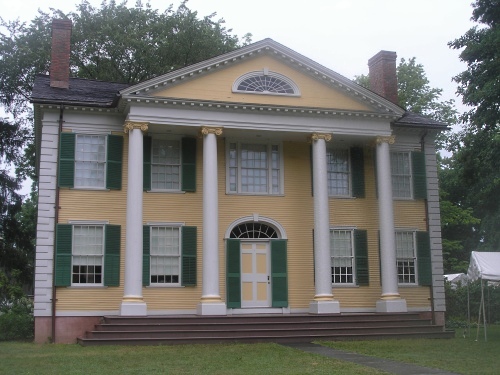
This week we will look at some notable buildings on Lyme Street in Old Lyme. The most famous residence on the street is the Florence Griswold House. Originally built in 1817 for William Noyes, Jr., a son of Judge William Noyes, the house was designed by Hartford builder Samuel Belcher, who was already at work on Old Lyme’s Congregational Church. In 1839, the house was sold to Richard Ely and in 1841 to the sea captain Robert Griswold. His daughter, Florence Griswold, was born in 1850. “Miss Florence” and her sister Adele inherited the house but, left in a precarious financial position, had to take in borders. In 1899, artist Henry Ward Ranger boarded at the house and soon encouraged other artists to stay there. In the following years, a number of notable American Impressionist painters made the home the center of an artist’s colony. The artists included Childe Hassam, Willard Metcalf, Matilda Browne, William Robinson and many others. Several of the artists painted panels in the house’s dining room.

By the 1930s, Florence Griswold was in debt and her property was sold, although the land’s new owner, Judge Robert McCurdy Marsh, who built a new house, allowed her to live in the old house until her death in 1937. In 1941, the house was purchased by the Florence Griswold Association and opened as a museum in 1947. In recent years, the Florece Griswold Museum has expanded, with the gift of the Hartford Steam Boiler and Inspection Company’s art collection in 2001, the construction of the Krieble Gallery in 2002 and the 2005-2006 restoration of the house, which is furnished as it would have been in 1910 at the height of the art colony. Edit: I’ve replaced my earlier image of the house with a new one!