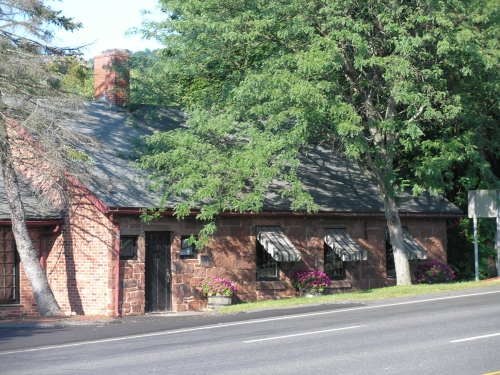
Peck Tavern (1680)


peck-tavern.jpg


The Peck Tavern, where George Washington once danced, is located where Sill Lane branches off from US 1 in Old Lyme. It may have been built as early as 1680, although the main block achieved its present form by about 1769, when John Peck acquired the tavern. The building served as an inn and tavern from the mid-eighteenth century into the nineteenth and remained in the Peck family until 1904. In the 1930s, the building was used by the Old Lyme Guild, a non-profit arts and crafts organization.  In recent years, the house served as a bed & breakfast.

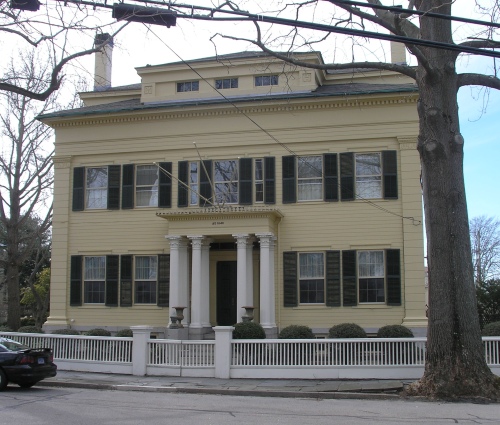
The William Pendleton House (1831)

william-pendleton.jpg

The William Pendleton House, on Main Street in Stonington Borough, is a Greek Revival style house, which retains elements of the Federal style. It was built after 1831 (perhaps as late as 1840) for Pendleton, who was a merchant. The gable may have been added later. During Prohibition, the house’s basement was used as an illegal bar, or speakeasy, and the period decor and original bar have been preserved by later owners.

Avon Old Farms Inn (1757)

avon-old-farms.jpg

The oldest section of what is now the Avon Old Farms Inn, at the intersection of Routes 10 and 44 in Avon, is a house built by Nathaniel North in 1757, on land which had been granted to his father, Thomas North, after his service in King Phillip’s War. Thomas’ father, John North, had arrived in the vicinity of Northington (the north part of Farmington, now Avon) in the 1630s. The house was later owned by Nathaniel North‘s great-grandson, John North, a blacksmith who added the 1832 stone blacksmith shop, which is now connected to the house. Across Route 44, once stood Marshall Tavern, a former stagecoach stop, which was demolished in 1933 to improve traffic safety at the intersection. The North House was also used to accommodate travelers, becoming the Old Farms Inn in 1923.

The John Johnson House (1840)

john-johnson.jpg

The John Johnson House, a large Greek Revival home, was built around 1840 on Broadway in Norwich. Johnson’s father was a president of the Norwich Bank. Later residents included a Dr. Linnell and Henry E. Bourne, who taught history and psychology at the Norwich Academy from 1889 to 1892. Later, Bourne joined his brother and former roommate at Yale, Edward Gaylord Bourne, as a professor of history at Western Reserve University. Henry Eldridge Bourne wrote articles and books, including A History of Mediæval and Modern Europe, The Teaching of History and Civics in the Elementary and the Secondary School, A History of the United States and The Revolutionary Period in Europe. The house, which originally had a center-hall plan, was later subdivided into five apartments.