Timothy Starkey, Jr. House (1800)

47 Main Street Essex

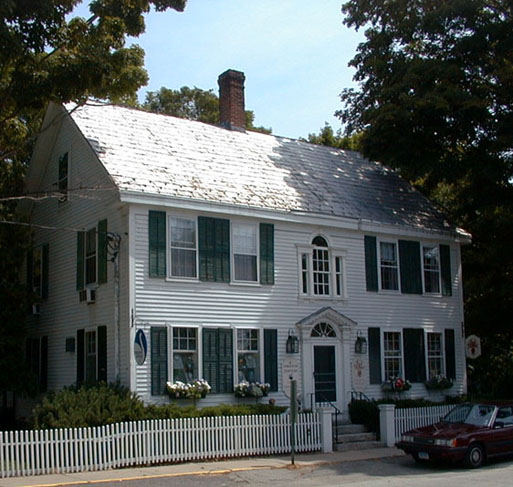
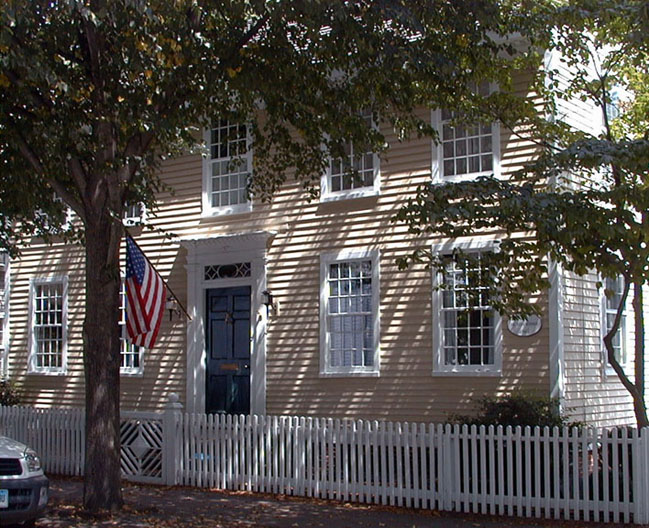
Timothy Starkey, Jr.’s house in Essex was built in 1800, when he leased land from Samuel Lay to build his home on the corner of Main Street and Ferry Street (the latter street being laid out in the 1820s, after the house was constructed). Starkey later bought the land and property extending along Main Street to the wharf, developed Pratt Street and was involved in various business ventures. Timothy Starkey married his cousin, Mary Ann Hayden, a daughter of Uriah Hayden. Starkey owned the Hayden-Starkey Store with his brothers-in-law, Samuel Hayden and Ebenezer Hayden II. Timothy’s brother, Felix Starkey, lived next door to him and married Esther Hayden, who was also a daughter of Uriah Hayden. The house later passed to Timothy’s daughter, Phoebe, who had married William S. Hayden. The house remained in the family until 1974 and is is now used for businesses.

(more…)

Joseph Arnold House (1765)


joseph-arnold.jpg


Joseph Arnold, not to be confused with the Joseph Arnold who lived in the Thankful Arnold House (although both men were descendants of the original Haddam proprietor, Joseph Arnold), built his home in the center of Haddam around 1765. Joseph’s son, Simon Arnold (1778-1867), occupied the house after his 1804 marriage to Alice Smith (1778-1834). The home was also occupied, from 1838 until his death in 1869, by Samuel Arnold, the son of Joseph and Thankful Arnold. Samuel Arnold served as a US Congressman from 1857 to 1859. The house, which was significantly altered in the nineteenth century but restored in the twentieth century, remained in the Arnold family until 1967.

Alfred C. Fuller House (1917)

alfred-c-fuller-house.jpg

In the 1920s, this 1917 Colonial Revival house on Prospect Avenue in Hartford, was occupied by Alfred C. Fuller, founder of the the Fuller Brush Company. Originally from Nova Scotia, Alfred Carl Fuller, the original “Fuller Brush Man,” emphasized door-to-door sellingFuller‘s memoir was titled, A Foot in the Door. The symmetrical house, which interestingly has non-symmetrical chimneys, was designed by William T. Marchant of Hartford.

Amasa Day House (1816)

amasa-day-house.jpg

The Amasa Day House in Moodus (in East Haddam) was built in 1816 by Colonel Julius Chapman, who farmed on the property. After his death, in 1842, the property was sold at auction and purchased by Amasa Day. In the following years, Day, who was an insurance agent and banker, sold off parts of the land. The house was inherited by his daughter, Katherine and her husband, Eugene Chaffee, who worked for the New York Net and Twine Company, one of several twine factories in Moodus. Their son was Dr. Amasa Day Chaffee, a well-known art photographer. The house was donated to Connecticut Landmarks in 1967 and is now a museum.

The Moses Andrews Homestead (1760)

Moses Andrews Homestead

The Moses Andrews Homestead, on West Main Street in Meriden, was built around 1760 by Sgt. Moses Andrews‘s father, Samuel Andrews III. Moses was a Tory and during the Revolutionary War, the house was used as the first Episcopal place of worship in Meriden, with Andrews later acting as Lay Reader. The house remained in the family until 1864 and was then used for various purposes over the years, including as a school. In 1933, the house was restored, as a W.P.A project, to become a school and museum. When the school board ceased to use the property, it again became a museum organized by the Andrews Homestead Committee (formed in 1940). The house was again restored in 1954 and is now operated by the Meriden Historical Society as a museum. (more…)

Epaphroditus Champion House (1794)

epaphroditus-champion-house.jpg

Epaphroditus Champion was the son of Col. Henry Champion, the primary purchasing agent for the Continental Army during the Revolutionary War. Father and son drove a heard of 300 cattle to feed the Washington’s soldiers at Valley forge in 1778. After the War, Epaphroditus Champion, who was a merchant, later settled in East Haddam and served as a U.S. Congressman from 1807 to 1817. The house he built in East Haddam, on a bluff which provides a view of the Connecticut River, is also known as The Terraces. Champion was the cousin and brother-in-law of the merchant Julius Deming of Litchfield. He hired William Sprats, the architect of Deming’s home, to recreate a similar house for himself in East Haddam. In 1940, the Champion House was purchased by the artist, Northam Robinson Gould, who restored it. According to John Warner Barber, in his Connecticut Historical Collections (1836), the house “is distinguished for its bold and lofty terraces, and is a striking object to travellers passing on the river.”