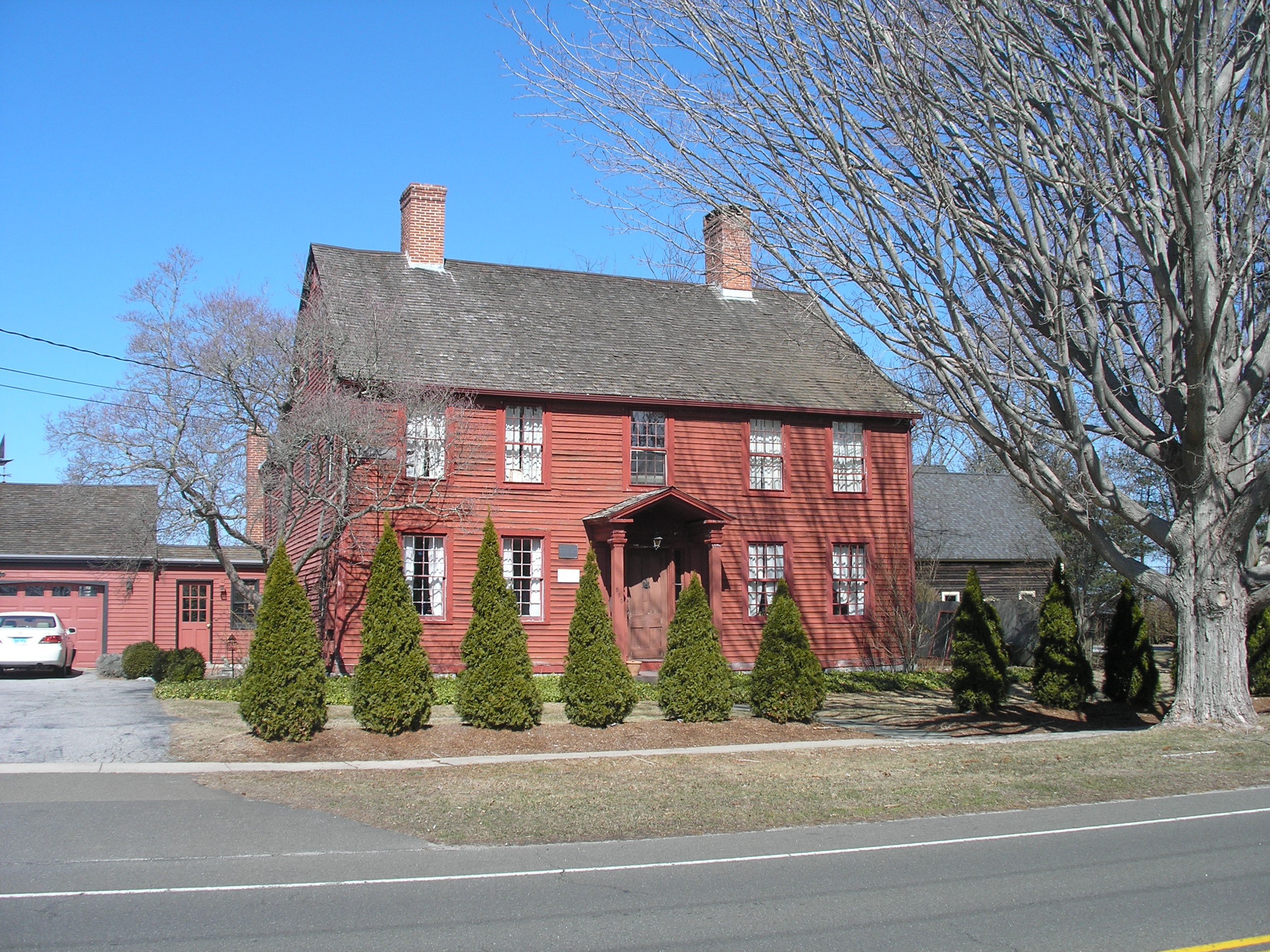
Dr. Sheldon C. Johnson House (1842)

dr-johnson-house.jpg

The home of Dr. Sheldon C. Johnson of Seymour is located at the intersection of West and Church Streets. This intersection could be called “Doctors Corner,” because doctors lived in each home at the four corners. Dr. Johnson settled in Seymour (then called Humphreysville) in 1825. He married Hannah Stoddard, the daughter of Dr. Abiram Stoddard, and the couple at first lived in an eighteenth century house, located behind the home Dr. Johnson later built in 1842. Dr. Johnson continued practicing medicine in the area into his 80s. The couple’s son, Charles Napoleon Johnson, became a lawyer.

Thomas Danforth House (1783)

danforth-house.jpg

Thomas Danforth II, who was based in Middletown, together with his sons, including Thomas Danforth III of Rocky Hill, were very successful Connecticut metalworkers. Five generations of the Danforth family, between 1730s and 1840s, were involved in metalworking and became famous for producing objects made of pewter and Britannia metal. The Danforth family business employed many peddlers, who sold their wares widely, with a focus on the southern states. Thomas Danforth III has been credited with establishing America’s first chain-store system, with branches in Philadelphia, Atlanta and Savannah. Having spent a number of years traveling between Connecticut and Philadelphia, where his son, Thomas Danforth IV would serve his apprenticeship, Thomas III returned to reside in his home in Rocky Hill. His house, built in 1783, is located at the corner of Glastonbury Avenue and Old Main Street.

Dr. Samuel Eliot House (1737)

Eliot House

According to tradition, the house at 500 Main Street in Old Saybrook was built by Dr. Samuel Eliot around 1737. Records indicate, though, that the house was built by Eliot’s brother, Dr. Augustus Eliot, who was also a physician. The house was likely not completed at the time of Augustus Eliot’s death in 1747. It was sold by his estate to Capt. Samuel Lord in 1749, who then sold it to his son-in-law, Capt. Jabez Stow, Sr. It was Capt. Stow who most likely finished the house. He later served as a lieutenant in the defense of Fort Griswold and was taken prisoner by the British. He died in 1785 and his son, Jabez Stow, Jr., was lost at sea in 1788. The house was then occupied by his daughter, Mary Stow, who had married Capt. David Newell in 1784. According to The History of Middlesex County (1884), “Capt. Newell was engaged in the slave trade, and was killed during a rising of the slaves on board his vessel” at the Island of Boa Vista, in the Cape Verde Islands in 1819. Sea captains’ families continued to live in the house until 1890. It remains a private residence today. (more…)

Stiles-Stoddard House (1795)

stiles-stoddard-house.jpg

The Stiles-Stoddard House in Seymour was built on the site of an earlier home, constructed by the son of a Pequot sachem, named Joseph Mauwehu, who was also known as “Chuse.” Joseph and his followers lived in an area of land known as Indian Hill, which was north of the Naugatuck River near the Great Falls. From around 1740, the Indians lived peacefully with the white settlers who were moving into the area, but eventually the newcomers numbers grew to an extent that made it difficult for the Indians to follow their traditional way of life. After living more than four decades in the area, Joseph then left with his tribesmen and moved to Kent, where their was a larger Indian reservation. Seymour was first known as Chusetown, named in honor of Chief Joseph. In 1795, Nathan Stiles built his house on the site where Joseph had lived, at a fork in the road, where today Pearl Street splits off from South Main Street. After Stiles’ death in 1804, his widow, Phebe Dayton Stiles, lived in the house and owned land on Indian Hill. Over the years, many people sought to buy her land, and to each of them she promised to sell it eventually, but these promises were so often repeated without her selling to anyone, that Indian Hill came to be known as the “Promised Land.” The house was later received by Dr. Thomas Stoddard as a gift from his father. In 1898, when C.H. Lounsbury owned the house, he raised and repaired the building, converting it into a two-family home.

Frank S. Brown House (1880)

frank-s-brown.jpg

The Queen Anne style house of Frank S. Brown, on Hartford Avenue in Wethersfield, was built sometime in the 1880s. Brown was a Hartford merchant who, in 1866, joined with James M. Thomson and William McWhirter to form the dry goods firm of Brown, Thomson & Co., which became a major New England department store. Brown retired from the company in 1890 and in 1893 the house was sold out of the Brown family. Ellsworth S. Grant, the Connecticut historian, former mayor of West Hartford and brother-in-law of Katharine Hepburn, was later born in the house. In 1920, Minnie Pricone and Mary Rometta, with their husbands and families, moved into the house. They owned the Marie Phillips Dress Company and tailoring work was done in the basement area of the house.

This blog has been featured on the Historical Home blog. Check it out!