Capt. James Monroe Buddington House (1854)

james-m-buddington-house.jpg

The 1854 Greek Revival home (with later Victorian additions) of Captain James Monroe Buddington, is on Monument Street in the Groton Bank neighborhood of Groton. Capt. Buddington was a whaling captain, famous for his recovery of the HMS Resolute. The Resolute was a British ship that, in 1852, was part of a four ship expedition sent to the Arctic to investigate the fate of the lost John Franklin Expedition, which had been searching for the Northwest Passage to Asia. The Resolute became lodged in ice in the Canadian Arctic and in 1854, after a year-and-a-half of being trapped, the ship was abandoned by her crew. Capt. Buddington, on the whaling ship George Henry, found the deserted Resolute, which had become freed from the ice and was drifting, having traveled nearly 1200 miles! He sailed the lost ship back to New London, arriving on Christmas Day, 1855. The US government restored the ship, which was returned to Britain and presented to Queen Victoria amid much fanfare. The Resolute would continue in service until 1879. When she was decommissioned, Queen Victoria had several desks made from her timbers and one was presented to President Rutherford B. Hayes in 1880. The famed Resolute Desk has been used by many presidents since then, frequently as the President’s desk in the Oval Office.

The Landers House (1910)

landers-house.jpg

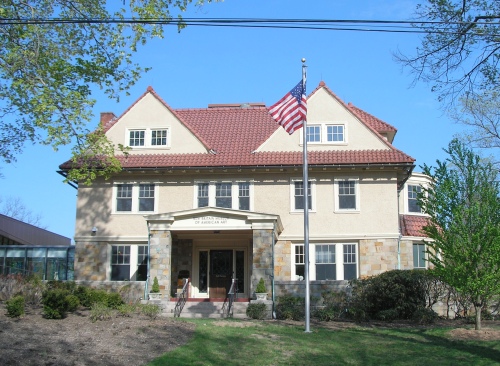
Landers, Frary & Clark, a New Britain company which manufactured cutlery, was founded in the 1850s by George M. Landers. The company (pdf) was known for such products as the Universal Food Chopper/Grinder. George M. Landersson, Charles Smith Landers, married Grace Judd, the daughter of Loren F. Judd, of North & Judd, a company which manufactured saddlery hardware. Their son was also named George M. Landers. Grace Judd Landers later lived in a house which on Lexington Street in New Britain. It was built around 1910 for William H. Hart, president of Stanley Works, and sold to Mrs. Landers upon the death of Hart’s widow in 1929. It is located on the edge of Walnut Hill Park, designed by Frederick Law Olmsted. The style of the house combines elements of the Spanish Mission style (the use of stucco and stone and the Spanish style roofing tiles) and the Craftsman style (the gables and overhanging eaves with decorative brackets).

In 1935, Grace Judd Landers bequeathed the house to the the Art Museum of the New Britain Institute, now the New Britain Museum of American Art. The building was remodeled as an art museum based on designs by William F. Brooks, of the firm Davis & Brooks, and opened in 1937. In 2007, a new museum building was opened, connected to the Landers House, which has again been renovated and now houses an art lab, library and art studio.

The Shaw-Perkins Mansion (1756)

shaw-perkins-mansion.jpg

The Shaw-Perkins Mansion, on Blinman Street in New London, was built, beginning in 1756 for the wealthy merchant and shipowner, Capt. Nathaniel Shaw. The house, completed in 1758, was constructed by French Canadian builders, who used granite from the ledge behind the property. Nathaniel Shaw, Jr. inherited the house. He served as Naval Agent for Connecticut and the Mansion was a naval War office during the Revolutionary War. Nathan Hale was a visitor to the Mansion around 1775 and George Washington likely spent the night there in 1776. The house survived Benedict Arnold’s 1781 burning of New London, with only the kitchen being damaged. Shaw’s wife, Lucretia, died in 1781, after becoming ill from nursing prisoners and Shaw himself died the following year from a hunting accident. The house then passed to his brother, Thomas Shaw, and then to his sister, Lucretia Shaw Woodbridge and her husband, Judge Elias Perkins. The house was extensively remodeled by Dr. Nathaniel Shaw Perkins in 1845. His daughter, Jane Richards Perkins (1844-1930), sold the house and its contents to the New London County Historical Society in 1907, on condition she could reside there until her death. The house was restored and is open to the public as a museum.

Thomas Lee House (1660)

thomas-lee-house.jpg

Built around 1660, the Thomas Lee House in Niantic is one of Connecticut’s oldest wood frame post-Medieval English houses. The original structure consisted of a single-room ground floor with a chamber above. This was expanded, after 1700, with the addition of a West Parlor and Chamber. The lean-to, which makes the house a saltbox, was added about 1765. The Lee family owned the house for two hundred years, until it was sold to a local farmer who used it as a barn and chicken coop. The farmer planned to tear the house down, but in 1914, it was saved by the East Lyme Historical Society, with help from the Connecticut Society of Colonial Wars, the Society of Colonial Dames, the Society for the Preservation of New England Antiquities and Lee family descendants. The house was restored under the direction of Norman Morrison Isham, an architectural historian and author of Early Connecticut Houses (1900). It opened to the public in 1915 as a historic house museum, operated by the East Lyme Historical Society.

John McCurdy House (1700)


john-mccurdy-house.jpg


Across from the First Congregational Church of Old Lyme, on South Green, is a house built around 1700 by Amos Tinker. In 1753, it was purchased by John McCurdy, a Scotch-Irish ship merchant who was a patriot during the Revolutionary War. George Washington spent a night in the house in April, 1776, when he was on his way from Boston to New York. In July, 1778, Lafayette was also a guest at the McCurdy home. John McCurdy was the grandfather of Judge Charles Johnson McCurdy, who lived in the home in his later years with his daughter. Judge McCurdy was a lawyer who served as Lt. Governor of Connecticut (1847-1849) and on the state Supreme Court (1863-1867). He was also U.S. Chargé to the Austrian Empire (1850-1852).

The David Bishop House (1796)

david-bishop-house.jpg

David Bishop was a New London builder who started a grocery, lumber and building business with his brothers. In 1872, he purchased a 1796 gambrel-roofed house at 49 Washington Street and raised the building, adding a new first floor for his grocery business. He also lengthened the windows and added dormers and a bay window. The building was restored in the 1990s and the ground floor now houses the offices of New London Landmarks, while the upper level contains two apartments.