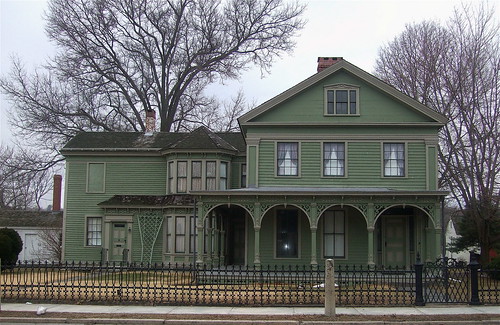
Langworthy-Allyn House (1820)

langworthy-house.jpg

Adjacent to the George Greenman House, on Greenmanville Avenue in Mystic, is an earlier house, possibly built around 1820, which was acquired by the Greenman brothers in 1837. The brothers resided in the house as they set up the George Greenman & Co. shipyard, eventually moving to the Greenman House, when it was built in 1839. Around 1849, the older house was raised an additional floor and a new two-story ell was added. For a half-century, it became a boarding house for workers at the shipyard and was run by the ship joiner David Langworthy and his wife, Fanny. From 1931 to 1974, the house was owned by the Allyn family. It is now owned by Mystic Seaport.

George Greenman House (1839)

george-greenman-house.jpg

George Greenman was the eldest of three brothers who founded the shipyard in Mystic known as George Greenman & Co. His house on Greenmanville Avenue was built in 1839 and was enlarged and further ornamented later in the nineteenth century. Greenman’s brothers initially resided in the house with him, until they built their own homes nearby on Greenmanville Avenue. The Greenman home is reported to have been a stop on the Underground Railroad. The Mystic Seaport living history museum acquired the house from George Greenman‘s great-granddaughter in 1970. The house has a Historic Structures Report.

Edgecomb-Gates House (1835)

15-gravel-street.jpg

The house at 15 Gravel Street in Mystic was built around 1835 by Daniel D. Edgecomb, a carpenter who made coffins in his basement workshop. In 1847, the house was acquired by Captain Gurdon Gates, who added the intricately detailed porch. The oldest of four brothers, who all became sea captains, Gurdon Gates was known for his record run in 1866 around the Horn in the clipper ship, Twilight. He also commanded other ships, including the steamship, Victor, during the Civil War. After his retirement from the sea, he was involved in business and politics, serving in the Connecticut Assembly. Gravel Street was known as “Captain’s Walk” because all of the homes there but one once belonged to sea captains.