Huntington Homestead (1700)

Built sometime in the period 1700-1722, the Huntington Homestead in Scotland was the birthplace and childhood home of Samuel Huntington, who went on to become a Signer of the Declaration of Independence, President of the Continental Congress from 1779 to 1781 and Governor of Connecticut. Huntington later lived in a house in Norwich. The Homestead was later owned by the Kimball family, who sold it to the Town of Scotland in 1994. The house was then acquired by The Governor Samuel Huntington Trust to be opened as a museum.

Also, Historic Buildings of Massachusetts now has a new blog theme!!!

Dr. Joshua Kendall House (1875)

kendall-house.jpg

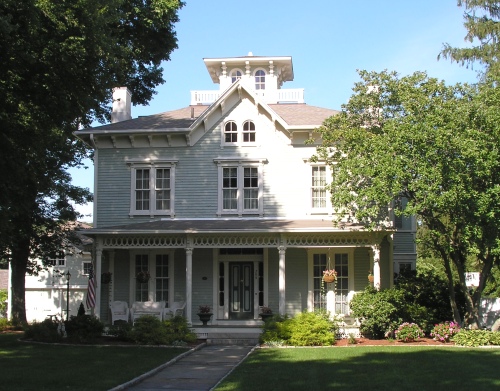
Dr. Joshua Kendall came to the Humphreysville section of Derby (now the town of Seymour) from Pennsylvania in 1833 and practiced medicine in town for over fifty years. According to The History of the Old town of Derby (1880), by Samuel Orcutt and Ambrose Beardsley, Dr. Kendall,

attended medical lectures at Castleton University, Vt, where he graduated. As a physician and as a citizen he has been a leading and influential man; has been a most efficient member of the school board over thirty years, and has done good work for the advancement of education, temperance and sound morality in the town. He has been ardent and unyielding in his politics and represented Derby in the Legislature in 1849, before Seymour was organized as a new town.

Dr. Kendall’s 1875 house is at the corner of West and Church Streets in Seymour, across Church Street from the Dr. Sheldon C. Johnson House.

Edmund Fanning Birthplace (1761)

fanning-birthplace.jpg

At 44 Main Street in the Borough of Stonington is a house, built in 1761 by the merchant Gilbert Fanning. Fanning was soon forced, due to his economic circumstances, to deed the house to his father-in-law, Dr. Nathan Palmer. Gilbert’s son, Edmund Fanning, was born in the house in 1769 and would go on to become the first American captain to circumnavigate the globe, in 1797-1798, aboard the Betsey, with a crew from Stonington. His elder brother, Nathaniel Fanning, served with John Paul Jones in the Revolutionary War during the 1779 battle of USS Bonhomme Richard and the HMS Serapis.

Ebenezer Avery House (1750)

ebenezer-avery-house.jpg

The Ebenezer Avery House, built around 1750, originally stood at the corner of Latham Street and Thames Street in Groton. On September 6, 1781, American soldiers, including Ebenezer Avery, who had been wounded at the Battle of Groton Heights, were being transported in a cart to become British prisoners. The rolling cart went out-of-control and collided with a tree. The wounded, in agony, were taken to the Ebenezer Avery House. The Averys were a prominent family of early settlers in Groton. Captain James Avery was the first of the family to settle in Groton in the seventeenth century. His son, also named James, occupied a house, built in 1671, known as the Hive of the Averys, which burned down in 1894. The Avery Memorial Association was formed the following year and erected a memorial at the site of the Hive. In 1971, Stanton Avery of California purchased the Ebenezer Avery House and donated it to the Association. The house was moved from its original location to the the grounds of Fort Griswold State Park, where today it is open to the public as a house museum.

The deKoven House (1791)

dekoven-house.jpg

Captain Benjamin Williams built an impressive brick house in Middletown in 1791. As described in New England Families, Genealogical and Memorial, Vol III (1913), compiled by William Richard Cutter,

Benjamin Williams came to America from the Island of Bermuda when a young man, and settled in Middletown, Connecticut, where he died June 15. 1812, at the age of forty-five years. He built and lived in the house on East Washington street subsequently known as the De Koven place, and at present as the Wadsworth House, He became a large ship owner and had many vessels plying between the East and West Indies and the port of Middletown, the towns on the Connecticut river having extensive shipping interests in those days. Then came the war of 1812, and French privateers captured the greater number of his ships. He expected that the government would reimburse him for this loss, and died in the hope that his widow would receive what was her due, but this was never done.

The house was later owned by Henry L. deKoven, who was also involved in merchant shipping and was the first president of the Middlesex County Bank in 1830. In 1900. the house passed to Clarence Seymour Wadsworth, who used it as a business office after he built the Mansion on his Long Hill Estate. In 1941, he bequeathed the house to the Rockfall Corporation, which he had founded in 1935 and has been dedicated to environmental education, conservation projects and planning initiatives in Middlesex County. Restored in 1942, the house opened as a Community Center for non-profit organizations in Middlesex County.

The Chapman-Sullivan House (1850)

Chapman-Sullivan House

The home of Norwich’s twelfth mayor, Gurdon Chapman, was built on Broadway in 1850. When he died, he left the house to his niece and it remained in the family until 1946, when it was sold to the Sullivan family. According to The History of New London County, Connecticut (1882), compiled by Duane Hamilton Hurd:

Gurdon Chapman was born in North Stonington in 1792. He went to Norwich in early life and engaged in trade, which subsequently developed into a large grain business, which he prosecuted during the remainder of his life with great financial success. He died in 1862, aged seventy-two years. During his life he was a marked character in the public affairs of the city. Overcoming the obstacles presented by a lack of early education, so common among the country boys of his day, by dint of study and close observation, aided by strong, native, common sense and a remarkably retentive memory, he qualified himself for a leader among his fellow-men and for the high positions of trust which they conferred upon him. For many years he was a member in turn of both branches of the city government, and from 1843 to 1845 was mayor of the city. He was also frequently called to responsible positions in the affairs of the town. He was a clear thinker, a forcible and fluent public speaker, and in all his public and private relations was highly respected and esteemed for his integrity, the kindness of his heart, and the soundness of his judgment as an advisor.