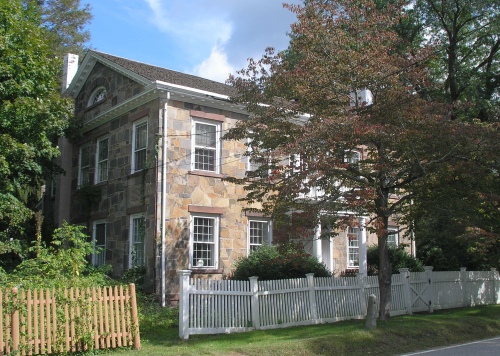
The Eliza Huntington Memorial Home (1832)

eliza-huntington-memorial-home.jpg

The Eliza Huntington Memorial Home in Norwich began as a private house, notable for its Greek Revival ornamentation. It was most likely built before 1835 (a “dwelling house” is already mentioned in an 1836 warranty to Jedidiah Huntington). Huntington bought the house when he retired from business. He died in 1872 and his will established the Eliza Huntington Memorial Home for Respectable and Indigent Aged and Inform Females on his former property. As described in a Report of the State Board of Charities to the Governor (1921):

The Home is located at no. 99 Washington Street and occupies a pleasant old-fashioned house surrounded by attractive grounds. It was formerly the residence of Mr. Jedediah Huntington, whose generosity established the Home as a memorial to his wife. The original endowment has increased until the income from it largely supports the Home.

As further explained in Caulkins History of Norwich (1874):

Mr. Huntington has made a deep and lasting impression upon the regard of our community, by the liberality which he has exhibited in his large and frequent donations to religious and benevolent objects, principally connected with the church to which he was attached. By his last will and testament, he gave the beautiful place, which was the residence of himself and wife for nearly forty years, as a home for indigent females, and appropriated $35,000 as a fund for its support. It is called the “Eliza Huntington Memorial Home,” as a tribute to his wife, who, during her last illness, expressed an earnest desire that a portion of his estate, which she would have received had she survived him, should be appropriated to found such an institution.

Levi W. Eaton House (1893)

eaton-house.jpg

In 1893, Levi W. Eaton, president of the Bryant Electric Company, built a house on the southeast corner of Marina Park and Linden Avenue in Bridgeport. Eaton had been invited to build a home there by P.T. Barnum, whose fourth and final mansion was also located on the elliptical Marina Park circle. Eaton’s financial situation led him to sell the house right after completion to William A. Grippin, president of the Bridgeport Malleable Iron Company, Vulcan Ironworks and the North and Judd Manufacturing Company of New Britain. Three years after Grippin‘s first wife died, he married again in 1910, but died at the Grand Canyon in Arizona in 1911, while he was on his wedding trip. The Eaton-Grippin House was acquired by the University of Bridgeport in 1959 and for thirty years it served as a dormitory for law school students. The house, known as Darien Hall, has been unoccupied since the early 1990s and is in currently in disrepair.

Stephen T. Mather Homestead (1778)

mather-homestead.jpg

The Stephen T. Mather Homestead, in Darien, is named for Stephen Tyng Mather, who laid the foundation of the National Park Service. The Mather Homestead was built in 1778 by Deacon Joseph Mather, son of Reverend Moses Mather, who was minister of the Middlesex Parish Church. During the Revolutionary War, there was much raiding by Tories along the coast of Long Island Sound, but the Mathers felt that their property was far enough inland to be safe. They encouraged friends and relatives to hide their money and valuables at the house until the war ended, but on the night of March 19, 1781, a gang of Tories raided their home and forced the Mathers to reveal the hidden items. During the War, Joseph Mather was an Ensign in the Connecticut Militia, fighting at Montreal in the 1775 invasion of Canada, and he was also a sergeant in the Coast Guard. Mathers have continued to own the Homestead since it was built. In the later nineteenth century, it had passed to Joseph Wakeman Mather, who moved to San Francisco to develop business interests there. His son, Stephen, was born in California in 1867. Stephen Mather went on to become a millionaire as president and owner of the Thorkildsen-Mather Borax Company. Inspired by his meeting with John Muir in 1912, Mather complained to the federal authorities about the government’s neglect of the nation’s National Parks. Soon working in the Interior Department, he established and became the first director of the National Park Service. He continued to own his family’s Homestead in Darien, using it as a summer residence. After his death, in 1930, the house was owned by his daughter, Bertha Mather McPherson, a founding member and the first president of the Darien Historical Society.

Update: In 2017, the Mather House became a museum open to the public.

Nathaniel Foote House (1702)

nathaniel-foote-house.jpg

The oldest house in Colchester is the Nathaniel Foote House, which has been moved several times, but is now located on Norwich Avenue. The house was begun in 1699 by Nathaniel Foote of Wethersfield, who was involved in the development of Colchester as a new community. Foote intended to settle in town, but ill health prevented him from completing the new house, which was finished in 1702 by his son, Nathaniel, shortly before his father’s death. It was soon occupied by the elder Nathaniel’s widow and four youngest children. In the early nineteenth century, the house stood on the Hartford Turnpike and was used as a post office. In 1896, the then neglected house was on Broadway and was bought by Mrs. Frederick G. Bock, who repaired it and gave it to the Colonel Henry Champion Chapter of the Daughters of the American Revolution. The D.A.R. moved the house to its present site in 1925 and restored it for use as a historical museum and chapter house.

Bates-Scofield Homestead (1736)

bates-scofield-homestead.jpg

The Bates-Scofield Homestead is a colonial saltbox-style house, built around 1736 in Darien for John Bates, who lived there until 1774. The house was later deeded to John Bates, Jr. Before Darien’s first meetinghouse was built, services were held in the Bates House. After the Bates family, the house was owned by the Scofield family for almost a century, starting with Ezra Scofield in 1822. By 1964 the house faced demolition, until it was given to the Darien Historical Society and moved to a new site to become a museum. In 2005, the 1827 Scofield Barn was also donated to the Society and dismantled. In 2008, the barn was reunited with the house and joined to it by a new connector building.

The Jesse Hurd House (1812)

The Jesse Hurd House, built of stone with bold Federal detailing, is the most impressive of the homes built in Middle Haddam (in East Hampton) during its period as a prosperous shipbuilding center. Jesse Hurd (1765-1831) was a prosperous shipbuilder and merchant who played a dominant role in the economic development of Middle Haddam. He built many ships for his partners, the brothers, George and Nathaniel Griswold, who ran the largest merchant shipping house in New York. Hurd owned shares in his vessels and cargoes, building cheaply in Middle Haddam and selling his shares in New York. In 1828, he patented new ship hoisting machinery which he had invented himself. This machinery more easily enabled the scraping and repairing of hulls. Hurd also joined the Griswolds in establishing the New York Screw Dock Company, a dry-dock facility on the East River which utilized the new technology. His impressive house in Middle Haddam, built around 1812, was most likely designed by a master architect/builder, whose name is currently not known. Shipbuilding in Middle Haddam began to decline after Hurd’s death in 1831.