Dr. John Hull built a house around 1764 in Cheshire next to the house, built around the same time, of his brother, Dr. Amos Hull. Both brothers married sisters from the Hitchcock family. The two houses are very similar in design and both were recently threatened with demolition until the developers who had acquired both properties agreed to restore the Colonial era homes. The John Hull House is also known as the Judge Hincks House
Deming Sexon House (1862)

The Deming Sexon House is an octagon house on Middletown Avenue in East Hampton. The house appears to have two floors in the picture above, but on the other side the house’s basement is exposed and has windows, revealing that it actually has three floors. Deming Sexton was an East Hampton bell manufacturer.
Enos S. Kimberly House (1884)

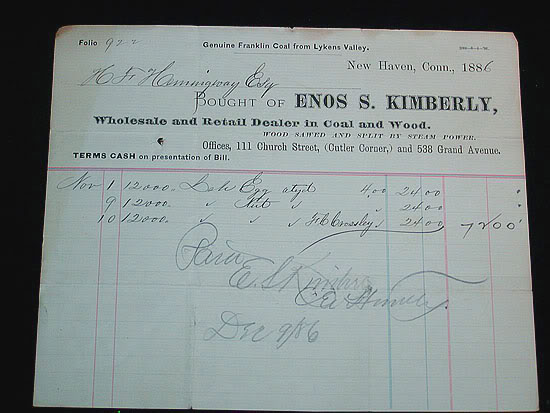
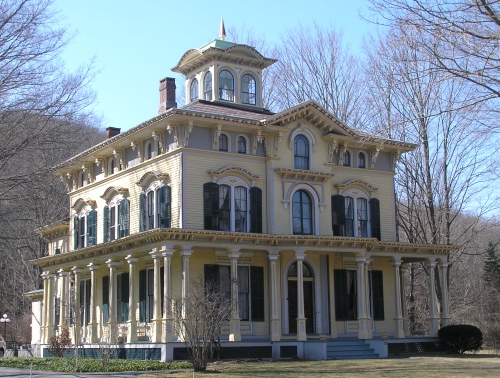
The Enos S. Kimberly House is a very solid and imposing Queen Anne house, built in 1884 on Orange Street in New Haven. Enos Kimberly was, according to an 1886 bill, a dealer in wholesale and retail coal and wood. His wife, Sarah Chatfield Kimberly, was a member of the Daughters of the American Revolution. The architect of the home was Rufus G. Russell, a former assistant of Henry Austin.
Charles Uriah Hayden House (1819)
Charles Uriah Hayden was the grandson of Ebeneezer Hayden, the leading shipbuilder of his time in Essex. Ebeneezer had been predeceased by his children, so when he died in 1818, he left his property to his grandchildren. They proceeded to construct several impressive homes along West Street and Champlin Square in Essex. Charles Uriah Hayden’s Federal style home was built in 1819, on West Street across from Essex town hall. Within fifteen years, he had lost his money and had to sell the house to Joseph Post, a sea captain and ship builder. Post was likely the owner who added a cupola to the house. After six years, Capt. Post sold the house to his brother in 1841. The house had other owners over the years, including the Brooklyn, New York businessman George Ives Stevens. The house was seriously damaged by a fire in 1994, but it has since been restored.
Stoddard-Sherwood House (1878)

Located in Newington Junction, the Stoddard-Sherwood House was built for John Rozwell Stoddard. He was superintendent for the Russell & Irwin Manufacturing Company and then manager for the Capewell Horseshoe Nail Company. Stoddard and his wife, Lila Marguerite Steele, had seven children and one of them, Lila Steele Stoddard Sherwood, who had married Charles Sherwood, lived in the house after her father’s death in 1936.
Philip Chapin House (1867)

On Church Street in the Pine Meadow section of New Hartford is a very impressive Italianate mansion, built in 1867 by William Bushnell as a wedding gift to his daughter Amelia, who in 1866 had married Philip E. Chapin. Philip’s father, Hermon Chapin, gave the land on which the house was built as a gift to his son. Hermon Chapin also donated land for the construction of St. John’s Episcopal Church, located adjacent to his son’s house. Hermon Chapin was a toolmaker who established the Union Factory in Pine Meadow. Philip Chapin and his brothers later established the Chapin Machine Company in 1870. After Amelia died in 1878, Chapin left New Hartford for Ohio, later remarrying and becoming the general manager of the Cambria Iron Company in Johnstown, Pennsylvania. The house in New Hartford was rented to various people and then, between 1887 and 1922, it was owned by Hubert P. Richards, who used it on weekends. After Richards died, his grandsons, Ralph and Howell owned the house and rented it out. Howell Richards eventually bought his brother’s interest in the Chapin House and owned it until his death in 1974. The house was recently on sale.
The Caleb Stone House (1749)
The Caleb Stone House was built in 1749, at the corner of Broad and River Streets, on the property which had been the homelot of William Leete, one of the original settlers of Guilford. Leete was a leader in Guilford and went on to become governor of the New Haven Colony and then of the Connecticut Colony, which had absorbed New Haven. While he was governor of the staunchly Puritan New Haven Colony in 1661, Leete sheltered Whalley and Goffe, two of the regicides, the judges who had signed the death warrant of Charles I and were being hunted by the Restoration government. A barn behind the Stone House stands over the cellar where the regicides hid for three days. Caleb Stone Jr. and his wife, Rebecca Evarts, bought the property in 1715 and later built his saltbox home, which was lived in by members of the Stone family until 1955.
You must be logged in to post a comment.