Watson Coe House (1867)

watson-coe-house.jpg

The Watson Coe House, built in 1867-1868 on Orange Street in New Haven, is a later example of the many Italianate style houses built in the city in the mid-nineteenth century. In the early twentieth century, the house at 484 Orange Street was home to Wesley Roswell Coe, who was a Yale professor of Comparative Anatomy, marine biologist and Curator of Zoology at the Yale Peabody Museum for sixteen years.

Trumbull-Carew House (1763)

trumbull-carew-house.jpg

The Trumbull-Carew House (pdf), at 44 East Town Street in Norwich, was built in 1763 by Joseph Carew. Capt. Carew sold the house to Col. Joseph Trumbull in 1778 and later enlarged the Simon Huntington House nearby as his new residence. Col. Trumbull was the son of Gov. Jonathan Trumbull and was appointed as the first commissary general of the Continental Army in 1777 during the Revolutionary War. Illness forced him to resign his duties the following year and he died at his father’s home in Lebanon, having only recently purchased the house in Norwich. The house has had many owners over the years and has recently been for sale.

The Simon Huntington, Jr. House (1690)

simon-huntington-jr-house-norwich.jpg

In 1688, Simon Huntington, Sr. granted an acre of land in Norwich to his son, Simon. According to Mary E. Perkins in Old Houses of the Antient Town of Norwich (1895),

This is then recorded as the home-lot of Simon Huntington, Jun., who was born in Saybrook, 1659, and married in 1683, Lydia, daughter of John Gager of Norwich. Like his father, Simon, 2nd, played an important part in the history of the town, serving in many civil offices, and in 1696, succeeding Simon, Sr., in the office of deacon of the church, which he held until his death in 1736. In 1704, he calls himself Simon Huntington (cooper.) In 1706, he was granted liberty to keep “a house of public entertainment.” His house, occupying a central position, was honored as the magazine for the defensive weapons of the town, and as late as 1720, a report, made to the town, states that it contained a half barrel of powder, 3 pounds of bullets, and 400 flints.

The Huntington Tavern remained in the family until 1782, when it is sold to Thomas Carey, who then sells it to Joseph Carew, a merchant. Again quoting from Perkins,

Capt. Joseph Carew perhaps tears down the old Huntington house, and builds the one now standing on the lot [in 1782-83], but it is also possible that instead of entirely destroying the old homestead, for which, being of Huntington blood, (though not a descendant of Simon, 2nd), he might have had some attachment, he may have altered, or added to the old framework, but this, of course, at this late day, we have no means of knowing. He also purchases the rest of the Huntington land, facing on the Green, except one small piece of one rod frontage, which is sold to Gardner Carpenter. The long, low, rambling house has the appearance of being of much older date than 1783. It was occupied by Capt. Joseph Carew until his death, and then by his daughter, Eunice, and son-in-law, Joseph Huntington. […] It has been occupied until recently [1895] as the First Church parsonage.

While there was later enlargement, the earliest parts of the house date to around 1690 and it is considered to be one of Norwichtown‘s surviving seventeenth century houses.

Whittlesey Homestead (1760)

whittlesey-homestead.jpg

Eliphalet Whittlesey (1679-1757) was born in Saybrook and later settled in the Newington section of Wethersfield, purchasing land from his older brother Jabez. Around 1709, he built a small one-story, two-room house at 20 Rod Highway, now 461 Maple Hill Avenue. His son, Eliphalet II, was born in 1714 and eventually left town with his wife and ten of his children in 1761. Eliphalet III later settled in Stockbridge, Massachusetts. Another son, Lemuel Whittlesey, remained in Newington, constructing the current Whittlesey Homestead sometime between 1758 and 1772. The house was inherited by his son, Asaph, and then by Asaph’s daughter Delia, who married Homer Camp. Their son was Lemuel Whittlesey Camp. The house has had many owners over the years.

The Aaron Chapin House (1779)

aaron-chapin-house-1779.jpg

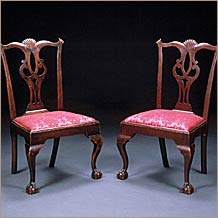
Aaron Chapin became a notable maker of furniture in the late eighteenth century. He was a second cousin of the famous East Windsor cabinetmaker, Eliphalet Chapin and worked in his cousin’s shop between 1774 and 1783. Chapin built his house in East Windsor Hill (now in South Windsor) in 1779, just south of his cousin’s home. Aaron Chapin later established a large shop in Hartford, which was the area’s leading cabinetmaking establishment in the first decade of the nineteenth century, being particularly dominant in the production of Federal-style sideboards.

The Everard Benjamin House (1838)

everard-benjamin-house.jpg

Originally built on Orange Street in New Haven in 1838, the Everard Benjamin House was moved to the corner of Bradley and Lincoln Streets in the late 1860s. This classical Greek Revival building, designed by Ithiel Town, was set off from the street with a large front lawn in its original location, but the house now right off the sidewalk. Everard Benjamin was a silversmith, jeweler, and watchmaker, who succeeded his father, the silversmith Barzillai Benjamin. The house was later owned by Hobart B. Bigelow, who started by learning the machinist’s trade, becoming a leading manufacturer of boilers and heavy machinery. Bigelow later became mayor of New Haven in 1879 and served as governor of Connecticut from 1881 to 1883.

Gurdon Whiting House (1786)

whiting-house.jpg

The land in West Hartford, where Gurdon Whiting would build a house around 1786, was originally part of a grant to Rev. Joseph Haynes, minister of First Church in Hartford and the son of John Haynes, first Governor of the Colony of Connecticut. Haynes’ daughter, Mary, inherited the property. She married Roswell Saltonstall, the son of Connecticut governor Gurdon Saltonstall. She later married Thomas Clap, President of Yale. Mary, who died in New Haven in 1769, left her land in the West Division of Hartford to her daughter, Mary Whiting, who deeded the land to her son, Gurdon Saltonstall Whiting in 1778. He built the Whiting House in the 1780s, at the time of his marriage. It remained in his family into the 1920s, when it was purchased by Philip Lawler, who had been mayor of West Hartford in 1915. The house, which has survived nearly intact, was in the Lawler family into the 1980s.