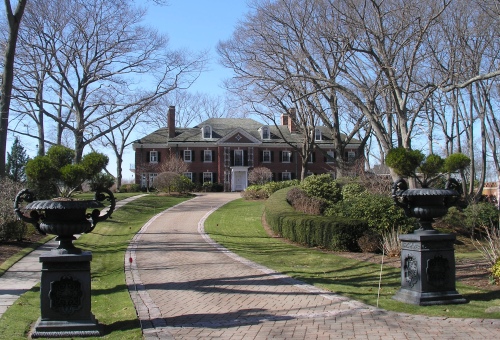
Sloper-Wesoly House (1887)

The Sloper-Wesoly House, on Grove Hill in New Britain, is a Queen Anne-style residence, built in 1887. Designed by George Dutton Rand, the house was built for Andrew Jackson Sloper, an industrialist and third president of the New Britain National Bank. His son, William Thomson Sloper, who grew up in the house and was a survivor of the Titanic, wrote a biography of his father, The Life and Times of Andrew Jackson Sloper, 1849-1933 (1949), which contains many anecdotes of nineteenth-century New Britain. The house was later owned by Dr. Andrew Wesoly, who served as an army captain in the Second World War and who, as a physician and Polish speaker, treated many of New Britain’s Polish residents. After his death, his daughters donated the house to the Polish American Foundation of Connecticut. The building is now the Sloper-Wesoly Immigrant Heritage and Cultural Center.

Chapin Park (1871)

Chapin Park, which is today a bed and breakfast, is an 1871 Gothic Revival house on Church Street in Pine Meadow in New Hartford. It was the second house on the site built for Edward M. Chapin (the earlier one was moved to make way for the new one). The house has a similar arrangement of interior rooms to that of Edward’s brother, Philip Chapin, nearby. Chapin Park was designed by Robert W. Hill, a Waterbury-based architect who designed buildings throughout Connecticut.

Millstreams (1917)

Millstreams is a mansion in Farmington, built in 1917 for the playwright Winchell Smith. Born in West Hartford and a graduate of Hartford Public High School, Smith was also an actor and director. He got his start in the theater company of his uncle, William Gillette, but became most known for his plays, many of which were written in collaboration with others, including Lightnin’ (1918), written with Frank Bacon, which ran for 1,291 performances. He also persuaded D.W. Griffith to film scenes from the film Way Down East, written and produced by Smith and starring Lilian Gish, in Farmington. Smith’s property in Farmington once included the old grist mill, which appears in the film, and the Gridley and Case Cottages, now owned by the Farmington Historical Society. Smith was fascinated by the Tunxis Indians and in his younger days had enjoyed camping near the Farmington River. His house was later built on Indian Neck, along a bend of the Farmington River, where it joins the Pequabuck River. Initial designs for the house were prepared by Edward T. Hapgood and completed by Cortland F. Luce after the architect’s death. At first, Smith called his estate “Lambs Gate,” because he had purchased and erected at his home the gates which had stood for many years at the entrance of the Lambs Club in New York City. Because another home in Farmington had recently been named “Old Gate,” Smith changed the name of his home to “Millstream Manor.” Smith, who died in 1933, is buried, near his home, in Riverside Cemetery. The house, surrounded by almost five acres of grounds and gardens, has recently been for sale.

The Williams-Pendleton House (1848)

The Greek revival house at 33 Main Street in Stonington Borough was built in 1846-1848 by Charles Phelps Williams, a prominent shipowner and businessman. The house replaced an earlier one, built shortly after 1768 by Ebenezer Cobb. Williams sold the house, in the year after it was completed, to Gurdon Pendleton, who then sold it to his brother Harris Pendleton, Jr. It was owned by printer Nathan G. Smith and his descendants from 1861 to 1924.

John Raymond House (1775)

The John Raymond House is located just south-east of the Congregational Church in Montville Center. It is listed as having been owned by John Raymond in 1775 and stood on part of the land which had been granted to Samuel Rogers by Uncas in the seventeenth century. In 1713, the land became part of the Raymond Farm (the house is located on Raymond Hill Road). John Raymond is described by Henry Augustus Baker, in his History of Montville (1896), as follows:

b. 7 Jan., 1748, son of John Raymond and Elizabeth Griswold; married 26 May, 1774, his first cousin, Mercy Raymond, daughter of Joshua Raymond and Lucy Jewett. He was a farmer, and settled at Montville. His farm was located next east from tho Congrogational church, and was afterwards owned by John G. Hillhouse. He was chosen first town clerk of Montville [in 1786], and held the office sixteen years. He died at Montville 30 March, 1828. She died 30 June, 1833.