
The house at 86 Buckingham Street in Waterbury was built around the end of the First World War for Alfred Hart, vice-president of the R. F. Griggs Company. The house, which has cedar shake siding, was designed by Davis and Brooks of Hartford.
The house at 86 Buckingham Street in Waterbury was built around the end of the First World War for Alfred Hart, vice-president of the R. F. Griggs Company. The house, which has cedar shake siding, was designed by Davis and Brooks of Hartford.

The house of Chauncey Jerome, on South Street in Bristol, has seen many changes over the years. Chauncey Jerome was a clockmaker and entrepreneur who became the most successful of the many clock manufacturers in the Bristol area. His house in Bristol was built in 1832. He later he hired architect Joel T. Case to construct a tower and make other alterations to the building (the semicircular window in the front gable, for instance, was changed to a tripartite Palladian window). The house was later owned by Edward Dunbar. Threatened with demolition around 2000, the house was saved to become the Bristol Elks Lodge. The house has lost its tower, as well as other decorative features, and an unattractive modern addition has been constructed on the front. The Images of America series book entitled Bristol Historic Homes has an image on the cover of the house in its former glory.

The Shingled Colonial Revival house at 33 Mountain Road in Farmington was built in 1905 by the lawyer Robert L. Redfield for his aunt, Miss Mary L. Redfield. She had come to Farmington in 1892 with her brother Amasa. They lived in the Deacon Edward L. Hart House on High Street, until Amasa died in 1902. Mary Redfield soon moved to the new house on Mountain Road, where she lived with her friend, Miss Ada DeAngelis. Miss Redfield was struck by a car and killed in 1921. Miss DeAngelis continued to live in the house until 1932. In 1936, it became the home of Myron Clark.

The former house at 30 Lewis Street in Hartford, like the nearby houses at nos. 24 and 36, was probably constructed by the designer and builder Austin Daniels around 1840. Like the building at 36 Lewis Street, no. 30 was altered to conform to the Italianate style, around 1860. The building became the home of the University Club in 1906 and the front door was then moved to the side of the structure. In 1928, a five-story rear addition was constructed. In more recent years, the building has been converted into office space.

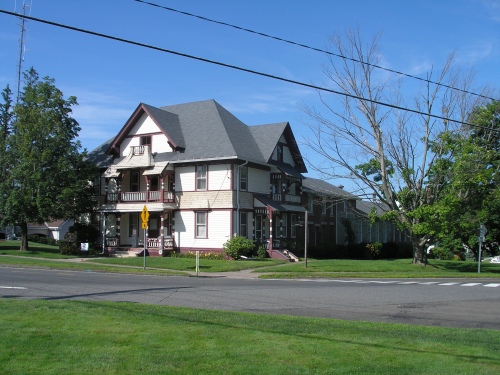
On Tolland Green is located the Old Tolland County Jail, the earliest surviving section of which dates to 1856. At one time the Jail was attached to a hotel known as the County House (first built in 1786), which could accommodate people who had business at the nearby county court. The hotel was owned by the state, but was managed under contract by a private innkeeper (who was sometimes also the jailer). The court later moved to Rockville in 1888 and the hotel was not rebuilt after it burned in 1893. Instead, it was replaced by a new County House, used primarily as a residence for the jailer and his family. The Victorian building was designed by local builder James Clough. Today, the house and attached jail serve as a museum, operated by the Tolland Historical Society.

Built in 1787, the house at 53 Main Street in Stonington Borough was shared by two brothers, Joseph and Benjamin Eells, whose wives drew a line down the kitchen floor, dividing it in two. The house was later home to the writers Grace Zaring Stone (d. 1991) and her daughter, Eleanor Perenyi (d. 2009). Stone, who was the great-great-granddaughter of Robert Owen, the British social reformer and socialist, wrote novels, including The Bitter Tea of General Yen (1932), Escape (1939) and Winter Meeting (1946) (all three of which were made into films). She began using the pseudonym Ethel Vance for her anti-Nazi novel Escape, because her daughter, who had married the Hungarian Baron Zsigmond Perenyi, was at the time living at her husband’s castle in Ruthenia, then controlled by German-occupied Czechoslovakia (now in Ukraine). Eleanor Perenyi later created an extensive private garden at the house in Stonington and wrote a classic book on gardening, called Green Thoughts: A Writer in the Garden (1981).

Built sometime between 1740 and 1780, the Joel White House is located on Bolton Center Road in Bolton. It was the site of Bolton’s first post office in 1812. Samuel Alvord was the first Postmaster.


You must be logged in to post a comment.