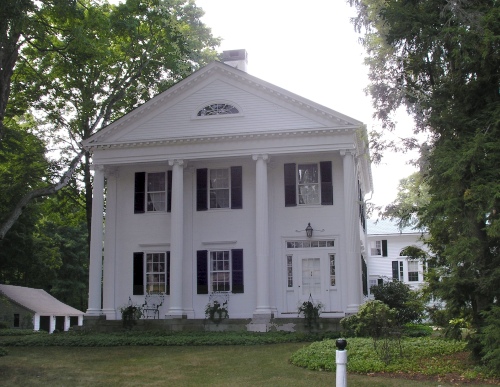
Samuel Simpson House (1840)

Architect Henry Austin designed the home of Wallingford industrialist Samuel Simposon, which originally stood on North Main Street in Wallingford. In the mid-nineteenth century, Simpson, a silver manufacturer, partnered with Robert Wallace in the firm of R. Wallace & Company, the forerunner of Wallace Silversmiths. He was later president of Simpson, Hall & Miller. Simpson’s great-granddaughter, Margaret Tibbits Taber, later had a bookstore in the house. The home was later moved to its current location on Scard Road in Wallingford.

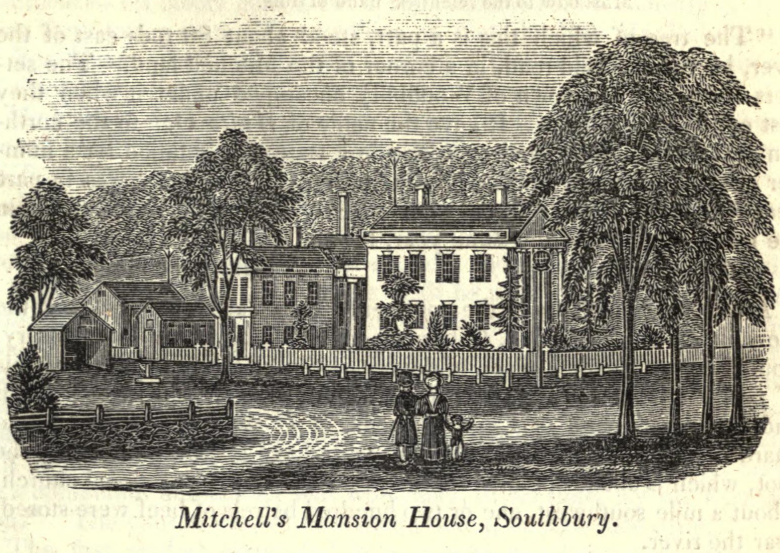
Mitchell’s Mansion House (1829)

In Connecticut Historical Collections (1836), John Warner Barber features an image of

the Mansion House of M. S. Mitchell, Esq. recently erected, and designed as a house of public entertainment. It is about three quarters of a mile north of the Congregational church. For beauty of situation and superior accommodations, it is not exceeded by any establishment of the kind in any country village in the State. This edifice stands on the spot where the house of the first minister of the place, Mr. Graham, formerly stood.

The Mansion House, on Mansion House Road in Southbury, was built in 1827-1829. One of the builders was James English, later a governor of Connecticut. The house was later owned by the famous furniture-maker Duncan Phyfe, who left the mansion in 1853 to his daughter, Mary, who had married Captain Sidney B. Whitlock, but was a widow by that time. There exists a table, made by Phyfe around 1840, that is known as the “Wedding Cake” table because it held the wedding cake of Phyfe’s grandson, Duncan Phyfe Whitlock, when he married Margaret Donaldson in Southbury.

Charles E. Beach House (1900)

On Brightwood Lane in West Hartford is a Shingle-style house, built in 1900-1901. It was once part of the extensive agricultural estate of the Beach family, known as Vine Hill Farm. The farm was begun by Charles Mason Beach, who had earlier established with his two brothers the Hartford firm of Beach & Co., dealers in paints, aniline dyes and other chemicals. Beach settled in the area of South Main Street in West Hartford in 1859, purchasing a farm house. He began buying land for a dairy farm, which soon gained a reputation in the area for its high-quality milk, cream and butter. Beach’s son, Charles Edward Beach, managed Vine Hill Farm for many years and became a prominent citizen of West Hartford, serving on the town Board of Selectmen and being elected to the Connecticut General Assembly in 1907. In the 1860s, Charles E. Beach’s father had hired a German immigrant named Louis Stadtmueller, who planted the vines on the property which gave Vine Hill Farm its name. His son, Frank Stadtmueller, developed the farm’s process of producing infant milk formula that would keep for two to three weeks. Stadtmueller was later appointed Connecticut’s State Dairy Commissioner.

The house that Charles E. Beach built on Vine Hill Farm has an asymmetrical exterior covered with wood shingles, while the interior has rich architectural details. Parcels of Vine Hill Farm land began to be sold to developers in the 1920s, with the last piece of farmland being sold in 1948 by Charles Frederick Beach, grandson of Charles M. Beach. Smaller houses, built on the subdivided land, now surround the Beach House. The home’s original cobblestone port-cochere is now to the rear of the house, because the laying out of Brightwood Lane led to the entrance being shifted from South Main Street to the newer road.

36 Forest Street, Hartford (1895)

The Queen Anne house at 36 Forest Street in Hartford was built around 1895. It stands on the site once occupied by an earlier house that burned down in 1870. That house, rented for many years by the Rev. Nathaniel J. Burton and his wife, Rachel Pine Chase Burton, was one of the homes of the Nook Farm neighborhood, where Mark Twain and Harriet Beecher Stowe also lived. Rev. Burton settled in Hartford in 1857, when he became the pastor of the Fourth Congregational Church. In 1870, he succeeded Horace Bushnell as minister at Park Church, where he remained until his death in 1887. Burton’s son, Richard Burton, was literary critic of the Hartford Courant. He edited a posthumously published collection of his father’s Yale Lectures on Preaching, and Other Writings (1888), republished in 1896 as In Pulpit and Parish. Richard Burton, who was also a poet, later lived in the 1895 house on Forest Street.

Sharpenhoe (1922)

Sharpenhoe is the name of a house at 132 Red Stone Hill in Plainville. This Colonial Revival home was built in 1921-1922 for Charles Hotchkiss Norton (1851-1942), a mechanical engineer and designer of machine tools. In the 1890s, Norton invented a heavy-duty cylindrical grinding machine capable of supplying machine parts for automobiles. The Charles H. Norton House was designed by Isaac A. Allen, Jr. of Hartford. As described in Modern Connecticut Homes and Homecrafts (1921): “this dwelling of red brick with garage attached is an exceptionally happy conception of the hip roof type of Colonial house with dormer windows. The design everywhere evidences a refinement of taste in the choice of its carefully considered decorative details.” Norton’s family continued to live in the house until about 1958.