Capt. David Judson House (1723)

Capt. David Judson built a Georgian-style house in Stratford around 1750 (or as early as 1723), on the foundation of his great-grandfather William‘s stone house of 1639. Nine generations of the family lived in the house until 1888, when the house was sold to John Wheeler. In 1891, it was sold to Celia and Cornelia Curtis, who willed it to the Stratford Historical Society in 1925. The Judson House, which is now a museum, is known for its particularly fine broken scroll pediment door surround.

Hermon Chapin House (1834)

On Main Street in New Hartford, across from Pine Meadow Green, is a Greek Revival home that once served as a parish house for St. John’s Episcopal Church. The earliest part of the house, in the rear, dates to 1784, but the front section was added in 1834, when Hermon Chapin, who established himself in Pine Meadow as a prominent tool manufacturer, moved in with his wife, Catharine Merrill. She later left the house to the Episcopal Church.

Theophilus Hyde House (1893)

The Theophilus Hyde House, built on Pine Street in Waterbury in 1893, is good example of a Queen Anne house with Stick style details. According to The Town and City of Waterbury, Connecticut, Vol. 2 (1896), edited by Joseph Anderson:

Theophilus Rogers Hyde, son of Theophilus Rogers and Fanny (Hazard) Hyde, was born in Stonington, December 18, 1855. He was educated at the high school in Westerly, R. I., and graduated from there in June, 1874. In September following he came to Waterbury to accept a position in the office of the Scovill Manufacturing company, and has continued there until the present time. On March 11, 1880, he married Jennie Pelton, daughter of William Burdon of Brooklyn, N. Y. They have five children, three sons and two daughters

Frederick Whittlesey House (1881)

Frederick Whittlesey, a dry goods merchant, built a house in 1881 at the corner of West Main Street and Grove Hill in New Britain. Whittlesey married Maria Carter Gilbert in 1861 and in 1881, the year the house was built, he married his second wife, Mary Wadsworth. The house was later home to his two unmarried daughters, Mary Swift Whittlesey (1865-1956) and Frances Whittlesey (1872-1970). Mary Swift Whittlesey was very active in historical and genealogical groups, like the D.A.R. In 1932, the sisters changed the entrance to the house from West Main Street to Grove Hill. After Frances Whittlesey’s death, the house was converted for use as offices.

Eells-Stow House (1700)

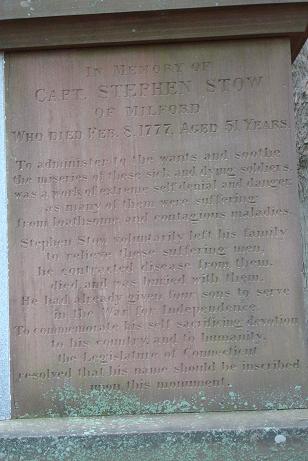
Samuel Eells settled in Milford in the later seventeenth century and owned property on Wharf Lane. He later settled in Hingham, Massachusetts and his son, Col. Samuel Eells, inherited the land in Milford, which later passed to his widowed third wife and then to Nathaniel Eells, his son by his second wife. Nathaniel, who lived in Middletown, sold the Milford property to Stephen Stow, the brother of his late wife. Stow, the captain of a coastal schooner, married Freelove Baldwin around 1751. He died in 1777 during the Revolutionary War while nursing 200 American prisoners of war suffering from smallpox, who had been cast off from a British prison ship. Four of Stow‘s sons also served in the war. The Eells-Stow House on Wharf Lane was once believed to date to the later seventeenth century, but is now thought to have been built c.1700-1720. The house was saved from destruction by the Freelove Baldwin Stow Chapter of the D.A.R. in 1930 and has since been preserved as a museum by the Milford Historical Society. The house underwent an extensive restoration in 1981-1982, which included the replacement of the later sash windows with the earlier type of diamond-pane casement windows.

Thomas Buckingham House (1640)

Thomas Buckingham was one of the original planters who settled Milford in 1639. The Buckingham House, on North Street in Milford, is said to have been built around 1640. The house, however, does not have the appearance of a First-Period seventeenth century house because it was remodeled after Jehiel Bryan, who married Esther Buckingham, acquired it in 1753. Capt. Jehiel Bryan, who served in the Revolutionary War, later built the Bryan-Downs House in Milford.