The Marjorie Hayden House (1908)

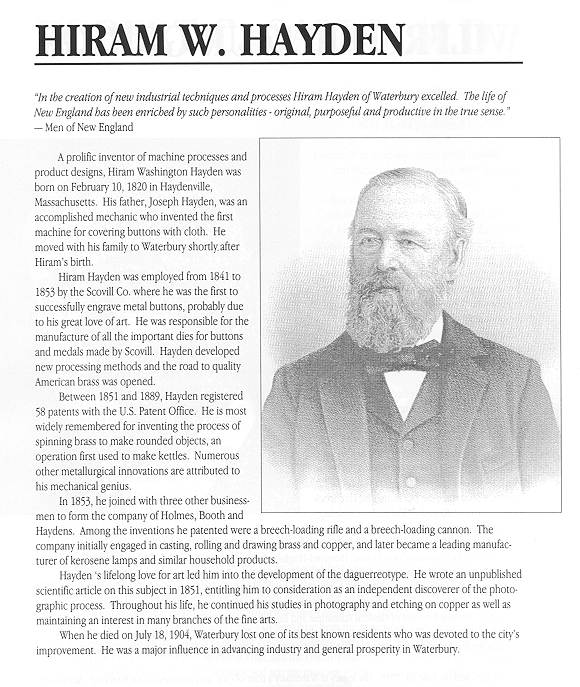
Architect Wilfred Griggs designed the house at 70 Pine Street in Waterbury, which was built in 1908 for Margery (or Marjorie) Hayden. Her father was the inventor Hiram Hayden. When his house next door burned down, Margery and her sister Rose donated the land to the City of Waterbury to become Hayden Homestead Park. Margery Hayden bequeathed her own home to Waterbury Child Guidance Clinic in 1974.

Another house on the same street designed by Griggs is at at 175 Pine Street. It was built around 1901 for his brother, David C. Griggs. According to the History of Waterbury and the Naugatuck Valley, Vol. III (1918):

In the acquirement of his education David C. Griggs attended Miss Pritchard’s private school, the public schools of Waterbury and the Sheffield Scientific School, from which he was graduated with the class of 1892. His early business experience came to him through eight months’ service with the Berlin Iron & Bridge Company and in February, 1893, he became identified with the Waterbury Farrel Foundry & Machine Company, in which he worked his way upward through the various positions of the engineering department. In 1899 he was made a director of the company and was chosen to his present position as secretary in 1902.

David C. Griggs and his wife, Helen Trowbridge Williams, moved into the house in 1904. They lived there until their deaths (David in 1958 and Helen in 1966). The house’s current occupant is architect John J. D’Amico.

Eli Lewis House (1764)

Josiah Lewis was a successful farmer who came from Southington and settled in Bristol. He had nine sons and, according to the 1907 history of Bristol,

Nine sons grew up and married, to each of whom he gave a farm of a hundred acres, a house, a barn, a cow, a hive of bees, and a Waterbury sweet apple tree. Five of these houses, including his own, were built on the Farmington road, three near the cemetery and two beyond the woods of Poker Hole. Four of the Lewis houses are still standing, built much after the same plan, all large, spacious houses, such as those early settlers used to build, when the heating of a house was not an important item in the yearly expenses. They were built before the Revolution and for years formed an uninterrupted row of Lewis possessions.

One of these houses, at 11-13 Lewis Street, was built by Josiah Lewis for his son Eli Lewis, who served in the Revolutionary War and crossed the Delaware under the leadership of George Washington.

Terry Homestead (1748)

For over two-and-a-half centuries, the Terry Homestead has stood prominently at what is now 54 Middle Street in Bristol. Built for Thomas Barns in 1748 and home over the years to various families, including the Terrys, in 1973 the house became the home of the Bristol Historical Society (now located in the old Bristol High School). Today, new developments are underway and the house’s site at the northwest corner of Middle Street and Mountain Road is being developed with construction of a new bank and drug store. As part of the plan, the old homestead is being relocated further uphill to Mountain Road. As the above picture shows, the house has already been moved uphill by truck!

Addendum: On April 13, 2012, I added the following update: The Historic Fletcher-Terry House is in danger of being demolished! I featured the house on this blog a year ago, but now its days are numbered.

WFSB story here:
http://www.wfsb.com/story/17384774/bristol-grapples-with-fate-of-historic-home

From the Bristol Free Press:
Time running out on Fletcher-Terry house

Fletcher-Terry house in limbo

Fletcher-Terry home in Bristol still standing – for now

Addendum: This house has been demolished.