The house at 66 Greenwood Avenue in Bethel is transitional between the architectural styles of the Greek Revival (note the columns on the front porch) and the Italianate (note the rooftop cupola with curved windows). The house was erected c. 1845 (before 1851) by Horace Hickok, a hat manufacturer and descendant of Capt. Ebenezer Hickok, who had given land for the Bethel Congregational Church‘s meetinghouse and burial ground in the eighteenth century.
On December 5, 1776, Capt. John Brainerd (1754-1820) married Hannah Hubbard and soon after erected a house at what is now the corner of Saybrook Road and High Street in Higganum. John’s father, Jabez Brainerd (c. 1713-1778), once lived in a house that stood at the rear of the property. As related in The Genealogy of the Brainerd-Brainard Family in America, 1649-1908, Vol. II (1908), by Lucy Abigail Brainard,
[John Brainerd] was a militia man in the Revolutionary War, and possibly was at White Plains, N.Y. He joined the Regiment Apr. 7, and was disc. May 19, 1777. He was Sergeant in Lieut. Smith’s Company. He was spoken of as Colonel. He was justice of the peace from 1795 to 1804, inclusive. He lived opposite the Higganum Church, which was then a part of Haddam. He was a farmer.
The family of Alson Barber is the most remarkable I have known, and seems to me worthy of special mention. He was born May 6, 1792, and died April 5, 1880. He was brother to Sadosa (their father, Reuben, being the first person buried in the Center cemetery), and first cousin to my father, Henry Barbour. His wife, Hannah Humphrey (born December 4, 1796, died April 19, 1877), was a sister to the Rev. Heman Humphrey, D.D., [. . .] and sister to my mother, thus producing double relationship between the children of the two families. John Brown, the martyr, was first cousin to these sisters and brother. Alson and Hannah were married November 16,1814, and the following named twelve children were born to them: Luther Humphrey, Maria, Nelson, Harriet, Sarah, Gaylord, John, Jennette, Lemuel, Mary, Hannah and Martha. All of these children lived to adult years, all were married, and excepting the first named, had children of their own. [. . .] All because members of the church in their youth and lived exemplarily. The parents lived together most happily more than 62 years, and celebrated their golden wedding and the sixtieth anniversary of their marriage. At the former celebration eleven of their twelve children were present, and at the latter nine were present. Thirty-five grandchildren were living at the time of the former celebration, and all the children were living at the sixty-second anniversary of the parents’ marriage.
Alson’s son, Gaylord, later ran the farm and erected barns on the property.
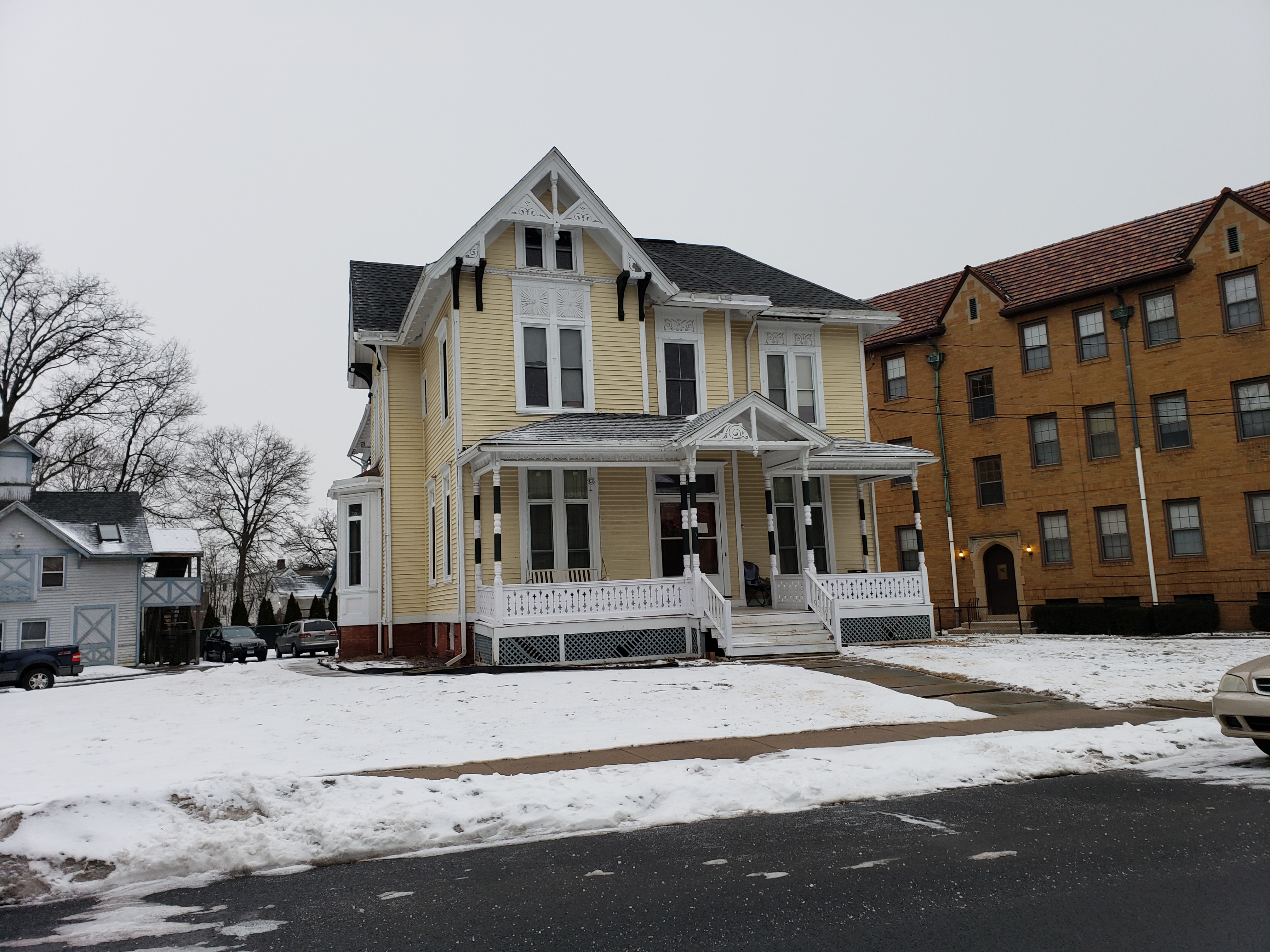
Construction of the house at 25 Vine Street in New Britain, which displays Victorian Gothic and Eastlake elements, has been dated to 1867, c. 1875, or, in A Walk Around Walnut Hill (1975), between 1885 and 1890. That same book indicates the house was built by Jacob J. and Charlotte Ritz (Jacob Ritz was a city councilman in 1882) and was purchased by George Tyler, an engineer, about 1900. The property includes an original carriage house.


You must be logged in to post a comment.