Captain James Thomas House (1790)

The Captain James Thomas House, which has Federal-style detailing, is on Killingworth Road, in the Ponsett District of Haddam. Capt. Thomas served in the Revolutionary War and returned to Haddam to farm on land given to him by his father, Lt. Ebenezer Thomas, in 1786. After occupying a house on Lynn Road, he moved to the one on Killingworth Road, which was completed by 1795. Rev. William C. Knowles, in his book By Gone Days in Ponsett-Haddam, Middlesex County, Connecticut: A Story (1914), writes of the house:

Large two-story house erected by Capt. James Thomas, soon after the Turnpike was opened. Was at one time a tavern. Capt. Thomas died in 1842. A few years later his son-in-law, Mr. Alfred Brainerd, came here to live. The present occupant is an enterprising Bohemian, Mr. Paul Jiroudek.

Sachem Farmhouse (1870)

The Sachem Farmhouse, at 15 Hopkins Road in Warren, overlooking Lake Waramaug, is just down the road from the Hopkins Inn. The house was built in 1870. In 1895, it was purchased by George Hopkins from the Beeman family. The Hopkins House was already being operated as a boarding house and George Hopkins also opened the Beeman House to guests, naming it the Sachem. It remained open until 1960. Still owned by Hopkins descendants, it opened again in 2007 as the Sachem Farmhouse Bed & Breakfast.

Pierce N. Welch House (1907)

The stuccoed Colonial Revival house at 301 Prospect Street in New Haven was built in 1907 for Pierce Noble Welch. He was Yale graduate (1862) who then studied in Germany. In 1871 Welch became treasurer of the New Haven Rolling Mill Company, which his father, Harmanus M. Welch, had founded. He later became president of the company and in 1889 he succeeded his late father as president of the First National Bank of New Haven. In 1891, Welch and his two sisters donated Harmanus Welch Hall to Yale. He was also president and a director of the Bristol Brass Company, a director of the Bristol Manufacturing Company, a vice-president and director of the New Haven Gas Light Company, and a director of the New Haven Clock Company. Pierce N. Welch, born in 1841, died in Berlin, Germany in 1909. The house was acquired by Yale in 1935 and served as a dormitory and later as offices. It is currently home to the Yale School of Forestry and Environmental Studies.

Nelson J. Welton House (1883)

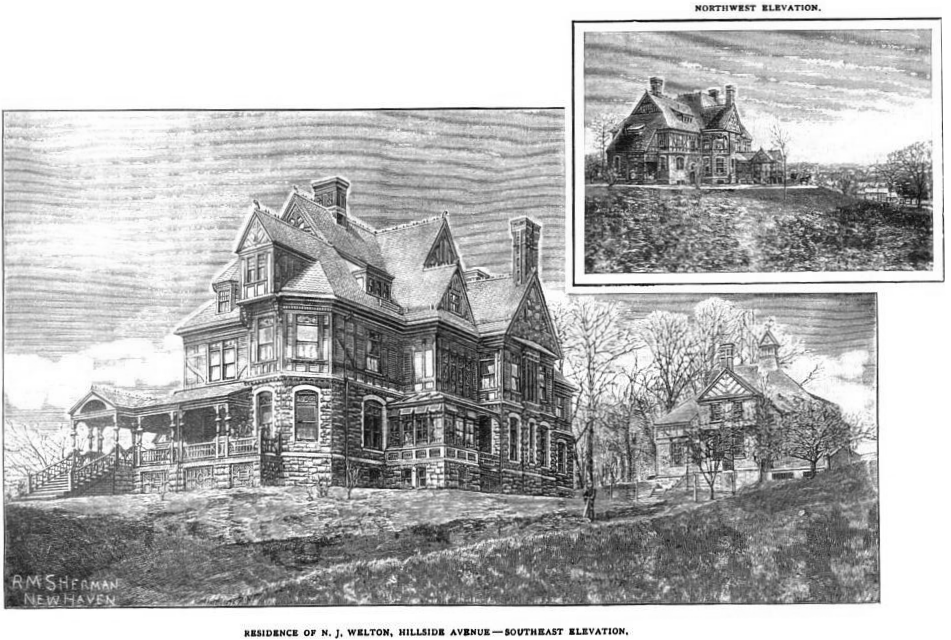
The firm of Palliser and Palliser, who had earlier been responsible for the Benedict-Miller and Mary Mitchell Houses on Hillside Avenue in Waterbury, were hired by Nelson J. Welton to design another house on the same street. Built in 1883, the Stick style house at 83 Hillside Avenue was featured in the 1887 book, Palliser’s New Cottage Homes. According to The Town and City of Waterbury, Connecticut, Volume 2 (1896),

Mr. Welton is a civil and hydraulic engineer, and is a member of the state board of civil engineers. He was appointed surveyor for New Haven county in 1850; was street surveyor of the city of Waterbury for thirty-two years, and was engineer in charge of the construction of the city water works and of the city’s system of sewerage. He has been president of the water board, with the exception of two years, since 1867. He has served the city and town in various other official capacities, and was representative to the General Assembly in 1861.

The Welton House was later much altered from its original appearance, including the addition of a Colonial Revival porch in the 1920s.

Barnes-Waldo House (1789)

Jonathan Barnes, a lawyer, was born in Southington in 1763, graduated from Yale in 1784, studied at the Litchfield Law School, and was admitted to the bar in 1789. He soon settled in Tolland, which had become a county seat in 1785. He married Rachael Steele in 1789. Barnes, who served as a town selectman in Tolland from 1798 to 1802 and in the Connecticut Legislature for twenty-eight terms, died in 1829. His oldest son, also named Jonathan Barnes, later became a prominent lawyer in Middletown. The Barnes House, at 34 Tolland Green, was next owned by Obediah Waldo, also a lawyer, who served as selectman, postmaster, town clerk, and member of the state House of Representatives. The house’s side ell was once used as an office.