
The house at 70 Hillside Avenue in Waterbury was built in 1902 for James H. Gross, superintendent of the Scovill Manufacturing Company. His Tudor house has two Dutch gable ends on the front facade and a Colonial Revival entryway.
The house at 70 Hillside Avenue in Waterbury was built in 1902 for James H. Gross, superintendent of the Scovill Manufacturing Company. His Tudor house has two Dutch gable ends on the front facade and a Colonial Revival entryway.

At 261 Salmon Brook Street in Granby Center is an Italianate house built around 1858 by J. N. Loomis. The house makes an impression with its total length being 145 feet. James Newton Loomis, born in Southwick, Mass., was the senior partner in the firm of Loomis Brothers, proprietors of Granby’s principal general store in the second half of the nineteenth century.

The Caleb Tefft House is a Greek Revival house at 60 Elm Street in Rockvile (Vernon). The house, built in 1848, is now used for offices.

At the intersection of Barnum Avenue and Harriet Street in Bridgeport is an Octagon house, built around 1856. The structure has the gravel wall with stuccoed exterior typical of this type of house, popularized in the 1850s by Orson Squire Fowler. Traditionally considered to have been built by P.T. Barnum, the house was actually built by Nathan Gould.

At 96 Webster Street in Hartford is a house in the Italian Villa style with a prominent Second Empire-style Mansard-roofed tower. The house, which has been significantly enlarged, has lost most of its original detailing and has unattractive modern siding, but still has a commanding presence. It was built around 1875 for George W. Fuller, who had a store that sold trunks and luggage.

One of two octagon houses on New Place Street in Yalesville in Wallingford is located at no. 37 (the other is at No. 31). The house was built about 1857. (more…)

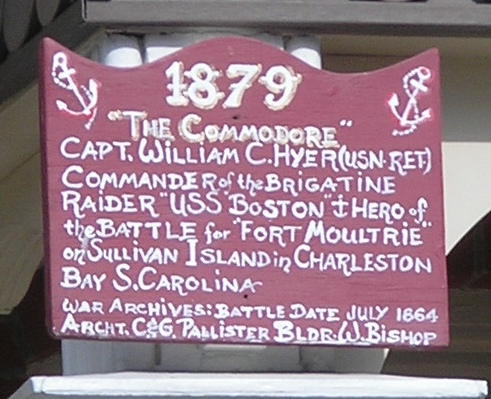
A block of brick row houses at 256–270 Broad Street in Bridgeport, which date to around 1879, have been attributed to the architectural firm of Palliser & Palliser and the builder W. Bishop. The houses combine elements of the Victorian Gothic, Queen Anne and Romanesque styles in their eclectic facades. George and Charles Palliser built a number of such brick row houses in different parts of Bridgeport in the early 1880s, but this style of urban housing did not catch on in the city. One of this row of houses has a sign out front indicating that it was the home of Capt. William C. Hyer, who commanded a brigantine in fighting in 1864 at Fort Moultrie, Sullivan’s Island, South Carolina.


You must be logged in to post a comment.