Vernet-Lee House (1809)

The house at 118 Washington Street in Norwich was built in 1809 by John Vernet. Born in France, the aristocratic Vernet had fled the French Revolution and settled first in Martinique and later in Norwich. In 1802, he married Ann Brown, daughter of tavern-keeper Jesse Brown. Vernet built an expensive and elegant house on property that had been owned by his father-in-law, but he quickly faced financial difficulties. Vernet sold the house in 1811 or 1812 and moved with his family to Wilkes-Barre, Pennsylvania. The house was bought by Benjamin Lee of Cambridge, whose family owned it for sixty years. According to tradition, the house was a stop on the Underground Railroad and had a tunnel to the river, but this has not been confirmed by physical evidence. In 1873, the house was sold to Albert P. Sturtevant, a manufacturer, and was home to his son, Charles P. Sturtevent. In 1920, the house became the Rectory of Christ Episcopal Church, but today it is again a private residence.

Hattie & Eliza Stowe House (1891)

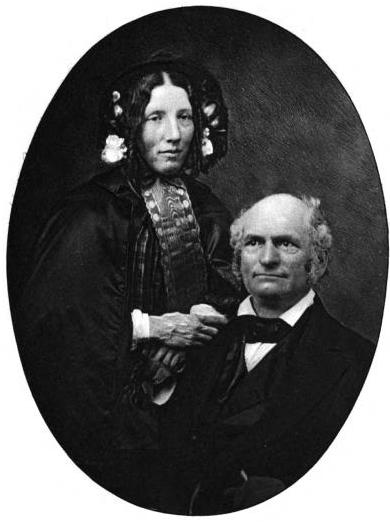
Author Harriet Beecher Stowe (1811-1896) and her husband, Calvin Stowe (1802-1886), had twin daughters named Harriet (Hattie) Beecher (1836-1907) and Eliza Tyler (1836-1912) Stowe. Neither twin married, but they lived with their parents, traveling with their mother and managing the family’s households in Hartford and in Mandarin, Florida. After their mother’s death in 1896, the twins settled in Simsbury, where their brother, Charles E. Stowe, was the minister at the First Church of Christ. According to the new Images of America series book on Simsbury, their former house at 965 Hopmeadow Street was provided for them by their brother when he became minister in 1891. They wouldn’t have moved there until their mother died, so perhaps the house was built in 1891? Today, the house is used for offices.

Update 4/5/12: There’s a new article about the Stowe family’s connections with Simsbury. Check it out!

Eugene L. Cushman House (1920)

Another house in West Hartford’s West Hill Historic District is the house built in 1920 for Eugene L. Cushman. Located at 14 West Hill, it was designed by Cortland F. Luce in the Tudor Revival style. As reported in The Iron Age, Vol. 104, No. 26, December 25, 1919:

Eugene L. Cushman died at his home in West Hartford, Conn., Dec. 18, aged 65 years. Mr. Cushman was chairman of the board of directors of the Cushman Chuck Co., Hartford, Conn., having formerly been president of that organization.

Could this be the father of the house’s first occupant, or did Cushman die before it was completed?

Alexander T. Pattison House (1896)

At 750 Hopmeadow Street in Simsbury is a distinctive house constructed in 1896 for Alexander T. Pattison. The following biographical entry is from Taylor’s Legislative History and Souvenir of Connecticut for 1903-1904:

Hon. Alexander T. Pattison of Simsbury, Republican Senator from the Third District, is the son of Joseph and Delia (Sceery) Pattison. He was born in East Weatogue, town of Simsbury, March 26, 1861, and received his education in the public schools of the town, Granby Academy and Prof. McLean’s School, Simsbury. He began his business career as clerk in the general store of Judson Wilcox, which was established in 1851. Since January, 1886, he has successfully managed the business. He married, October 7, 1885, Miss Ella Ruth Wilcox, daughter of Judson and Nancy S. (Chapman) Wilcox of Simsbury. They have had four daughters: Lucy W., born October 14, 1886; Stella C, born September 1, 1888, died Dec. 26, 1888, Julia E., born August 26, 1890, and Ruth Frances, born June 8, 1902. He has been secretary and treasurer of the Simsbury Cemetery Association since 1888, and is a director and secretary of the Simsbury Electric Co. He was a valuable member of the House in 1897. This session he was Senate chairman of the Committee on Appropriations and plainly showed that he was the “right man in the right place.” He was also chairman of the Committee on Engrossed Bills. Senator Pattison’s influence is ever felt for the good of the community in which he resides.

Horace R. Grant House (1923)

One of the houses in West Hartford’s West Hill development of the 1920s is the Horace R. Grant House, designed by Cortland Luce and built in 1923. Horace R. Grant, President of the Allen Manufacturing Company, is credited with conceiving the idea for the development. He planned it with Stanley K. Dimock, who had inherited the land from his father, Ira Dimock, a silk manufacturer. Ira Dimock had purchased the former Vanderbilt Mansion on the property, which was later demolished to make way for the new houses. The Grant House has a rear addition, dating to 1937 and designed by William T. Marchant.

Elisha Steel House (1720)

The house at 64 Tolland Green in Tolland was built around 1720. From 1765, the residence was home to Elisha Steel. As described in Waldo’s Early History of Tolland (1861)

Elisha Steel, the son of Rev. Stephen Steel, married Sarah Wolcott, of Windsor, April 26, 1758. He graduated at Yale College in 1750, was educated for the bar, located in the town of Tolland, and engaged in the practice of his profession. He was chosen a representative in the General Assembly in 1761, and was reelected five times. He was one of the two Justices of the Peace from 1761 to 1766 inclusive. He was the first lawyer ever located in the town of Tolland, and the only one while he lived. He died August 17, 1773.

Alfred Alford House (1838)

The Alfred Alford House is a brick Greek Revival-style residence, built c. 1834-1838 and located at 3 Main Street in RivertonAlfred Alford was the brother of Abra Alford, who was the partner of famous chairmaker Lambert Hitchcock, and of Eunice Alford, who married Hitchcock.  The Alford brothers continued the manufacture of chairs in Riverton after Hitchcock moved to Unionville in 1842.  Alfred Alford’s company also produced wood planes.