
As related in D. Hamilton Hurd’s History of Fairfield County, Connecticut (1881):
Samuel Clayton Kingman, the second son of Samuel Kingman, was born in South Redding, Mass. (now Wakefield), in 1830, graduated in the high school, and was the valedictorian of his class. The following year he spent at sea for the benefit of his health, after which he served his time as a machinist in the celebrated Lawrence Machine-Shop, with such apprentices as Amos Whitney, Joseph Marble, F. Higgins, and J. A. Taylor, after which he spent one year in the service of Col. Anderson, at the Tredegar Works at Richmond, Va. Upon his return he entered the employ of the Wheeler & Wilson Manufacturing Company, at Watertown, Conn., organized about that time [1852; the company moved to Bridgeport in 1856], and still remains in their employ. He has invented a number of machines for the Company which have resulted in a great saving of labor.
Mr. Kingman was married in 1853 to Miss Emily Eustis Brooks, at Haverhill, Mass., a descendant of Governor Eustis. He has ever been a benefactor to the poor and sorrowing, and his gifts, with those of his companions, have been many. The bell of the Park Street Church, to which they belonged, memorizes the death of a soldier, friend, and brother, Albion D. Brooks, killed at Cold Harbor, June 3, 1864. The clock and communion-table presented by them attest their interest in the welfare of their church.
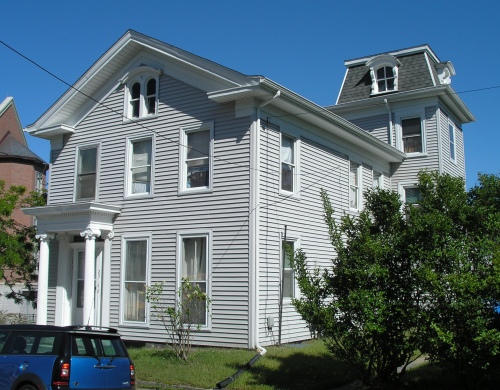
Mr. Kingman resides at Washington Park, [in East Bridgeport,] in a delightful residence, surrounded by his family, which consists of his wife and live daughters. He has occupied many positions of public trust, and enjoys the confidence and esteem of the citizens of the city in which he resides.
As a prominent citizen of Bridgeport, Kingman was appointed a secretary of the meeting of Republicans in Washington Hall that heard a speech by Abraham Lincoln on March 10, 1860. Kingman’s house in East Bridgeport was built in 1870. Located at 373 Noble Avenue, it was designed by architect Abram Skaats.




You must be logged in to post a comment.